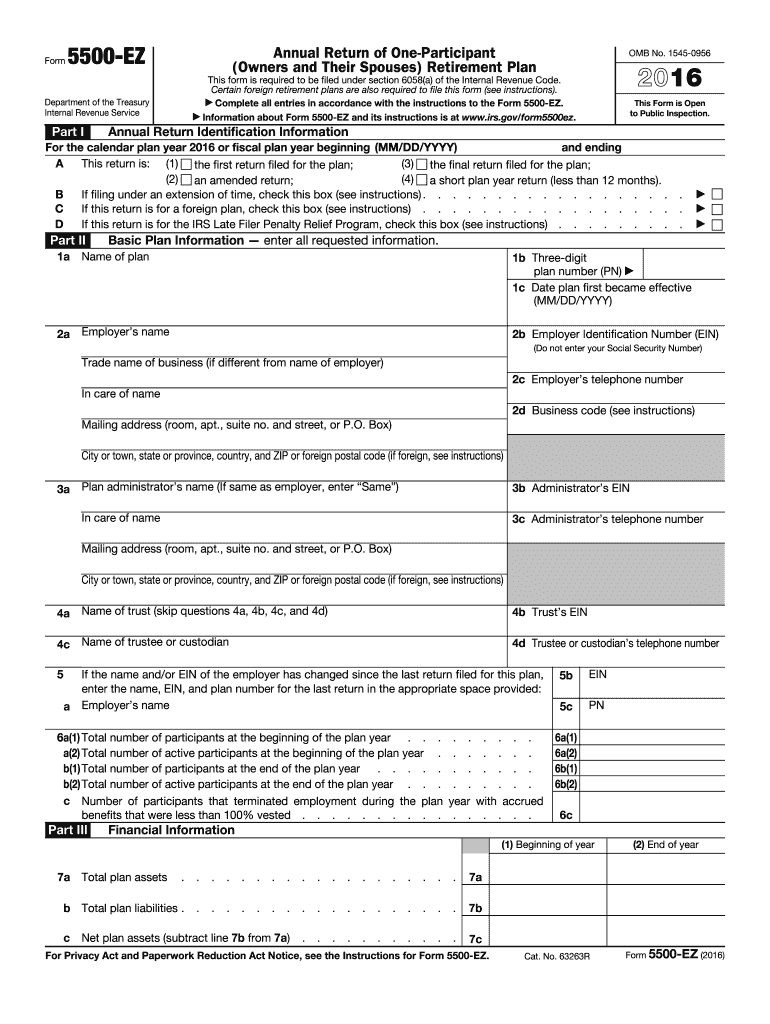
6a(2) 6b(1) 6b(2) 6c Financial Information (1) Beginning of year 7a . . . . . . . . . . . . . . . . . . . 7a b Total plan liabilities . . . . . . . . . . . . . . . . . . . 7b Net plan assets (subtract line 7b from 7a) . . . . . . . . . . . 7c (2) End of year c Total plan assets For Privacy Act and Paperwork Reduction Act Notice, see the Instructions for Form 5500-EZ. Cat. No. 63263R Form 5500-EZ (2016) Form 5500-EZ (2016) Part III 8.

Open form follow the instructions

Easily sign the form with your finger

Send filled & signed form or save
How to fill out the IRS 5500-EZ online
The IRS 5500-EZ form is essential for reporting the annual return of a one-participant retirement plan. This guide provides clear, step-by-step instructions on how to complete the form online, making the process accessible for all users, regardless of their experience with legal documents.
Follow the steps to complete the IRS 5500-EZ online.
- Click ‘Get Form’ button to obtain the form and access it in the editor.
- In Part I, identify the return type by marking the applicable box: (1) first return, (2) amended return, (3) final return, or (4) short plan year return. Additionally, check the box if filing under an extension, for a foreign plan, or for the IRS Late Filer Penalty Relief Program.
- Complete Part II with Basic Plan Information. This includes entering the name of the plan, the three-digit plan number, and the date the plan first became effective. Provide the employer's name, EIN, and contact details, including phone and mailing address.
- Fill in the plan administrator’s details if different from the employer, or write 'Same' if they are the same. Include the administrator's EIN, contact number, and address.
- Input total participant numbers in section 6, including the total number of active participants at the start and end of the year, along with those who terminated employment.
- In Part III, provide financial information by entering total plan assets and liabilities at the beginning and end of the year. Calculate net plan assets by subtracting liabilities from assets.
- Report contributions received in section 8, detailing amounts from participants, others, and employers.
- Address plan characteristics in Part IV by entering applicable feature codes from the provided list.
- Answer compliance and funding questions in Part V. Mark 'Yes' or 'No' as appropriate, providing necessary details for each relevant question.
- Sign the form declaring its accuracy and completeness. Include the name, title, and date of the signature. If applicable, list the preparer’s information.
- Once all entries are complete, review the form for accuracy, then save changes, download, print, or share the form as needed.
Complete your IRS 5500-EZ form online today to ensure compliance and avoid penalties.
Experience a faster way to fill out and sign forms on the web. Access the most extensive library of templates available.
Related content
Nov 12, 2024 — Form 5500-EZ is used by one-participant plans and certain foreign plans...
2 days ago — One-participant plans must file Form 5500-EZ if plan assets exceed $250,000...
Jan 26, 2017 — You must file Form 5500EZ or Form. 5500SF. All oneparticipant plans...
Get answers to your most pressing questions about US Legal Forms API.
Who files the IRS form 5500?
Generally, administrators or sponsors of retirement plans are responsible for filing the IRS form 5500. This includes employers offering pension plans, profit-sharing arrangements, and other retirement benefits. Understanding your role in this process is crucial for maintaining compliance with IRS regulations.
What is the penalty for filing 5500-EZ?
The penalties for not filing the IRS 5500-EZ can be quite severe, often exceeding $2,000 per day based on the length of the delay. This hefty fine underscores the importance of timely filing. Utilizing resources from platforms like USLegalForms can help ensure you meet your obligations and avoid these costly penalties.
What happens if you don't file form 5500-EZ?
Failing to file the IRS 5500-EZ can lead to serious consequences, including substantial penalties. The IRS has set strict guidelines, and missing the deadline can result in fines or additional scrutiny. To avoid complications, consider using tools like USLegalForms, which can help streamline your filing process.
What is the difference between 5500 and 5500-EZ?
The differences between form 5500 and IRS 5500-EZ primarily relate to their purpose and requirements. The form 5500 is required for plans with 100 or more participants, while the 5500-EZ is designed specifically for smaller, mostly individual plans. Knowing which form to file can simplify your reporting process.
Who must file IRS form 5500-EZ?
Any individual who manages a one-participant or certain small retirement plans must file the IRS 5500-EZ. This includes self-employed individuals and small business owners who have set up retirement plans for themselves. Staying compliant with the filing is essential for avoiding penalties from the IRS.
What is the difference between form 5500 and 5500-EZ?
The key difference between form 5500 and IRS 5500-EZ lies in the type of plans they cover. Form 5500 is generally for larger plans with more than 100 participants, whereas the 5500-EZ targets smaller, one-participant plans. Depending on your plan structure, you may only need to file the simpler 5500-EZ form.
Who is required to file form 5500-EZ?
The IRS 5500-EZ must be filed by any plan that meets the coverage requirements under the Employee Retirement Income Security Act (ERISA). Typically, this includes solo 401(k) plans and certain other retirement plans. It’s essential to be aware of your plan type and its requirements to ensure compliance with IRS regulations.
Who is exempt from filing a form 5500?
Certain plans are exempt from filing the IRS 5500-EZ. Generally, one-person plans and those with fewer than 100 participants do not fall under the filing requirements. Additionally, plans that meet specific criteria related to funding and type may also be exempt. It is important to review the IRS guidelines to determine your specific situation.
What is reasonable cause for form 5500-EZ?
Reasonable cause is a legitimate reason that justifies a delay in filing the IRS 5500-EZ. This could include circumstances like natural disasters, serious illness, or other unexpected events that prevented timely filing. Demonstrating reasonable cause to the IRS can sometimes help alleviate penalties, so understanding this aspect can be beneficial.
What is the filing threshold for 5500-EZ?
The IRS 5500-EZ must be filed for one-participant plans when the plan's assets exceed $250,000. If your plan is under this threshold, you may not need to file the form at all. Staying informed about these requirements helps you avoid unnecessary penalties and ensures compliance with IRS regulations.
Use professional pre-built templates to fill in and sign documents online faster. Get access to thousands of forms.
If you believe that this page should be taken down, please follow our DMCA take down process here.
This form is available in several versions. Select the version you need from the drop-down list below.