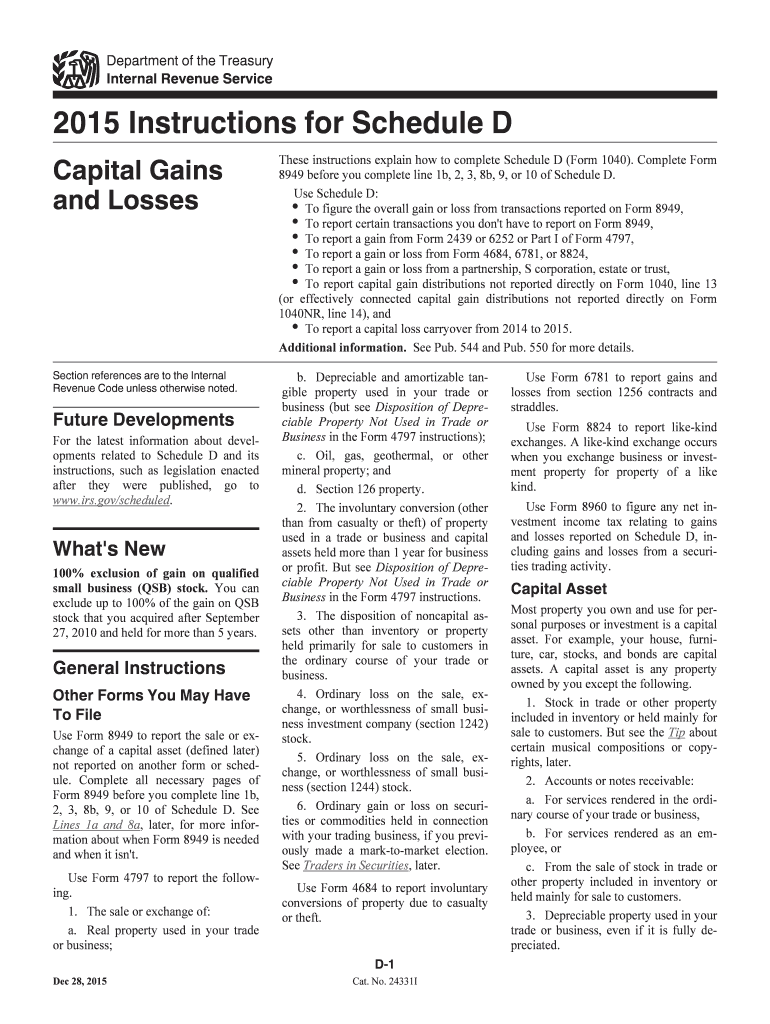
Versions of property due to casualty or theft. D-1 Dec 28, 2015 Cat. No. 24331I Use Form 6781 to report gains and losses from section 1256 contracts and straddles. Use Form 8824 to report like-kind exchanges. A like-kind exchange occurs when you exchange business or investment property for property of a like kind. Use Form 8960 to figure any net investment income tax relating to gains and losses reported on Schedule D, including gains and losses from a securities trading activity. Capital As.

Open form follow the instructions

Easily sign the form with your finger

Send filled & signed form or save
How to fill out the IRS 1040 Schedule D Instructions online
The IRS 1040 Schedule D Instructions detail the process of reporting capital gains and losses for tax purposes. This guide provides step-by-step instructions on filling out the form online, ensuring clarity and ease of use for all individuals, regardless of their tax experience.
Follow the steps to complete the Schedule D Instructions effectively.
- Click ‘Get Form’ button to obtain the form and open it in the editor.
- Complete Form 8949 prior to filling out lines 1b, 2, 3, 8b, 9, or 10 of Schedule D. This form records individual sales or exchanges of capital assets.
- Segment your transactions based on holding periods: report short-term gains or losses in Part I, and long-term in Part II.
- To report aggregate totals for transactions without adjustments, enter the summaries for short-term transactions on line 1a and long-term transactions on line 8a.
- Enter any capital gain distributions received during the year on line 13 of Schedule D.
- If reporting the sale of your primary home, complete Form 8949 first, and then transfer the information to Schedule D.
- For partnership interests or when dealing with small business stock, ensure you understand the specific reporting methods for losses and gains.
- Double-check all entries, ensuring that any necessary adjustments are recorded accurately before finalizing.
- Once completed, save changes, download, print, or share the form as needed.
Complete your documents online to make filing easier and more efficient.
Experience a faster way to fill out and sign forms on the web. Access the most extensive library of templates available.
Related content
These instructions explain how to complete Schedule D (Form 1040). Complete Form 8949...
by D SCHEDULE · Cited by 1 — Complete the Qualified Dividends and Capital Gain Tax...
Dec 6, 2017 — Attach to Form 1045 a copy of Form. 6781 and Schedule D (Form 1040) for...
Get answers to your most pressing questions about US Legal Forms API.
What is the limit on Schedule D losses?
The limit on Schedule D losses is typically $3,000 when offsetting ordinary income on your tax return. If your losses exceed this amount, you can carry the remaining losses to the following years. It's crucial to adhere to this limit to optimize your tax outcomes. For accurate reporting of losses, consult the IRS 1040 Schedule D Instructions.
Who needs to file 1040 schedule D?
Anyone who has sold a capital asset and realized a gain or loss should consider filing IRS 1040 Schedule D. This includes individuals who sold stocks, bonds, or real estate. Additionally, you're required to report if you received capital gains distributions from mutual funds. The IRS 1040 Schedule D Instructions detail eligibility criteria and help ensure proper compliance.
Why are capital losses limited to $3,000?
The IRS limits capital losses to $3,000 for individuals to prevent excessively offsetting ordinary income beyond this threshold. If your total capital losses exceed this limit, you can carry forward the excess to future tax years. Understanding this rule helps plan your finances better and reduces tax liabilities. The IRS 1040 Schedule D Instructions explain how to report losses accurately.
What can be reported directly on Schedule D?
You can report various transactions directly on IRS 1040 Schedule D, including sales of stocks, bonds, and real estate. Additionally, it allows you to report capital gains and losses, both short-term and long-term. Summary totals from Form 8949 are then included in Schedule D. Utilizing the IRS 1040 Schedule D Instructions can help you navigate what to include.
Do I have to report the sale of inherited property to the IRS?
Yes, you generally must report the sale of inherited property to the IRS. However, the basis for inherited property is usually the fair market value on the date of death, which often minimizes capital gains taxes. Reporting this sale on IRS 1040 Schedule D is essential, even if it results in a loss. The IRS 1040 Schedule D Instructions provide detailed guidelines for these situations.
Who must file 1040 Schedule D?
You must file IRS 1040 Schedule D if you have capital gains or losses from the sale of assets such as stocks, bonds, or real estate. This requirement applies whether you sold short-term or long-term assets. If your transactions resulted in any capital gains or losses during the year, ensure you include Schedule D in your tax return. The IRS 1040 Schedule D Instructions provide clarity on specific circumstances that necessitate filing.
What is the $3000 capital loss rule?
The $3,000 capital loss rule allows taxpayers to offset other income by deducting up to $3,000 of net capital losses per tax year. If your losses surpass this figure, you can carry the excess to future years. This guideline is essential when completing IRS 1040 Schedule D Instructions, as it can significantly lower your taxable income. Keeping good records ensures smooth calculations and maximizes tax efficiency.
What is the difference between Schedule D and form 8949?
Schedule D and Form 8949 serve interconnected purposes but differ in detail levels. Form 8949 is used for detailing each sale of capital assets, capturing specifics such as dates and costs. In contrast, Schedule D aggregates this information, summarizing total gains and losses. Both are essential for completing IRS 1040 Schedule D Instructions, so understanding their roles can streamline your filing process.
Who is exempt from filing Schedule D?
Certain individuals may be exempt from filing Schedule D, including those who did not sell any capital assets during the tax year. If your capital transactions resulted in no gains or losses, your filing responsibility diminishes. Additionally, if your income falls below specific thresholds, IRS 1040 Schedule D Instructions may indicate exemptions. It's crucial to review personal circumstances or consult with a tax professional for tailored advice.
Where can I get a copy of 1040 instructions?
A copy of the 1040 instructions is available on the IRS website, where they publish the latest versions each tax year. You can also contact the IRS directly to request a printed version. Alternatively, using services like US Legal Forms can provide you with the 1040 instructions, including the IRS 1040 Schedule D Instructions for more detailed guidance.
Use professional pre-built templates to fill in and sign documents online faster. Get access to thousands of forms.
If you believe that this page should be taken down, please follow our DMCA take down process here.
This form is available in several versions. Select the version you need from the drop-down list below.