. . . . . . . . . . . . . . . . . . . . . . . . . . . . . . . . . . . . . . . . . 851(d)(2) . . . . . . . . . . . . . . . . . and . 25b 5 6 7 8 9 10 11 12 13 14 15 16 17 18 19 20 21 22 23 24 25a . . . . 25c Under penalties of perjury, I declare that I have examined this return, including accompanying schedules and statements, and to the best of my knowledge and belief, it is true, correct, and complete. Declaration of preparer (other than taxpayer) is based on all informatio.

How it works
  • Open form

    Open form follow the instructions

  • Easily sign form

    Easily sign the form with your finger

  • Share form

    Send filled & signed form or save

How to fill out the IRS 1120-RIC online

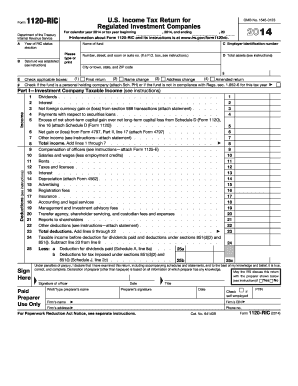
Filling out the IRS 1120-RIC is essential for regulated investment companies to report their income, deductions, and credits for tax purposes. This guide provides clear and practical steps to assist users in completing the form online.

Follow the steps to successfully complete the IRS 1120-RIC form online.

  1. Click 'Get Form' button to acquire the IRS 1120-RIC form and open it in your preferred editing interface.
  2. Enter the date when the fund was established at the top of the form. Ensure the date is accurate, as it is crucial for determining tax obligations.
  3. Provide the calendar year for which you are filing the return. This should align with the tax year of the regulated investment company.
  4. Fill out the name of the fund in section C, ensuring to type or print it clearly to avoid any confusion.
  5. Enter the employer identification number (EIN) in the specified field. This number is essential for the IRS to identify the entity.
  6. Complete the 'Total assets' section by accurately reporting the total assets of the fund as of the end of the tax year.
  7. Check all applicable boxes for final return, name change, address change, or amended return as relevant to your submission.
  8. In Part I, report the investment company taxable income, beginning with the total income, including dividends, interest, and gains from various sources.
  9. Deduct relevant expenses in the deductions section, ensuring to attach any necessary statements or forms that support the deductions claimed.
  10. Complete the rest of the sections, including tax calculations and credits, following the form's instructions to ensure accuracy.
  11. Once all sections are filled, save your changes, and you can then download, print, or securely share the completed IRS 1120-RIC form as needed.

Begin filing your IRS 1120-RIC form online today to stay compliant with tax regulations.

Get form

Experience a faster way to fill out and sign forms on the web. Access the most extensive library of templates available.

Related content

About Form 1120-RIC, U.S. Income Tax Return for...

Apr 29, 2025 — Form 1120-RIC is used to report an annual return of tax payable on or...

Learn more
Instructions for Form 1120-RIC, US income tax...

Instructions for Form Form 1120-RIC, U.S. income tax return for regulated investment...

Learn more
Instructions for Form 1125-E (Rev. October 2016)

Form 1125-E must be completed and attached to Form. 1120, 1120-C, 1120-F, 1120-RIC...

Learn more
Questions & Answers

Get answers to your most pressing questions about US Legal Forms API.

Contact support

What is the RIC 90% distribution requirement?

The RIC 90% distribution requirement mandates that a RIC must distribute at least 90% of its taxable income to shareholders annually. This regulation encourages the responsible management of investment income, aligning with the goals of IRS 1120-RIC compliance. Meeting this requirement is crucial for maintaining RIC status and avoiding corporate taxation.

While all mutual funds can be RICs, not all RICs are mutual funds. RICs encompass a broader category of investment companies that may include ETFs or closed-end funds, whereas mutual funds specifically refer to investment vehicles pooling resources from multiple investors. The IRS 1120-RIC outlines the requirements that these entities must meet.

The annual investment allowance refers to the amount a RIC can deduct from their taxable income based on their qualifying investments. This deduction can significantly affect the tax obligations outlined in IRS 1120-RIC. Understanding what qualifies as an annual investment allowance helps in thoroughly managing financials.

To qualify as a RIC, an entity must meet several IRS regulations including specific income distribution and diversification requirements. This entails distributing at least 90% of its taxable income to shareholders as defined in IRS 1120-RIC. Proper documentation and adherence to guidelines are essential for maintaining this status.

RIC calculations generally involve determining the company’s total assets, investment earnings, and distributing a specific percentage of income to shareholders. The IRS 1120-RIC form requires accurate reporting to ensure compliance with distribution obligations. This process requires meticulous tracking of both assets and earnings.

An example of a RIC includes mutual funds or exchange-traded funds (ETFs) that pool investor resources to buy a diversified portfolio of securities. These entities often file IRS 1120-RIC to comply with tax requirements while offering investors the benefits of diversification and professional management. Most well-known mutual funds qualify as RICs.

To become a RIC, a corporation must apply to the IRS and meet specific organizational and operational requirements. This includes maintaining a diversified investment portfolio and meeting income distribution requirements as specified in IRS 1120-RIC. Consulting legal or tax advisors can provide guidance through the process.

Bad income for a RIC is income that does not meet the definitions outlined by the IRS for qualifying income. Examples include certain types of interest income, rental income, or foreign income that falls outside the defined scope. Understanding what constitutes bad income is crucial for ensuring compliance with IRS 1120-RIC regulations.

The IRS 1120-RIC is a tax form that Registered Investment Companies use to report their earnings and distributions. It ensures that the company meets the distribution requirements necessary for maintaining its RIC status. By filing this form, a RIC demonstrates compliance with IRS regulations and fulfills its tax obligations.

You can determine if a company is classified as a RIC by reviewing its corporate structure and investment focus. The company must adhere to IRS regulations outlined in the IRS 1120-RIC and must declare itself a RIC in its financial documents. Additionally, inspection of their investment strategy can provide insights into their RIC status.

Get This Form Now!

Use professional pre-built templates to fill in and sign documents online faster. Get access to thousands of forms.

If you believe that this page should be taken down, please follow our DMCA take down process here.

IRS 1120-RIC Form

This form is available in several versions. Select the version you need from the drop-down list below.

Get IRS 1120-RIC