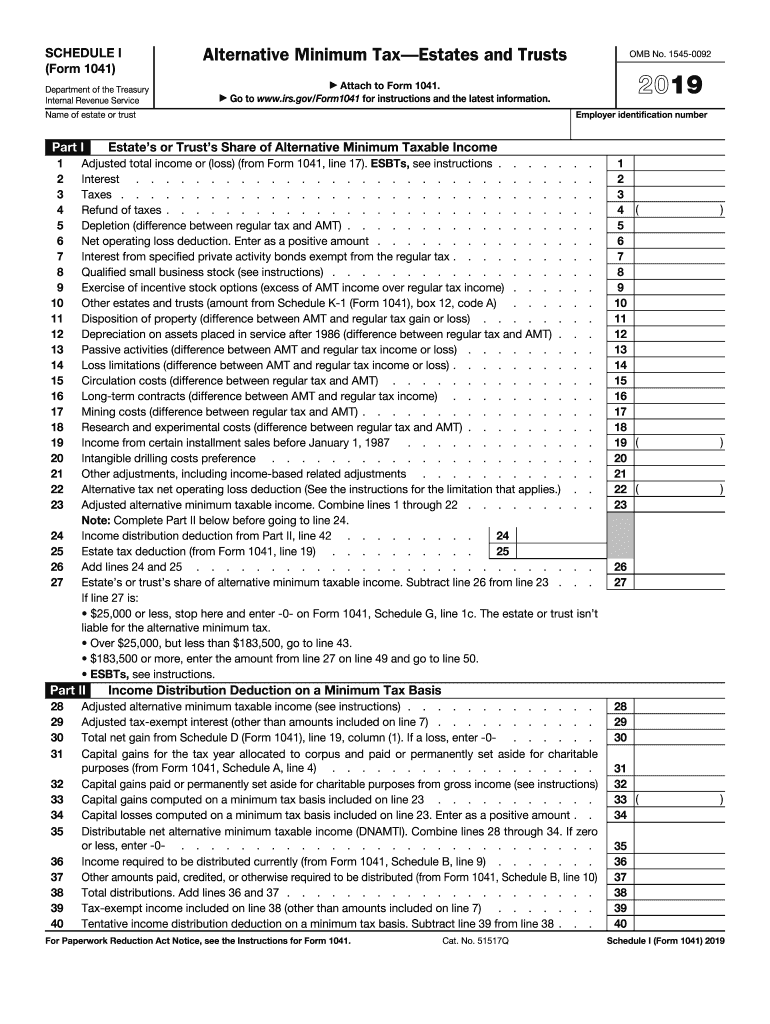
Y (difference between AMT and regular tax gain or loss) . . . . . . Depreciation on assets placed in service after 1986 (difference between regular tax and AMT) . Passive activities (difference between AMT and regular tax income or loss) . . . . . . . Loss limitations (difference between AMT and regular tax income or loss) . . . . . . . . Circulation costs (difference between regular tax and AMT) . . . . . . . . . . . . Long-term contracts (difference between AMT and regular tax income) . . . .
Loading

Open form follow the instructions

Easily sign the form with your finger

Send filled & signed form or save
How to fill out the IRS 1041 - Schedule I online
Filling out the IRS 1041 - Schedule I is an important step in reporting the alternative minimum tax for estates and trusts. This guide provides clear, step-by-step instructions to assist users in completing the form online with confidence.
Follow the steps to fill out the IRS 1041 - Schedule I online.
- Click the ‘Get Form’ button to obtain the IRS 1041 - Schedule I form and open it in your preferred editor.
- Enter the employer identification number of the estate or trust in the designated field at the top of the form.
- Proceed to Part I and complete lines 1 through 22, entering the appropriate figures as instructed, derived from the income information of the estate or trust.
- On line 23, calculate the adjusted alternative minimum taxable income by combining the totals from lines 1 through 22.
- For line 24, provide the income distribution deduction from Part II of the form.
- Add the figures from lines 24 and 25 in line 26 to complete that calculation.
- Subtract line 26 from line 23 in line 27 to determine the estate's or trust's share of alternative minimum taxable income.
- Review if the amount on line 27 meets the thresholds provided; follow the instructions for what to do next based on that result.
- Continue to Part II and enter the required figures on lines 28 through 40, ensuring all calculations for income distribution are accurately reflected.
- Finalize by filling out Part III, calculating the alternative minimum tax amounts as guided through the remaining lines and summaries.
- Once all sections are complete, save the changes, download the form, print it for your records, or share it as necessary.
Begin filling out the IRS 1041 - Schedule I online today for accurate tax reporting.
Experience a faster way to fill out and sign forms on the web. Access the most extensive library of templates available.
Related content
Part I. Estate's or Trust's Share of Alternative Minimum Taxable Income. 1. Adjusted total...
Income distribution deduction (from Schedule B, line 17) (attach ... Total net gain from...
Under penalties of perjury, I declare that I have examined this application and...
Get answers to your most pressing questions about US Legal Forms API.
What is the Schedule I for 1041?
The Schedule I for Form 1041 details the distribution of income to beneficiaries from an estate or trust. It plays a critical role in tax reporting, as it outlines the specific amounts recipients need to declare on their personal tax returns. Understanding how to accurately complete Schedule I ensures compliance and clarity in tax matters. For those seeking assistance, platforms like USLegalForms can provide helpful resources.
Who receives a Schedule K-1 form 1041 typically?
A Schedule K-1 form 1041 is typically issued to beneficiaries of a trust or estate who receive distributions. Each beneficiary receives their K-1 detailing their share of income, deductions, and credits allocated from the estate or trust. This form is essential for beneficiaries to accurately report their tax obligations. To navigate the complexities of IRS 1041 - Schedule I, USLegalForms provides valuable resources.
What is Schedule I on tax return?
Schedule I on a tax return specifically addresses income distributions to beneficiaries from a trust or estate. This schedule is critical for beneficiaries, as it reflects the amounts they must report as income on their personal tax returns. Correctly completing Schedule I helps clarify tax responsibilities and enhances compliance with IRS regulations. For guidance, consider leveraging tools available on USLegalForms.
Can I file the IRS form 1041 electronically?
Yes, you can file the IRS form 1041 electronically through approved e-filing software. E-filing streamlines the process and often results in faster processing times for your return. Using electronic methods also reduces the chances of errors compared to paper filing. For your IRS 1041 - Schedule I needs, various platforms like USLegalForms offer user-friendly e-filing options.
Do you have to file a final 1041 if there is no income?
Even if there is no income, you may still need to file a final IRS 1041 form for the trust or estate. The IRS requires this for the proper closure of the tax entity and to report that no income was generated. Filing a final return maintains transparency and complies with legal requirements. To ensure you meet all obligations, consider using USLegalForms for assistance with the IRS 1041 - Schedule I.
What is the Schedule I for form 1041?
Schedule I for Form 1041 outlines the income distribution to beneficiaries of the trust or estate. This schedule helps identify which amounts were distributed to beneficiaries and how those distributions impact the taxable income of the estate or trust. Accurately filling out Schedule I is essential for compliance with IRS regulations and proper tax reporting. For comprehensive guidance, you can explore resources on USLegalForms.
What goes on schedule A in a trust?
Schedule A of the IRS 1041 is dedicated to listing the income received by the trust and the deductions that are claimed. This part details different sources of income, including dividends, interests, and any gains from the sale of assets. Understanding Schedule A is crucial for accurately reporting the trust's financial performance. For more assistance, consider using platforms like USLegalForms to navigate IRS 1041 - Schedule I filings.
What is the formula for distributable earnings?
The formula for distributable earnings typically involves calculating adjusted gross income from the estate or trust, subtracting any exemptions, and considering allowable deductions. This calculation helps determine what portion of the income is available for distribution to beneficiaries. The IRS 1041 - Schedule I can be a useful resource for formalizing these figures and maintaining compliance.
How do you calculate income required to be distributed?
Calculating the income required to be distributed involves reviewing the trust's or estate's taxable income and identifying allowed deductions. This gives you the net income that must be distributed to beneficiaries. Referring to IRS 1041 - Schedule I will provide clarity and ensure accurate reporting.
How to calculate income distribution?
To calculate income distribution, identify total income generated by the trust or estate, minus allowable expenses or deductions. Then, divide this amount based on the terms outlined in the trust document or will. To streamline this process, consider referencing IRS 1041 - Schedule I for accurate income distribution calculations and compliance.
Use professional pre-built templates to fill in and sign documents online faster. Get access to thousands of forms.
If you believe that this page should be taken down, please follow our DMCA take down process here.
This form is available in several versions. Select the version you need from the drop-down list below.