Loading
Form preview
  • US Legal Forms
  • Other Templates
  • Tax Forms
  • Executive Department Treasury IRS Forms
  • Irs 1040 - Schedule D 2012

Get Irs 1040 - Schedule D 2012

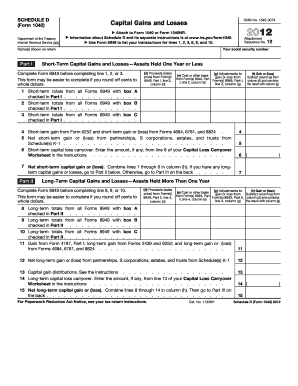
. . . . . . . . . . . . . . . 14 Long-term capital loss carryover. Enter the amount, if any, from line 13 of your Capital Loss Carryover Worksheet in the instructions . . . . . . . . . . . . . . . . . . . . . . . 15 Net long-term capital gain or (loss). Combine lines 8 through 14 in column (h). Then go to Part III on the back . . . . . . . . . . . . . . . . . . . . . . . . . . . . . . . 13 For Paperwork Reduction Act Notice, see your tax return instructions. Cat. No. 11338H 14 ( ) 15 Sc.

This website is not affiliated with IRS

How it works

  1. Open form

    Open form follow the instructions

  2. Easily sign form

    Easily sign the form with your finger

  3. Share form

    Send filled & signed form or save

How to fill out the IRS 1040 - Schedule D online

Filing your taxes can be a challenging process, especially when it comes to reporting capital gains and losses. The IRS 1040 - Schedule D form provides a structured way to report these transactions online. This guide will help you navigate the form step-by-step, ensuring you understand each section and its requirements.

Follow the steps to fill out Schedule D accurately

  1. Click the ‘Get Form’ button to access the IRS 1040 - Schedule D online and open it in your chosen editing platform.
  2. Begin with Part I for short-term capital gains and losses. Complete Form 8949 before filling in lines 1, 2, or 3. Enter the total proceeds from sales on line 1, 2, or 3 based on the assets held for one year or less.
  3. For each line in Part I, provide the proceeds (sales price) and the cost or other basis of the assets as indicated in the form. Be sure to accurately combine the necessary columns to calculate your gain or loss.
  4. Transition to Part II for long-term capital gains and losses. Similar to Part I, complete Form 8949 first before filling lines 8, 9, or 10, recording totals for assets held for more than one year.
  5. In Part II, enter the proceeds, cost basis, and any adjustments for each applicable line. It is essential to accurately calculate the net long-term gain or loss.
  6. Finally, move to Part III to summarize your totals. Combine your short-term and long-term results from lines 7 and 15 and follow instructions for reporting any gains or losses as indicated.

Start filling out your IRS 1040 - Schedule D online to ensure a smooth and accurate tax filing process.

Get form

Experience a faster way to fill out and sign forms on the web. Access the most extensive library of templates available.

Related content

About Schedule D (Form 1040), Capital Gains and...
Mar 25, 2025 — Use Schedule D (Form 1040) to report the following: The sale or exchange...
Learn more
2012 Form 1040 (Schedule D)
by D SCHEDULE · Cited by 1 — Complete the Qualified Dividends and Capital Gain Tax...
Learn more
f1045--2017.pdf
19. Enter the loss, if any, from line 21 of your 2017 Schedule D (Form 1040). (Estates and...
Learn more

Related links form

IRS 1099-A 2015 IRS 1099-A 2014 IRS 1099-A 2013 IRS 1099-A 2012

Questions & Answers

Get answers to your most pressing questions about US Legal Forms API.

Contact support

You can find your IRS 1040 - Schedule D in the official IRS tax forms section on their website. If you're filing electronically, your tax software will typically generate this form for you based on the information you provide. Additionally, if you previously filed taxes, you can reference your past returns for a copy of Schedule D. If you need further assistance with this, platforms like US Legal Forms can provide guides and templates.

Sales reported on the IRS 1040 - Schedule D include the sale of stocks, bonds, and other capital assets. Any transaction that results in a gain or loss must be included, whether it’s a short-term or long-term sale. It's essential to report even small transactions as they could impact your tax calculations. Keeping track of all these sales can ultimately help you when filing your tax return.

The $3000 capital loss rule allows you to deduct up to $3,000 of net capital losses from your taxable income each year. If your losses exceed this amount, you can carry the excess loss forward to future tax years. This rule helps manage your tax burden and tends to assist taxpayers with significant losses. Utilizing this rule can be efficient, and resources on the US Legal Forms platform can offer detailed insights.

To report capital gains and losses, you need to complete the IRS 1040 - Schedule D along with your main tax form. Start by categorizing your gains and losses as short-term or long-term, then fill out the appropriate sections. Each transaction must have accurate details, as this ensures that you report everything correctly. If you find this process complicated, the US Legal Forms platform offers helpful tools to guide you through the reporting process.

An example of the IRS 1040 - Schedule D could involve reporting the sale of stocks you purchased a year ago. Let’s say you bought 100 shares at $50 each and sold them for $70 each. You would use Schedule D to report the profit of $2,000 from that sale. This document will help you track your financial activity and manage your tax obligations.

The IRS 1040 - Schedule D is required if you sold assets like stocks or real estate for a profit or a loss. It helps the IRS track your capital gains and losses. If your transactions involve selling capital assets, you'll need to report them on this schedule. Failing to file can lead to penalties, so it’s essential to understand these requirements.

Schedule D is the form used to report capital gains and losses from your investments. This form is crucial when dealing with assets like stocks, bonds, and real estate, including inherited property. When filing your taxes using IRS 1040, Schedule D plays a key role in calculating any tax you may owe on these financial transactions. Make sure to understand its details for accurate filing.

Yes, you must report the sale of inherited property to the IRS if you sell the property for a gain. This transaction will need to be included on your IRS 1040 - Schedule D when you file your taxes. Even if it is not considered income, the profit may still be subject to taxes. It's best practice to keep detailed records of the sale.

To avoid capital gains tax on inherited real estate, you should consider selling the property shortly after the owner’s death. This often allows you to take advantage of the stepped-up basis, which adjusts the property value to market rates at the time of inheritance. It's also wise to consult a tax professional for strategies that align with IRS 1040 - Schedule D to maximize your savings.

Whether you need to file Form 8949 or Schedule D depends on your specific transactions. If you have both short-term and long-term capital gains to report, you will use both forms. Schedule D summarizes these transactions, while Form 8949 provides the details. Make sure you assess your situation carefully to ensure proper reporting on IRS 1040 - Schedule D.

Get This Form Now!

Use professional pre-built templates to fill in and sign documents online faster. Get access to thousands of forms.
If you believe that this page should be taken down, please follow our DMCA take down processhere.
Get IRS 1040 - Schedule D
  • Adoption
  • Bankruptcy
  • Contractors
  • Divorce
  • Home Sales
  • Employment
  • Identity Theft
  • Incorporation
  • Landlord Tenant
  • Living Trust
  • Name Change
  • Personal Planning
  • Small Business
  • Wills & Estates
  • Packages A-Z
  • Affidavits
  • Bankruptcy
  • Bill of Sale
  • Corporate - LLC
  • Divorce
  • Employment
  • Identity Theft
  • Internet Technology
  • Landlord Tenant
  • Living Wills
  • Name Change
  • Power of Attorney
  • Real Estate
  • Small Estates
  • Wills
  • All Forms
  • Forms A-Z
  • Other Templates
  • Legal Hub
  • About Us
  • Help Portal
  • Legal Resources
  • Blog
  • Affiliates
  • Contact Us
  • Delete My Account
  • Site Map
  • Industries
  • Forms in Spanish
  • Localized Forms
  • State-specific Forms
  • Forms Kit
  • Real Estate Handbook
  • All Guides
  • Notarize
  • Incorporation services
  • For Consumers
  • For Small Business
  • For Attorneys
  • USLegal
  • FormsPass
  • pdfFiller
  • signNow
  • altaFlow
  • DocHub
  • Instapage
Form Packages
  • Adoption
  • Bankruptcy
  • Contractors
  • Divorce
  • Home Sales
  • Employment
  • Identity Theft
  • Incorporation
  • Landlord Tenant
  • Living Trust
  • Name Change
  • Personal Planning
  • Small Business
  • Wills & Estates
  • Packages A-Z
Form Categories
  • Affidavits
  • Bankruptcy
  • Bill of Sale
  • Corporate - LLC
  • Divorce
  • Employment
  • Identity Theft
  • Internet Technology
  • Landlord Tenant
  • Living Wills
  • Name Change
  • Power of Attorney
  • Real Estate
  • Small Estates
  • Wills
  • All Forms
  • Forms A-Z
  • Other Templates
Customer Service
  • Legal Hub
  • About Us
  • Help Portal
  • Legal Resources
  • Blog
  • Affiliates
  • Contact Us
  • Delete My Account
  • Site Map
  • Industries
  • Forms in Spanish
  • Localized Forms
  • State-specific Forms
  • Forms Kit
Legal Guides
  • Real Estate Handbook
  • All Guides
Prepared for you
  • Notarize
  • Incorporation services
Our Customers
  • For Consumers
  • For Small Business
  • For Attorneys
Our Sites
  • USLegal
  • FormsPass
  • pdfFiller
  • signNow
  • altaFlow
  • DocHub
  • Instapage
Social Media
Call us now toll free:
+1 833 426 79 33
As seen in:
© Copyright 1999-2026 airSlate Legal Forms, Inc. 17 Station Street, Suite 303, Brookline, MA 02445
  • Your Privacy Choices
  • Terms of Service
  • Privacy Notice
  • Content Takedown Policy
  • Bug Bounty Program
IRS 1040 - Schedule D
This form is available in several versions.
Select the version you need from the drop-down list below.
2021 IRS 1040 - Schedule D
Select form
  • 2021 IRS 1040 - Schedule D
  • 2020 IRS 1040 - Schedule D
  • 2019 IRS 1040 - Schedule D
  • 2018 IRS 1040 - Schedule D
  • 2017 IRS 1040 - Schedule D
  • 2016 IRS 1040 - Schedule D
  • 2015 IRS 1040 - Schedule D
  • 2014 IRS 1040 - Schedule D
  • 2013 IRS 1040 - Schedule D
  • 2012 IRS 1040 - Schedule D
  • 2011 IRS 1040 - Schedule D
  • 2010 IRS 1040 - Schedule D
  • 1997 IRS 1040 - Schedule D
Select form