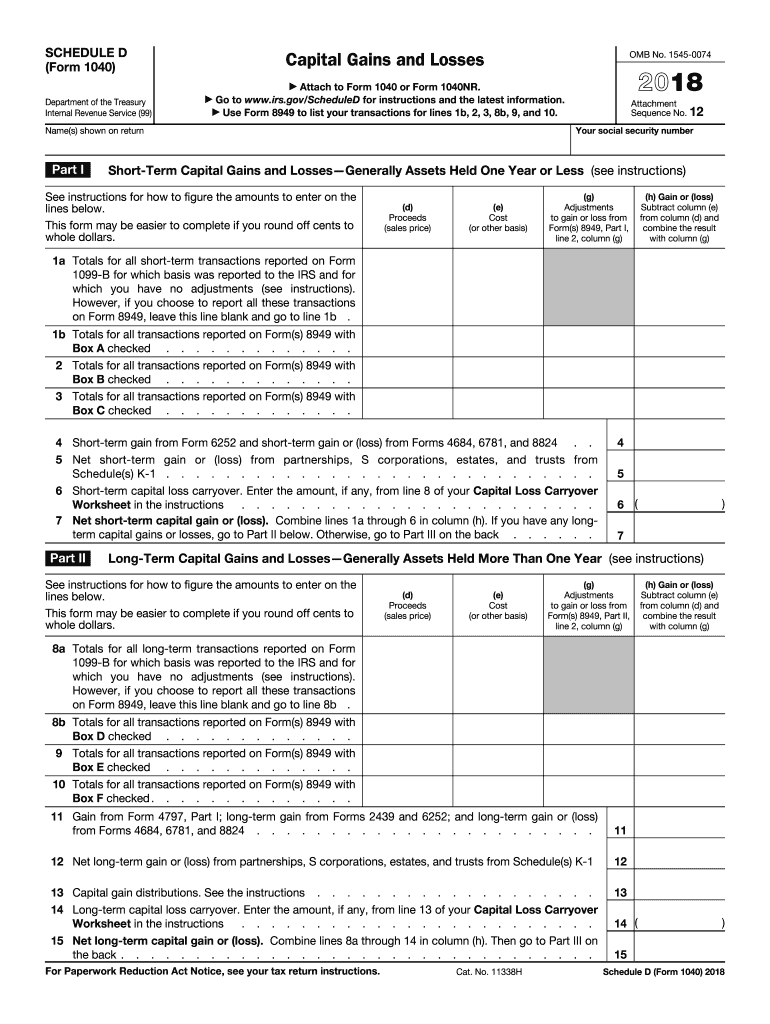
. . 10 Totals for all transactions reported on Form(s) 8949 with Box F checked . . . . . . . . . . . . . . 11 Gain from Form 4797, Part I; long-term gain from Forms 2439 and 6252; and long-term gain or (loss) from Forms 4684, 6781, and 8824 . . . . . . . . . . . . . . . . . . . . . . . 11 12 Net long-term gain or (loss) from partnerships, S corporations, estates, and trusts from Schedule(s) K-1 12 13 Capital gain distributions. See the instructions . . . . . . . . . . . . . . . . . . . 14.

Open form follow the instructions

Easily sign the form with your finger

Send filled & signed form or save
How to fill out the IRS 1040 - Schedule D online
The IRS 1040 - Schedule D form is used for reporting capital gains and losses from the sale of assets. This guide will walk you through the process of completing Schedule D online, ensuring you accurately report your financial information.
Follow the steps to effectively complete your Schedule D.
- Press the ‘Get Form’ button to download the IRS 1040 - Schedule D form and open it in your chosen editor.
- In the section for personal information, enter your social security number and the names as they appear on your tax return.
- Begin Part I for short-term capital gains and losses. Fill in the proceeds or sales price in column (d), the cost or other basis in column (e), and any adjustments in column (g). Calculate your gain or loss in column (h) by subtracting the cost from the proceeds and adding any adjustments.
- Complete lines 1a through 7 according to your short-term capital transactions, ensuring to follow instructions on whether to report via Form 8949.
- Move to Part II for long-term capital gains and losses. Similarly, fill in columns (d), (e), and (g) for your long-term transactions. Calculate the gain or loss for each transaction in column (h).
- Finalize lines 8a through 15 in Part II by following the guidelines and using Form 8949 if required.
- Proceed to Part III to summarize your overall capital gains and losses. Combine the totals from lines 7 and 15 to report on line 16.
- If line 16 shows a gain, transfer that amount to Schedule 1 (Form 1040). If it's a loss, enter the smaller of line 16 or the limit allowed, and follow any additional instructions provided.
- Finally, carefully review your entries, make any necessary adjustments, and save your changes. You may then download, print, or share the completed form as needed.
Complete your tax forms online efficiently and accurately for a smooth filing process.
Experience a faster way to fill out and sign forms on the web. Access the most extensive library of templates available.
Related content
Mar 25, 2025 — Use Schedule D (Form 1040) to report the following: The sale or exchange...
by D SCHEDULE · Cited by 1 — Complete the Qualified Dividends and Capital Gain Tax...
19. Enter the loss, if any, from line 21 of your 2017 Schedule D (Form 1040). (Estates and...
Get answers to your most pressing questions about US Legal Forms API.
How do I avoid capital gains tax on inherited real estate?
You typically avoid capital gains tax on inherited real estate by utilizing the step-up in basis rule. When inherited, the property is valued at its fair market value at the date of death, potentially reducing your gains. Understanding the IRS 1040 - Schedule D form can help you navigate your tax liabilities more effectively.
Should I file form 8949 or schedule D?
You may need to file both Form 8949 and Schedule D, depending on the complexity of your transactions. Use Form 8949 to report individual sales or exchanges, and then summarize this information on Schedule D. This combination ensures proper reporting of your capital gains and losses.
What is the Schedule D on the 1040 form?
Schedule D is a form attached to your IRS 1040 that reports capital gains and losses. This schedule is essential for detailing transactions, such as the sale of inherited property. Using Schedule D allows you to accurately report your financial activities to the IRS.
Do you get a 1099 when you sell an inherited house?
Typically, you do not receive a 1099 when selling an inherited house, as it's not considered ordinary income. However, you should still report the sale on your IRS 1040 - Schedule D. It’s wise to keep track of all transactions for proper tax reporting.
Is selling inherited property considered income?
Selling inherited property usually results in a capital gain or loss rather than ordinary income. This distinction is critical when reporting on the IRS 1040 - Schedule D. It’s essential to calculate this gain or loss accurately, as it impacts your tax obligations.
Who does not need to file Schedule D?
Individuals who do not have any capital gains or losses from sales or exchanges generally do not need to file Schedule D. If your only income comes from wages or other sources without capital transactions, you can skip this form. Always consult the latest IRS guidelines to be certain.
Do I have to report the sale of inherited property to the IRS?
Yes, you need to report the sale of inherited property to the IRS on the IRS 1040 - Schedule D. While you may not owe taxes on the sale, it's crucial to report it to maintain transparency. This helps establish your gains or losses clearly for the IRS.
How do you report the sale of inherited property to the IRS?
When you sell inherited property, you report the sale on your IRS 1040 - Schedule D. First, determine the asset’s fair market value at the date of the decedent's death. This value becomes your basis for the property, minimizing your taxable gains. Use the correct forms to ensure compliance with IRS regulations.
Who needs to file 1040 Schedule D?
You need to file IRS 1040 - Schedule D if you have capital gains or losses to report, which can include sales of securities or property. If you participate in investments that yield gains or losses, this form is essential for accurate tax reporting. Ensure you understand the requirements, and if needed, platforms like US Legal Forms can assist you in navigating this process.
Who must file Schedule D Form 1040?
Any taxpayer who has sold capital assets must file IRS 1040 - Schedule D to report those gains or losses. This includes individuals who sold stocks, bonds, or other investments. If you have unique circumstances or uncertainties, using reliable resources like US Legal Forms can make the process smoother.
Use professional pre-built templates to fill in and sign documents online faster. Get access to thousands of forms.
If you believe that this page should be taken down, please follow our DMCA take down process here.
This form is available in several versions. Select the version you need from the drop-down list below.