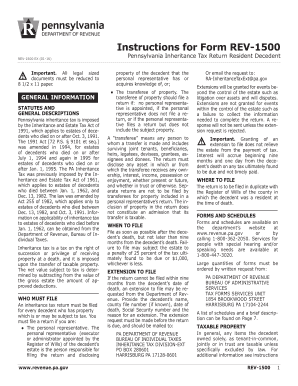
Ritance tax is imposed by the Inheritance and Estate Tax Act of 1991, which applies to estates of decedents who died on or after Oct. 3, 1991. The 1991 Act 72 P.S. 9101 et seq. was amended in 1994, for estates of decedents who died on or after July 1, 1994 and again in 1995 for estates of decedents who died on or after Jan. 1, 1995. The PA Inheritance Tax was previously imposed by the Inheritance and Estate Tax Act of 1961, which applies to estates of decedents who died between Jan. 1, 1962.
Open form follow the instructions
Easily sign the form with your finger
Send filled & signed form or save
How to fill out the PA REV-1500 EX online
The PA REV-1500 EX form is essential for reporting Pennsylvania inheritance tax for decedents. This guide provides comprehensive step-by-step instructions to assist users in accurately filling out the form online.
Follow the steps to complete the PA REV-1500 EX effectively.
- Click ‘Get Form’ button to obtain the PA REV-1500 EX and open it in your online editor.
- Begin with the decedent information section. Enter the decedent's Social Security number, date of birth, and full name as required.
- Indicate whether the decedent had a valid will or maintained a living trust by filling in the appropriate ovals.
- Complete the correspondent section by providing the personal representative's name, phone number, address, and email.
- Proceed to fill in the recapitulation lines with values from the necessary schedules that correspond to the decedent’s assets, such as real estate, stocks, and other properties.
- Calculate total deductions for funeral expenses and debts by entering their amounts on the specified lines.
- Compute the net value of the estate by subtracting total deductions from total gross assets. Enter this value on the net value line.
- Determine the net value subject to tax and calculate the applicable tax rates for different beneficiaries, entering these on their respective lines.
- Once all sections are completed, sign, address, and date the return. If necessary, include any schedules that correspond to reported assets and deductions.
- After confirming all information is accurate, proceed to save changes, download, print, or share the filled form as needed.
Complete your documents online with confidence and accuracy.
Experience a faster way to fill out and sign forms on the web. Access the most extensive library of templates available.
Related content
REV-1500 (EX) MOD 08-24 (FI). Page 4. Page 5. Instructions for REV-1500. Pennsylvania...
The $1,500 transferred from H to W from February 28, 2006, (a year before the billing...
Jan 2, 2018 — Your capital loss deduction limit is $1,500. (instead of $3,000 on a joint...
Get answers to your most pressing questions about US Legal Forms API.
What is a PA Rev 1500?
The PA REV-1500 is a formal document required in Pennsylvania to report and calculate inheritance tax on an estate. This form simplifies the process for executors by providing a structured format for detailing estate assets. Completing the PA REV-1500 accurately is vital for compliance and for ensuring that beneficiaries receive their inheritance without delay. Utilizing platforms that assist with estate filings can make this task more manageable.
Who is exempt from PA inheritance tax?
Several groups are exempt from Pennsylvania inheritance tax, including surviving spouses and charitable organizations. Additionally, certain exemptions apply to family farms and businesses under specific conditions. To determine one’s eligibility for exemptions, understanding the regulations surrounding the PA REV-1500 EX is crucial. Consulting with expert platforms can help clarify these nuances.
Who needs to file a PA inheritance tax return?
Individuals who receive an inheritance in Pennsylvania, including spouses, children, and any other beneficiaries, must file a PA inheritance tax return. This requirement applies regardless of the amount inherited. Timely filing is essential to avoid complications, and utilizing the PA REV-1500 EX can provide clarity and guidance. Platforms that assist with these processes can make compliance easier.
Who must file the PA Rev 1500?
The PA REV-1500 must be filed by the executor or administrator of an estate in Pennsylvania. This includes individuals responsible for settling the estate and distributing assets. Proper filing ensures compliance with state tax laws, protecting the interests of both the estate and its beneficiaries. If you’re managing an estate, using tools designed to assist with PA REV-1500 EX can streamline this process.
What is a rev 1500?
The rev 1500, or PA REV-1500, is a form used to calculate and report Pennsylvania inheritance tax accurately. It is essential for estate executors to complete this form as it determines tax obligations based on the value of the estate. Completing the PA REV-1500 ensures you comply with state requirements and can potentially ease the tax burden for beneficiaries. Engaging with reliable platforms can improve the accuracy of this filing.
Who has to file a PA inheritance tax return?
Generally, anyone receiving an inheritance in Pennsylvania must file a PA inheritance tax return. This includes heirs, beneficiaries, and other parties entitled to assets from the estate. Understanding when to file can prevent unnecessary penalties, and the PA REV-1500 EX plays a critical role in this process. Utilize platforms that guide you through these requirements.
What is a PA 1000?
The PA 1000 is a form used by executors to report the assets of an estate to the Pennsylvania Department of Revenue. This form helps determine the amount of inheritance tax owed on the estate. Completing the PA 1000 accurately is crucial for compliance, and it often accompanies the filing of a PA REV-1500 EX. Be sure to consult resources or platforms that simplify this process.
Is Pennsylvania considering eliminating the inheritance tax?
Currently, Pennsylvania has not made definitive plans to eliminate the inheritance tax. However, discussions among lawmakers continue regarding potential reforms. It is essential to stay updated on legislative changes since these could affect the way estates are handled. For those navigating these regulations, understanding tools like the PA REV-1500 EX can offer clarity.
How to file estimated taxes for pa?
To file estimated taxes for PA, you need to complete the required estimated tax forms and submit them quarterly. You can file online via the Pennsylvania Department of Revenue's website or by mailing in your forms. It’s essential to accurately calculate your estimated tax to prevent underpayment issues. The PA REV-1500 EX provides guidance and tools to help you navigate this process easily.
Where to file pa Rev 1500?
You should file the PA REV-1500 at your local Pennsylvania Department of Revenue office or through their online e-filing portal. The process is designed to be straightforward, making it easier to submit your tax information. Staying organized and submitting your form on time can help avoid penalties. Leveraging the PA REV-1500 EX can simplify your filing journey.
Use professional pre-built templates to fill in and sign documents online faster. Get access to thousands of forms.
If you believe that this page should be taken down, please follow our DMCA take down process here.
This form is available in several versions. Select the version you need from the drop-down list below.