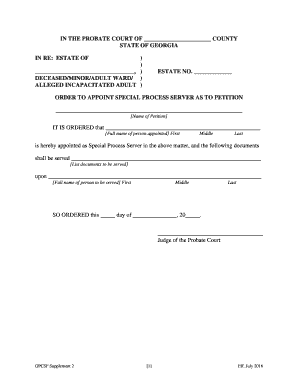
S appropriate to appoint a special process server to better perfect service. 2. O.C.G.A. 53-11-2 provides that a party to a probate proceeding who is not sui juris must be represented by a guardian provided that the Court may appoint a guardian ad litem or determine that the natural guardian, guardian, conservator, or testamentary guardian has no conflict and may serve. Should a guardian ad litem be necessary because a party is not sui juris, use Supplement 1. 3. Use Supplement 3 when an addi.
Open form follow the instructions
Easily sign the form with your finger
Send filled & signed form or save
How to fill out the GA GPCSF Supplement 2 online
This guide provides comprehensive instructions on completing the GA GPCSF Supplement 2 online. Designed for users of all experience levels, it guides you through each section of the form clearly and supportively.
Follow the steps to complete the GA GPCSF Supplement 2 online.
- Press the ‘Get Form’ button to access the form and open it in your preferred online tool.
- Begin by entering the county's name where the probate court is located in the designated section at the top of the form.
- Input the estate of the deceased, minor, adult ward, or alleged incapacitated adult, including their full name in the appropriate fields.
- Complete the estate number field. If this information is not available, consult with relevant court documents.
- In the 'Order to appoint special process server' section, fill in the full name of the person being appointed as the special process server.
- List the documents that are to be served in the designated area. Ensure each document is accurately represented.
- Fill in the full name of the individual to be served, ensuring that their first, middle, and last names are correctly recorded.
- Proceed to complete the date and signature fields at the bottom of the order section.
- For the return sections, complete the details of the service provided, including the time and date of service.
- Indicate any attempts at service if applicable, including reasons for unsuccessful attempts.
- At the completion of the form, you can choose to save your changes, download, print, or share the document as needed.
Complete your documents online today for a smoother process.
Experience a faster way to fill out and sign forms on the web. Access the most extensive library of templates available.
Related content
APPOINTMENT OF SPECIAL PROCESS SERVER. Supplement 2. INSTRUCTIONS. I. Specific...
The Gavel: the official newsletter of the Georgia Council of Probate Court Judges [Mar...
Get answers to your most pressing questions about US Legal Forms API.
What does petition to probate will in solemn form mean in Georgia?
A petition to probate a will in solemn form means that the will must undergo a formal court process to be validated. This method may be necessary in disputes or when there is uncertainty about the will's authenticity. Engaging with the GA GPCSF Supplement 2 can guide you through this intricate procedure, offering the assistance you need to ensure a smooth probate experience.
Can an estate be settled without probate in Georgia?
Yes, certain estates can be settled without probate in Georgia, particularly those with minimal assets or if all heirs agree. This can simplify the process, saving time and reducing costs. Exploring options like the GA GPCSF Supplement 2 can provide insights into whether your estate qualifies for non-probate settlement methods and how to implement them efficiently.
Do all wills need to be probated in Georgia?
Not all wills require probate in Georgia, but most do, especially if the deceased owned significant assets. However, small estates may qualify for simplified processes that bypass formal probate. Understanding when probate is necessary can facilitate efficient estate management, and the GA GPCSF Supplement 2 can clarify this aspect for you.
What are the two types of probate in Georgia?
The two primary types of probate in Georgia are probate in common form and probate in solemn form. Each type addresses different needs, from simpler estates to those requiring more intricate oversight. Knowing which type applies to your situation can save you time and reduce stress, which is where the GA GPCSF Supplement 2 can assist you in making informed choices.
What is the difference between probate in common form and solemn form in Georgia?
Probate in common form is generally faster and less formal, allowing for quicker processing of wills. In contrast, probate in solemn form involves a more detailed judicial review, which can provide additional protection against disputes. Recognizing the differences can streamline your probate experience, making resources like the GA GPCSF Supplement 2 particularly beneficial.
What are the different types of probate in Georgia?
Georgia recognizes several types of probate, primarily focusing on two main categories: probate in common form and probate in solemn form. Each type serves unique purposes, depending on the estate’s circumstances. Understanding these distinctions is essential, and the GA GPCSF Supplement 2 serves as a valuable resource in determining the best option for your situation.
How long do you have to file probate after death in Georgia?
In Georgia, you typically have six months from the date of death to file probate. This time frame is crucial for ensuring that the estate is settled efficiently. If you miss this window, you may face complications, such as additional court costs and delays. Utilizing the GA GPCSF Supplement 2 can help you navigate this process smoothly.
How to file probate in Georgia without a will?
Filing probate in Georgia without a will requires you to petition the court to appoint an administrator for the estate. This process involves gathering necessary documents, such as the deceased's death certificate and information about the heirs. You will also need to file forms specific to the GA GPCSF Supplement 2. Utilizing platforms like US Legal Forms can simplify this process, offering assistance and the necessary documentation.
How to get a small estate affidavit in Georgia?
To get a small estate affidavit in Georgia, you must confirm that the estate qualifies under the state’s value limits, which is currently set at $10,000. You can then obtain the affidavit form from Georgia courts or online resources. Completing this affidavit allows you to distribute the deceased's assets without enduring lengthy probate procedures.
How much does an estate have to be worth to go to probate in Georgia?
In Georgia, an estate must exceed $10,000 to necessitate a formal probate process. If the total value is less than this amount, you may opt for a small estate affidavit under GA GPCSF Supplement 2 instead. This provision can significantly expedite the process. For specific advice and forms, consider using US Legal Forms for your probate needs.
Use professional pre-built templates to fill in and sign documents online faster. Get access to thousands of forms.
If you believe that this page should be taken down, please follow our DMCA take down process here.