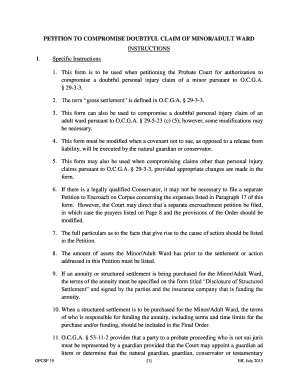
L personal injury claim of a minor pursuant to O.C.G.A. 29-3-3. 2. The term gross settlement is defined in O.C.G.A. 29-3-3. 3. This form can also be used to compromise a doubtful personal injury claim of an adult ward pursuant to O.C.G.A. 29-5-23 (c) (5); however, some modifications may be necessary. 4. This form must be modified when a covenant not to sue, as opposed to a release from liability, will be executed by the natural guardian or conservator. 5. This form may also be use.
Open form follow the instructions
Easily sign the form with your finger
Send filled & signed form or save
How to fill out the GA GPCSF 19 online
Filling out the GA GPCSF 19 form is an essential step in petitioning the Probate Court for the compromise of a doubtful personal injury claim on behalf of a minor or adult ward. This guide will help you navigate each section of the form with clear and supportive instructions.
Follow the steps to accurately complete the GA GPCSF 19 form online.
- Click ‘Get Form’ button to obtain the form and open it in the online editor.
- Begin by filling in the 'County' and 'State of Georgia' at the top of the form to specify where the petition is being filed.
- Proceed to complete the section titled 'In re: Estate of' by entering the full name of the minor or adult ward and the corresponding estate number.
- In the next section, enter the full name and addresses of the petitioner or petitioners. Ensure to include both physical and mailing addresses for clarity.
- List the full name and address of the minor or adult ward in the designated field, along with their birth date and current age.
- Detail the occurrence that led to the personal injuries sustained by specifying the particulars in the provided text box.
- Indicate the current assets of the minor/adult ward by entering the amounts in the respective fields, including any existing bonds.
- Select the appropriate options regarding conservatorship from Paragraph 3 and fill out the corresponding fields as applicable.
- Provide details of the claim being settled, including the name of the party the claim is against and the date of the occurrence.
- Next, indicate whether a lawsuit has been filed, and if so, provide necessary documentation as exhibits.
- For any medical expenses related to the injury, list all current and expected future expenses, ensuring to attach documentation where needed.
- Fill in the settlement terms, including gross settlement amount, expenses, and details regarding any structured settlements.
- Complete the attorney representation section, detailing their name, address, and the arrangement for their fees.
- Review all entered information for accuracy. After ensuring everything is complete, save your changes.
- Finally, download, print, or share the completed form as necessary to complete your filing.
Get started now by filling out the GA GPCSF 19 online and ensure your petition is submitted correctly!
Experience a faster way to fill out and sign forms on the web. Access the most extensive library of templates available.
Related content
Jul 14, 2021 — GPCSF 18, Petition for Declaration of Death of Missing Individual...
The Gavel: the official newsletter of the Georgia Council of Probate Court Judges [Mar...
Get answers to your most pressing questions about US Legal Forms API.
How do I file probate without a lawyer in Georgia?
Filing probate without a lawyer in Georgia is possible, but it requires careful attention to detail. You will need to fill out the necessary forms correctly and file them with your local probate court. For comprehensive instructions and forms, consider using the resources available through GA GPCSF 19 to guide you through the process.
Do bank accounts have to go through probate in Georgia?
In Georgia, whether bank accounts go through probate largely depends on how the accounts are titled. Joint accounts or those with a beneficiary designation typically bypass probate. If you have questions about your specific situation, GA GPCSF 19 can provide resources to clarify these nuances.
Do you need an attorney for probate court in Georgia?
While hiring an attorney for probate court in Georgia is not mandatory, it is often beneficial. An attorney can help navigate the complexities of the process and ensure compliance with legal requirements. To further simplify this process, GA GPCSF 19 offers valuable tools to understand your options.
How to file a claim of exemption wage garnishment in Georgia?
Filing a claim of exemption for wage garnishment in Georgia requires submitting a written claim to the court where the judgment was issued. You must demonstrate that your wages fall under the exempt categories. For helpful resources and templates, check out GA GPCSF 19 to assist you in this procedure.
How do I petition for permanent guardianship in Georgia?
Petitioning for permanent guardianship in Georgia involves filing the necessary paperwork in the probate court. You'll need to provide evidence that the guardianship is in the best interest of the child or incapacitated adult. To make the process smoother, explore the solutions offered by GA GPCSF 19 for comprehensive guidance.
How long do you have to file probate after death in Georgia?
In Georgia, you generally have six months from the date of death to file for probate. It is crucial to be timely, as any delay can complicate the process. If you are unsure about the timing or procedures involved, consider utilizing GA GPCSF 19 resources to streamline your application.
How much does an estate have to be worth to go to probate in Georgia?
While there is no set minimum value for an estate to undergo probate in Georgia, it often becomes necessary when the estate contains significant assets or property. Factors such as real estate, bank accounts, or valuable personal property usually make probate important to settle any debts and distribute the remaining assets. To understand how these values apply in your situation, reach out to USLegalForms, which can provide you with relevant information about GA GPCSF 19.
What is exempt from probate in Georgia?
Certain assets in Georgia can be exempt from probate, which typically includes items such as life insurance proceeds, retirement accounts, and jointly owned property. These assets transfer directly to the named beneficiaries or co-owners, bypassing the probate process altogether. Understanding what is exempt can save time and costs in settling an estate. USLegalForms can help clarify these exemptions as part of their services regarding GA GPCSF 19.
How do I get a letter of testamentary in Georgia?
To obtain a letter of testamentary in Georgia, an executor named in the will must file a petition with the probate court in the county where the deceased lived. This document serves as legal proof of the executor's authority to administer the estate. Once the court processes the petition and approves it, they will issue the letter. For a streamlined experience through this process, consider using USLegalForms for resources related to GA GPCSF 19.
What is GA Code 19 6 2?
GA Code 19 6 2 defines the laws surrounding inheritance and the rights of heirs in the state of Georgia. This code clarifies how property is distributed when a decedent dies without a valid will. Familiarity with this law is crucial for anyone navigating the intricacies of estate distribution, especially in complicated situations. USLegalForms can provide you with valuable information about GA GPCSF 19, helping you understand your rights and options.
Use professional pre-built templates to fill in and sign documents online faster. Get access to thousands of forms.
If you believe that this page should be taken down, please follow our DMCA take down process here.