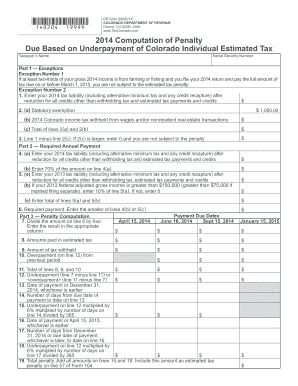
Tax Taxpayer s Name Social Security Number Part 1 Exceptions Exception Number 1 If at least two-thirds of your gross 2014 income is from farming or fishing and you file your 2014 return and pay the full amount of tax due on or before March 1, 2015, you are not subject to the estimated tax penalty. Exception Number 2 1. Enter your 2014 tax liability (including alternative minimum tax and any credit recapture) after reduction for all credits other than withholding tax and estimated tax pa.
Open form follow the instructions
Easily sign the form with your finger
Send filled & signed form or save
How to fill out the CO DR 0204 online
The CO DR 0204 form is used for computing the penalty due based on underpayment of Colorado individual estimated tax. This guide will assist you in filling out the form online, ensuring a smooth and accurate experience.
Follow the steps to successfully complete the CO DR 0204 form online.
- Click ‘Get Form’ button to obtain the form and open it in your digital editor.
- Complete the taxpayer's name and Social Security number in the designated fields.
- For Part 1, determine if any exceptions apply. If at least two-thirds of your gross 2014 income is from farming or fishing and you file your return on or before March 1, 2015, you qualify for an exception.
- If no exceptions apply, move to Part 2. Enter your 2014 tax liability on line 4(a). Calculate and fill in 70% of that amount on line 4(b).
- Enter your 2013 tax liability on line 5(a) and, if applicable, calculate 10% for high-income thresholds on line 5(b). Add these amounts to get line 5(c).
- On line 6, enter the smaller of line 4(b) or line 5(c) as your required payment.
- Proceed to Part 3. Divide the amount on line 6 by four and enter the result in the appropriate column for Payment Due Dates.
- Record the amounts paid in estimated tax on line 8, tax withheld on line 9, and any overpayment on line 10.
- On line 11, sum the entries from lines 8, 9, and 10.
- Calculate your underpayment or overpayment on line 12, using the amounts from line 7 and line 11.
- Fill in the date of payment on line 13, and calculate the number of days from the payment due date on line 14.
- Complete lines 15 and 18 to compute your penalty amounts, and sum them for line 19, which will be included on line 57 of Form 104.
- If applicable, move to Part 4 to complete the Annualized Installment Method Schedule for any uneven income periods.
- Review all fields for accuracy, then save your changes, and follow prompts to download, print, or share the completed form.
Complete your forms online today to streamline your document management process.
Experience a faster way to fill out and sign forms on the web. Access the most extensive library of templates available.
Related content
DR 0204 - Tax Year ... Review the Individual Income Tax Guide for additional information...
If the vehicle is not titled in the loaner's name, the loaner must apply for a new...
- Recomenda-se o tratamento de água a fim de evitar falhas prema- turas do equipamento...
Get answers to your most pressing questions about US Legal Forms API.
How do I avoid underpayment penalties in Colorado?
To avoid underpayment penalties in Colorado, consistently review your tax situation and make estimated tax payments, if necessary. Staying informed about changes in tax laws and regulations is also essential. If you’re unsure of your obligations, seeking support from CO DR 0204 materials can provide the clarity you need.
What is a reasonable cause for underpayment penalty?
A reasonable cause for the underpayment penalty may include unforeseen circumstances, such as a serious illness or natural disaster. If you can demonstrate that your situation was beyond your control, you might qualify for relief from the penalty. It is crucial to document your circumstances appropriately. Understanding the nuances of CO DR 0204 can guide you through this process.
How long can the state of Colorado collect back taxes?
The state of Colorado generally has three years to collect back taxes from the date they were due. However, certain circumstances can extend this time frame, such as filing a fraudulent return or failing to file a return at all. It is essential to be aware of these timelines to prevent further complications. Resources related to CO DR 0204 can provide valuable insights into tax collection periods and obligations.
What is a recurring distraint warrant penalty in Colorado?
In Colorado, a recurring distraint warrant penalty occurs when the state attempts to collect overdue taxes using a legal warrant. If a taxpayer fails to resolve their tax debt, the state can seize assets or income. This could lead to additional fees and complications with your financial situation. Understanding CO DR 0204 will help you navigate these challenges effectively.
Where do I mail my estimated tax payments to?
Mail your estimated tax payments to the designated address provided by the Colorado Department of Revenue. Always verify the current address to make sure your payment is processed without delays. Adhering to the CO DR 0204 guidelines will help streamline your tax responsibilities. For more detailed instructions, USLegalForms can be a valuable resource.
Do I need to mail form Dr. 1778 Colorado?
Yes, if you are required to file for income tax withholding, mailing form DR 1778 is necessary. This form helps ensure your tax withholdings are accurately calculated and reported in accordance with the CO DR 0204. Be sure to check the state's instructions for the correct mailing address. USLegalForms can assist you in ensuring your forms are filled out correctly.
Where to mail Colorado estimated tax payments?
You can mail your Colorado estimated tax payments to the address specified in the official Colorado Department of Revenue guidelines. It's essential to check the latest instructions to ensure your payments arrive on time. Remember, following the CO DR 0204 guidelines will help you stay on top of your tax obligations. USLegalForms can assist you with accurate mailing information.
Do you have to file a state tax return in Colorado?
If you earn income in Colorado, you typically need to file a state tax return. Exceptions exist, such as when your income falls below a certain threshold. Understanding these requirements can help you navigate the CO DR 0204 process efficiently. Utilizing platforms like USLegalForms can simplify your filing experience.
How do I set up tax withholding?
Setting up tax withholding can be done through your employer using Form W-4, while in Colorado, you may rely on the CO DR 0204 for state-specific guidelines. It's important to provide accurate information about your income and deductions on these forms. You can also contact your HR department for assistance with the setup process. This ensures that the right amount is withheld from your paycheck, facilitating easier tax payments.
How much should I withhold for taxes in Colorado?
The amount you should withhold depends on several factors, including your expected income. Form CO DR 0204 provides guidance on determining the right withholding amount tailored to your financial situation. It's essential to assess your tax liability to avoid underpayment penalties. Regularly reviewing and adjusting your withholding ensures you stay on track with your tax responsibilities.
Use professional pre-built templates to fill in and sign documents online faster. Get access to thousands of forms.
If you believe that this page should be taken down, please follow our DMCA take down process here.
This form is available in several versions. Select the version you need from the drop-down list below.