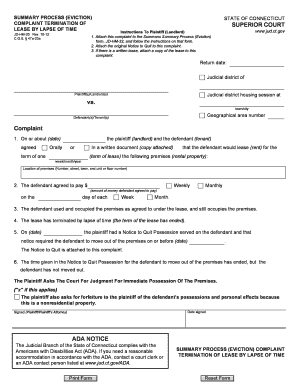
Ons Summary Process (Eviction) form, JD-HM-32, and follow the instructions on that form. 2. Attach the original Notice to Quit to this complaint. 3. If there is a written lease, attach a copy of the lease to this complaint. JD-HM-20 Rev. 10-12 C.G.S. 47a-23a Return date: Judicial district of Judicial district housing session at Plaintiff(s)/Landlord(s) vs. town/city Geographical area number Defendant(s)/Tenant(s) Complaint 1. On or about (date) agreed term of one Orally the plaintiff.

How it works
  • Open form

    Open form follow the instructions

  • Easily sign form

    Easily sign the form with your finger

  • Share form

    Send filled & signed form or save

How to fill out the CT JD-HM-20 online

The CT JD-HM-20 form is essential for landlords in Connecticut initiating the eviction process due to lease termination by lapse of time. This guide provides clear instructions on how to complete the form online, ensuring you meet all necessary legal requirements.

Follow the steps to successfully complete the CT JD-HM-20 form.

  1. Click ‘Get Form’ button to access the CT JD-HM-20 form and load it into your online editing tool.
  2. Input the return date and judicial district, along with the housing session information relevant to your case. This is critical for proper court processing.
  3. In the plaintiff(s)/landlord(s) section, clearly list the names of all landlords involved in the complaint.
  4. In the defendant(s)/tenant(s) section, provide the details of the tenant(s) including names and any relevant geographical area numbers where the property is located.
  5. Detail the agreement terms under section 1, including whether the agreement was oral or written and specify the duration of the lease.
  6. Fill in the location of the premises accurately, including street number, town, and any unit or floor number if applicable.
  7. Enter the amount the defendant agreed to pay and specify the payment frequency, whether it's weekly or monthly.
  8. Confirm in section 3 that the defendant has been occupying the premises as agreed until the lease termination.
  9. Indicate in section 4 that the lease has terminated and include the date on which the Notice to Quit was served as specified in the complaint.
  10. State whether the defendant has vacated the property as required by the Notice to Quit.
  11. Finalize the completion of the document by signing under the appropriate section, ensuring to enter the date of signing.
  12. Once completed, you can save the changes, download the document, print it, or share it as necessary for your records or further legal processes.

Begin filling out your CT JD-HM-20 form online today to ensure a smooth eviction process.

Get form

Experience a faster way to fill out and sign forms on the web. Access the most extensive library of templates available.

Related content

SUMMARY PROCESS (EVICTION) COMPLAINT ...

JD-HM-20 Rev. 4-19. C.G.S. § 47a-23a. P.B. § 10-29. Complaint. 4. The lease has...

Learn more
Pediatric Radiology Normal Measurements

Normal measurements in pediatric radiology is being compiled by pediatric radiologists...

Learn more
Primary Urethral Carcinoma - Cloudfront.net

Imaging work-up should include computed tomography of the chest, abdomen and pelvis for...

Learn more
Questions & Answers

Get answers to your most pressing questions about US Legal Forms API.

Contact support

Is a notice to quit an eviction CT?

A notice to quit is a crucial step in the eviction process in Connecticut, but it is not the eviction itself. This notice informs the tenant that they must vacate the property, typically for not paying rent or violating lease terms. It is the first formal action a landlord must take before pursuing eviction in court. For clarity and accuracy, using resources like the CT JD-HM-20 form can guide you in issuing this notice correctly.

Evicting a tenant in Connecticut can be challenging due to the legal requirements involved. Landlords must adhere strictly to state laws, which include providing proper notice and following court procedures. While the process may seem daunting, understanding the steps can significantly ease the task. The CT JD-HM-20 form serves as a valuable resource to help you manage your eviction needs effectively.

In Connecticut, a landlord cannot legally evict a tenant without a court order. Self-help evictions, where a landlord tries to force a tenant to leave without a court's involvement, are prohibited. This rule protects tenants' rights and ensures a fair process. To navigate these procedures correctly, you may refer to the CT JD-HM-20 form, which provides guidance for proper legal actions.

Evicting a tenant in Connecticut generally takes about 30 to 60 days, depending on various factors, including how quickly the tenant responds to the eviction notice. The process involves filing for an eviction, waiting for court dates, and obtaining a judgment. It's important to follow proper procedures to ensure a smooth eviction process. Utilizing the CT JD-HM-20 form can help simplify your legal obligations and move forward efficiently.

Delaying an eviction in Connecticut often involves filing a motion with the court, citing valid reasons such as seeking legal assistance or negotiating with your landlord. Refer to CT JD-HM-20 to understand your rights and any potential defenses. You can also utilize UsLegalForms to prepare necessary legal documents efficiently.

To fight an eviction in Connecticut, gather all relevant documents, including your lease and any communication with your landlord. Familiarize yourself with the CT JD-HM-20 provisions to understand your rights and defenses. Consider consulting legal resources, like UsLegalForms, which can provide helpful templates and guidance throughout the process.

No, a landlord cannot legally evict you without a court order in Connecticut. Under the CT JD-HM-20 guidelines, landlords must follow proper judicial processes to initiate an eviction. If you face an unlawful eviction attempt, you can protect your rights and access legal support through platforms like UsLegalForms.

If you fail to attend court for an eviction in Connecticut, the court may rule in favor of the landlord by default. This means they can secure an eviction order without any opposition from you. It is crucial to respond to eviction notices by utilizing CT JD-HM-20 for your defense and to understand your rights fully.

The new tenant law in CT, known as CT JD-HM-20, introduces important protections for renters. This law requires landlords to provide clear notices before taking any action related to evictions. Additionally, it emphasizes the need for fair treatment and transparency in rental agreements, ensuring tenants understand their rights.

To fight an eviction in Connecticut, you can respond to the eviction notice and present your case in court. It is crucial to gather all relevant documentation, such as payment records and communication with your landlord. Understanding the CT JD-HM-20 process gives you a structured approach to challenge the eviction. Consider using US Legal Forms to access helpful resources that can strengthen your defense.

Get This Form Now!

Use professional pre-built templates to fill in and sign documents online faster. Get access to thousands of forms.

If you believe that this page should be taken down, please follow our DMCA take down process here.

CT JD-HM-20 Form

This form is available in several versions. Select the version you need from the drop-down list below.

Get CT JD-HM-20