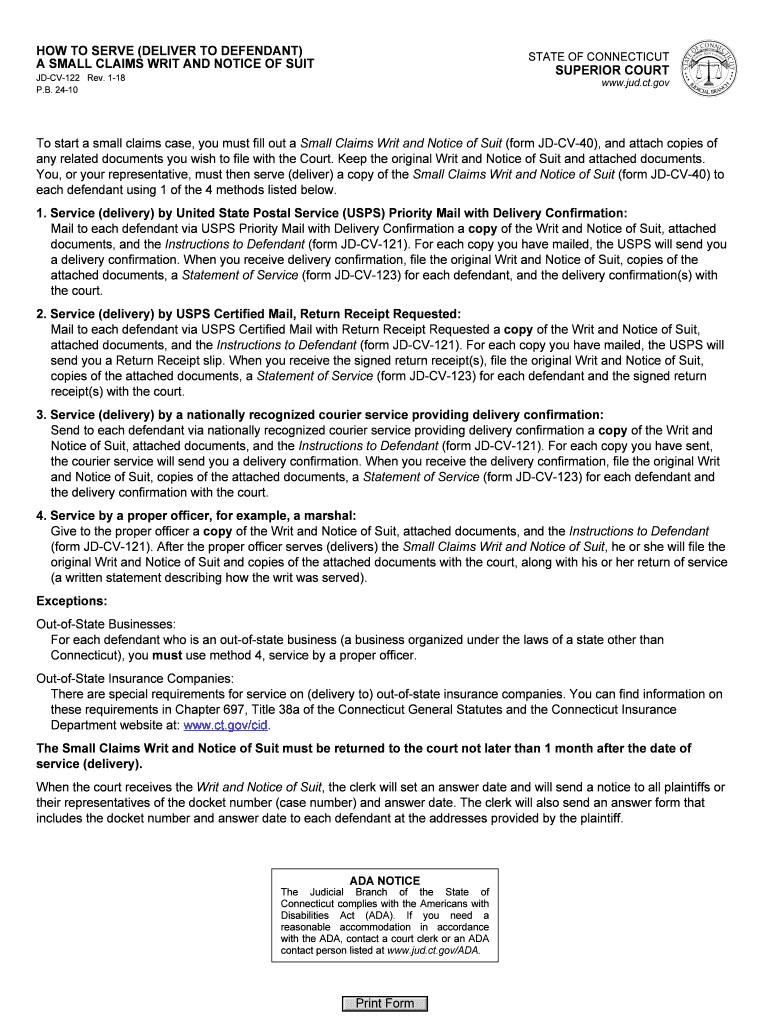
A reasonable accommodation in accordance with the ADA, contact a court clerk or an ADA contact person listed at www.jud.ct.gov/ADA/. Print Form.

Open form follow the instructions

Easily sign the form with your finger

Send filled & signed form or save
How to fill out the CT JD-CV-122 online
The CT JD-CV-122 form, known as the Small Claims Writ and Notice of Suit, is an essential document for those initiating a small claims lawsuit in Connecticut. This guide will provide step-by-step instructions on how to complete this form online, ensuring a smooth filing process.
Follow the steps to successfully complete the CT JD-CV-122 online.
- Click 'Get Form' button to access the CT JD-CV-122 form and open it in the online editor.
- Begin by entering the plaintiff's information in the designated fields. This includes your name, address, and contact information. Ensure all details are accurate and current, as this information is crucial for court correspondence.
- Next, provide the defendant's information. Input the full name, address, and any other identifying details. It is important to have correct and complete information to avoid issues with service.
- In the relevant section, specify the nature of the claim. Clearly describe the reason for the lawsuit, outlining the basis of your claim in concise terms. This will help the court understand the context for your filing.
- Attach any required documents to support your claim. Ensure you have all necessary evidence ready, as it needs to be submitted along with the form.
- Review all filled fields for accuracy before submission. It is essential to check for typos or incorrect information, as these can delay the filing process.
- Once you are satisfied with the information provided, save your changes. You can then choose to download, print, or share the form as needed to complete the filing process.
Complete your documents online to ensure a timely and efficient filing process.
Experience a faster way to fill out and sign forms on the web. Access the most extensive library of templates available.
Related content
To start a small claims case, you must fill out a Small Claims Writ and Notice of Suit...
by TOM VILSACK — In 2004, the Animal and Plant Health Inspection Service (APHIS), housed...
Design Circumaural Supra-auricular de Costas. Fechadas • Curva de EQ para Música e...
Get answers to your most pressing questions about US Legal Forms API.
What percentage of people win in small claims court?
Winning in small claims court often depends on the specifics of your case. Generally, many people have success when they present clear evidence and a well-prepared claim, such as those filed using the CT JD-CV-122. Research shows that a substantial percentage of claimants achieve favorable outcomes. Nonetheless, it's essential to be prepared and knowledgeable about the process.
Should I sue for 500 dollars?
Deciding whether to sue for $500 requires careful consideration of the time and effort involved. Small claims court, facilitated by the CT JD-CV-122 form, makes it easier and more affordable to pursue such amounts. However, factor in any associated costs, as they can impact the overall benefit of your claim. Ultimately, if the claim is valid and you're willing to proceed, it could be worth it.
What is the lowest amount for small claims court?
The lowest amount you can file for in small claims court varies by state. In Connecticut, this amount is typically $5,000. However, you'll want to reference the specific guidelines for the CT JD-CV-122 form, as it pertains to small claims procedures. This form is an essential tool in initiating your claim.
How to fill out the back of CT title?
Filling out the back of the CT title involves providing all necessary information accurately, such as the buyer's information and the sale date. Ensure you use the CT JD-CV-122 form to guide you through the process. Additionally, it’s smart to verify if any other paperwork is needed to avoid any delays during the transaction.
How to serve a small claims writ and notice of suit in CT?
To serve a small claims writ and notice of suit in Connecticut, you must ensure that the documents are delivered to the defendant properly. You can do this via a state marshal or process server, which is an effective way to ensure legal procedures are followed. This step is essential for your case, as proper service allows you to move forward with your claim confidently.
What is the statute of limitations in CT for small claims court?
In Connecticut, the statute of limitations for small claims is typically six years for most claims. This means you must file your suit within six years of the incident that prompted your claim. Knowing this timeline is crucial for ensuring you take action promptly and do not miss your opportunity to seek resolution.
Do I need to wear a suit to small claims court?
While it is not required to wear a suit to small claims court in Connecticut, dressing neatly is advisable. The atmosphere is professional, and looking presentable can help you feel more confident. You should focus on being respectful and prepared, which can positively influence how your case is perceived.
How to fill out a CT registration and title application?
To fill out the CT registration and title application, you will need the CT JD-CV-122 form, which requires information about the vehicle, including its make, model, and VIN. Ensure you provide accurate personal details, along with any necessary documentation, such as proof of identity and residency. You can easily obtain this form through U.S. Legal Forms, which simplifies the process with clear instructions.
What is the largest amount of compensation in the small claims court?
The largest amount of compensation you can seek in small claims court is determined by state rules, which often limit claims to a few thousand dollars. In some states, this cap may be as high as $10,000. Before proceeding, check your state’s guidelines, as this will help you utilize resources like the CT JD-CV-122 effectively in your claim. Overall, small claims courts provide a straightforward avenue for resolving disputes without extensive legal procedures.
What is the maximum amount you can sue for in civil court?
In civil court, the maximum amount you can sue for varies by jurisdiction and the type of claim. Typically, general civil courts allow for larger claims than small claims courts, which usually have caps. To understand the specifics in your area, look into state guidelines or consult resources like the CT JD-CV-122. Being informed will help you choose the right court for your situation.
Use professional pre-built templates to fill in and sign documents online faster. Get access to thousands of forms.
If you believe that this page should be taken down, please follow our DMCA take down process here.
This form is available in several versions. Select the version you need from the drop-down list below.