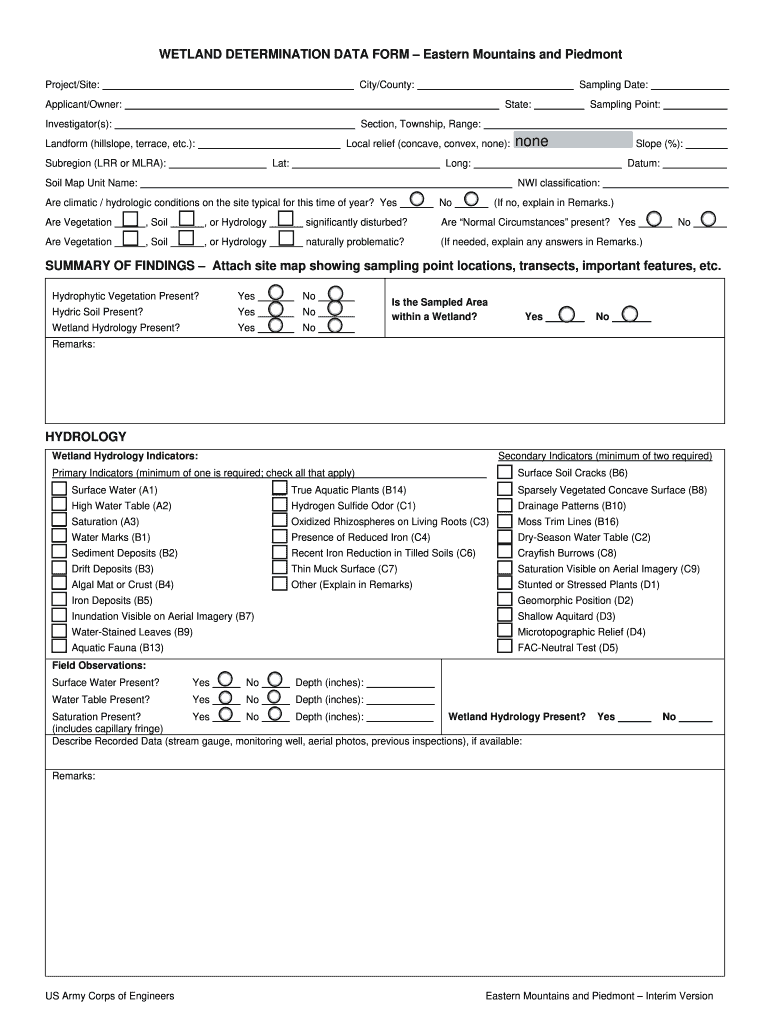
L relief (concave, convex, none): Landform (hillslope, terrace, etc.): Subregion (LRR or MLRA): Lat: none Slope (%): Long: Datum: Soil Map Unit Name: NWI classification: Are climatic / hydrologic conditions on the site typical for this time of year? Yes No (If no, explain in Remarks.) Are Vegetation , Soil , or Hydrology significantly disturbed? Are “Normal Circumstances” present? Yes Are Vegetation , Soil , or Hydrology naturally problematic? (If needed, explain any ans.
Loading

Open form follow the instructions

Easily sign the form with your finger

Send filled & signed form or save
How to fill out the Wetland Determination Data Form - Eastern Mountains and Piedmont online
Completing the Wetland Determination Data Form for the Eastern Mountains and Piedmont can seem daunting, but with clear guidance, you can fill it out effectively. This guide offers step-by-step instructions to help you navigate through the form confidently.
Follow the steps to complete your form online.
- Click ‘Get Form’ button to access the Wetland Determination Data Form for the Eastern Mountains and Piedmont.
- Fill in the project information, including 'City/County,' 'Project/Site,' 'Sampling Date,' and 'Applicant/Owner.' This information identifies the specific site and parties involved.
- Provide 'Investigator(s)' names, 'Sampling Point,' and details about the 'Section, Township, Range.' Additionally, describe 'Local relief' and 'Landform' characteristics.
- Indicate the 'Lat' and 'Long' coordinates for your sampling site and the appropriate datum.
- Complete the soil map unit and NWI classification. Answer whether climatic/hydrologic conditions are typical for the season, checking 'Yes' or 'No.' If 'No,' provide an explanation in 'Remarks.'
- Assess whether vegetation, soil, or hydrology is significantly disturbed and whether 'Normal Circumstances' are present, marking the appropriate options. Use 'Remarks' for clarifications.
- In the summary section, attach a site map indicating sampling point locations and significant features. Assess the presence of 'Hydrophytic Vegetation,' 'Hydric Soil,' and 'Wetland Hydrology,' checking 'Yes' or 'No' as applicable.
- For the hydrology section, identify indicators, differentiating between primary and secondary indicators of wetland hydrology, checking all that apply.
- Complete the vegetation section by documenting the five strata: Tree, Sapling, Shrub, Herb, and Woody Vine, including the scientific names and relevant data for each.
- Describe the soil profile, including depth, color, and texture, and assess whether hydric soil indicators are present.
- Finally, review all information entered in the form for accuracy. You can choose to save your changes, download, print, or share your completed form as needed.
Begin filling out the Wetland Determination Data Form online today for a streamlined experience.
Experience a faster way to fill out and sign forms on the web. Access the most extensive library of templates available.
Related content
WETLAND DETERMINATION DATA FORM – Eastern Mountains and Piedmont Region ... Eastern...
Eastern Mountains and Piedmont – Interim Version. WETLAND DETERMINATION DATA FORM –...
May 16, 2007 — The Eastern Highlands region presents the most concerns, with only 18% of...
Get answers to your most pressing questions about US Legal Forms API.
What is the 50/20 rule in wetland delineation?
The 50/20 rule in wetland delineation specifies that wetland areas must demonstrate certain characteristics, including specific vegetation and soil types over a defined percentage of the area. Specifically, at least 50% of the area should exhibit wetland traits, with hydric soils present across 20% of the site. Utilizing the Wetland Determination Data Form- Eastern Mountains and Piedmont can facilitate your understanding and application of this rule.
What are the parameters for wetland delineation?
Parameters for wetland delineation include evaluating hydrological conditions, assessing soil types, and identifying plant communities. Each factor plays a critical role in determining whether an area is classified as a wetland. To ensure accuracy in this assessment, the Wetland Determination Data Form- Eastern Mountains and Piedmont serves as an essential tool, guiding you through the necessary evaluations.
What is the 50/20 rule for wetlands?
The 50/20 rule refers to a guideline used in determining wetland boundaries based on specific vegetation and soil features. According to this rule, if an area has wetland characteristics across at least 50% of its area, it may qualify for wetland status, complemented by the 20% threshold for hydric soils. Using the Wetland Determination Data Form- Eastern Mountains and Piedmont can help clarify how this rule applies to your property.
How to get a wetlands determination?
To obtain a wetlands determination, you must approach the relevant environmental authority or agency that oversees wetland regulations. This process usually requires submitting forms, such as the Wetland Determination Data Form- Eastern Mountains and Piedmont, which helps present your case effectively. Engaging with professionals who specialize in wetland assessments can further simplify this process.
What are the three wetland delineation criteria?
The three criteria used for wetland delineation include hydrology, soil type, and vegetation. Specifically, an area must demonstrate signs of wetland hydrology, possess hydric soils, and support wetland plant species. Understanding these criteria is vital, and utilizing the Wetland Determination Data Form- Eastern Mountains and Piedmont can assist you in accurately assessing these features.
How do I get a wetland delineation certificate?
Obtaining a wetland delineation certificate involves a thorough examination of the site to identify wetland boundaries. You typically need to hire a professional who specializes in wetland delineation. By using the Wetland Determination Data Form- Eastern Mountains and Piedmont, you can streamline this process and ensure that all necessary data is collected for your application.
What is a jurisdictional determination of wetlands?
A jurisdictional determination of wetlands is an assessment that identifies whether a particular area meets the legal criteria for being classified as a wetland. This designation is crucial because it affects land use and development regulations. By completing a Wetland Determination Data Form- Eastern Mountains and Piedmont, you can clarify the status of your property and navigate any associated legal requirements.
Who determines what is a wetland?
The determination of what qualifies as a wetland typically falls to professionals, such as environmental consultants and officials from governmental agencies. These experts utilize the guidelines detailed in the Wetland Determination Data Form- Eastern Mountains and Piedmont for accurate evaluations. By engaging with certified professionals, you can ensure reliable assessments of your land's wetland status.
How do I get wetland certification?
To secure wetland certification, you typically need to submit a completed Wetland Determination Data Form- Eastern Mountains and Piedmont through a recognized agency or organization. This process may include an on-site assessment to verify wetland conditions. By using our USLegalForms platform, you can simplify this process and ensure all appropriate documents are submitted correctly.
What are the three criteria that are necessary for an area to be classified as wetland?
For an area to qualify as a wetland, it must demonstrate three specific conditions: hydrology, which involves the presence of water; hydric soils, which are waterlogged for substantial periods; and wetland vegetation, which consists predominantly of plants suited to wet environments. These criteria form the basis of the Wetland Determination Data Form- Eastern Mountains and Piedmont, helping you gain clarity about your land's designation.
Use professional pre-built templates to fill in and sign documents online faster. Get access to thousands of forms.
If you believe that this page should be taken down, please follow our DMCA take down process here.