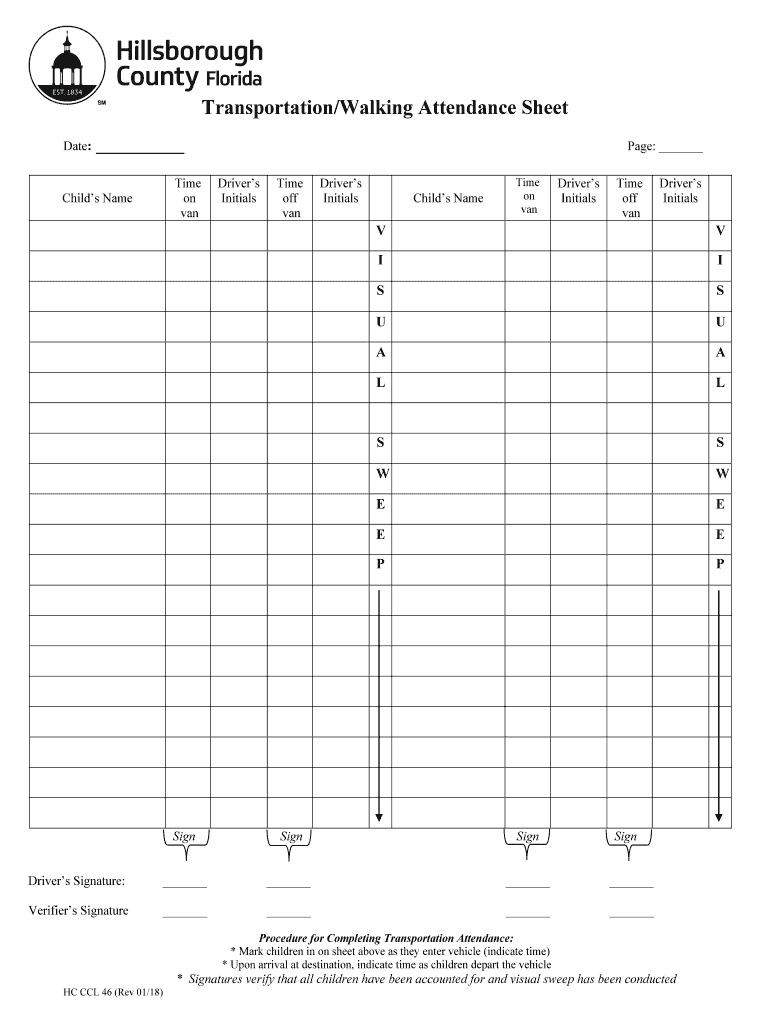
Transportation/Walking Attendance Sheet Date: Time on vanChilds NamePage: Drivers InitialsTime off vanDrivers InitialsChilds NameTime on vanVDrivers InitialsTime off vanVIISSUUAALLSSWWEEEEPPSignSignSignDrivers.
Loading

Open form follow the instructions

Easily sign the form with your finger

Send filled & signed form or save
How to fill out the FL HC CCL 46 online
The FL HC CCL 46 form is designed for tracking transportation attendance for children. Completing this form accurately ensures accountability during transport and supports safety protocols.
Follow the steps to effectively complete the FL HC CCL 46 form.
- Click ‘Get Form’ button to obtain the form and open it in the editor.
- Begin by entering the date at the top of the form to indicate when the transportation occurred.
- In the section provided, record the time the vehicle departed for the first child by noting the time under 'Time on van' next to the child's name.
- After noting the arrival time at the destination, enter the time under 'Time off van' and initial as the driver for verification.
- Repeat steps 3 and 4 for each child, ensuring to fill in every child's name, entry, and exit times accordingly.
- Conduct a visual sweep of the vehicle to ensure all children are accounted for, noting this in the signature section.
- Both the driver and the verifier must sign the signature lines at the bottom of the form to affirm the attendance record.
- Once all information is filled in, save your changes. You can then download, print, or share the form as needed.
Complete your documents online today and ensure proper transportation attendance tracking.
Experience a faster way to fill out and sign forms on the web. Access the most extensive library of templates available.
Related content
EPA followed a 3-step process to identify chemicals for inclusion on the Final CCL 5...
by SM Nguyen · 2017 · Cited by 230 — Our study serves to model ZIKV transmission in...
can be undertaken. For these reasons certain areas sf the local airspace must k regarded...
Get answers to your most pressing questions about US Legal Forms API.
What is a good HC/AC ratio?
A good head circumference to abdominal circumference (HC/AC) ratio typically lies between 1.0 and 1.1. This ratio suggests that the head and abdomen are growing proportionately, which is a positive sign for fetal development. To ensure accurate monitoring during pregnancy, it is wise to consult with professionals who understand the significance behind FL HC CCL 46 metrics.
What BPD/FL ratio indicates Down syndrome?
A biparietal diameter (BPD) to femur length (FL) ratio greater than 1.5 may indicate a risk factor for Down syndrome and should lead to further evaluation. Healthcare providers often use this ratio in conjunction with other tests and assessments to determine fetal health. Thus, if you are monitoring these parameters, stay actively engaged with your healthcare team to discuss any FL HC CCL 46 concerns.
What does FL HC mean on an ultrasound?
FL HC stands for femur length and head circumference, two critical measurements taken during ultrasound examinations. These metrics help assess your baby's size and growth trajectory throughout pregnancy. Understanding these measurements can play an important role in monitoring fetal health, making discussions with your provider essential in interpreting FL HC CCL 46 data.
What percentile is concerning for fetus?
A belly circumference below the 10th percentile may raise concerns about fetal growth. When measuring FL HC CCL 46, it’s essential to consider not just the AC but also the overall growth trends over time. Always consult with a healthcare provider if you notice any significant deviations from normal percentiles.
What is a normal HC to AC ratio?
A normal head circumference to abdominal circumference (HC/AC) ratio is about or slightly greater than 1. This ratio helps healthcare providers evaluate fetal health and growth patterns. When monitoring FL HC CCL 46, staying informed about these ratios can provide peace of mind during pregnancy.
What is normal HC AC at 20 weeks?
At 20 weeks, a typical head circumference (HC) should range from approximately 16.5 to 18.5 cm while the abdominal circumference (AC) averages between 14 to 15.5 cm. These measurements give a snapshot of your baby's development, guiding healthcare professionals in assessing overall growth. It is important to follow up regularly to ensure the FL HC CCL 46 parameters are being met.
Should HC be bigger than AC?
Yes, in most cases, the head circumference (HC) should be larger than the abdominal circumference (AC) during pregnancy. This is a normal growth pattern for a developing fetus, ensuring the head is growing proportionately. If you have concerns about FL HC CCL 46 measurements, consult with your healthcare provider for personalized advice.
What is normal HC in pregnancy?
Normal head circumference, or HC, varies with gestational age, indicating healthy brain development. Typically, healthcare providers measure this at each ultrasound to ensure your baby is developing normally. Keeping track of HC as part of the FL HC CCL 46 assessment ensures comprehensive monitoring of fetal well-being.
What is the significance of the fl/hc ratio?
The fl/hc ratio compares femur length to head circumference, providing insight into fetal growth patterns. A normal ratio suggests balanced growth, while deviations may indicate potential issues. Understanding this ratio is crucial as part of the overall assessment of FL HC CCL 46, giving you a clearer picture of your baby’s health.
Should I be worried about short femur length pregnancy?
A short femur length can raise concerns during pregnancy, but it's essential to follow up with healthcare professionals. It may indicate growth restrictions, but not always. Discussing the implications of your FL measurements with your doctor can provide clarity, especially in the context of the FL HC CCL 46, which assesses additional fetal parameters.
Use professional pre-built templates to fill in and sign documents online faster. Get access to thousands of forms.
If you believe that this page should be taken down, please follow our DMCA take down process here.