F you have more than one partner please write their names, addresses and National Insurance numbers in the ‘Additional information’ box. If you are joining an existing business partnership, please provide the partnership tax reference number Signed If you are going to do all the work for one person or firm, you may be an employee. For more information you can: • phone the Self Assessment Helpline on 0845 9000 444 or • go to any HM Revenue & Customs office. Date DD MM YYYY If you are,.
Loading

Open form follow the instructions

Easily sign the form with your finger

Send filled & signed form or save
How to fill out the UK HMRC CWF1 online
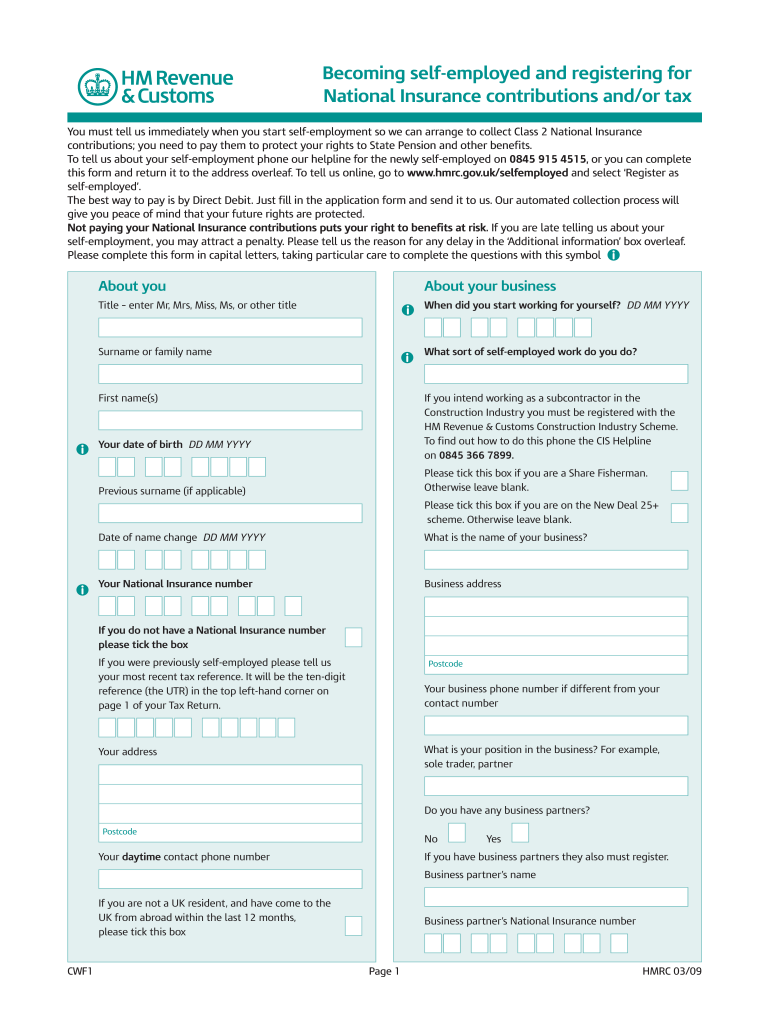
Filling out the UK HMRC CWF1 form is an essential step for individuals starting self-employment. This guide provides detailed, step-by-step instructions to help users navigate the online form effectively and efficiently.
Follow the steps to fill out the UK HMRC CWF1 form online.
- Click ‘Get Form’ button to obtain the form and open it for completion.
- Begin by filling in your title, choosing from options such as Mr, Mrs, Miss, Ms, or another title that applies to you.
- Indicate the date you began your self-employment in the format DD MM YYYY.
- Provide your surname or family name in the respective field.
- Describe the type of self-employed work you will be undertaking.
- Enter your first name(s) in the specified area.
- If applicable, indicate if you are a subcontractor in the Construction Industry and ensure you are registered with HM Revenue & Customs.
- Fill in your date of birth using the DD MM YYYY format.
- Check the box if you are a Share Fisherman; otherwise, leave it blank.
- Complete the field for your previous surname if you have changed your name.
- Tick the box if you are participating in the New Deal 25+ scheme or leave it blank if it does not apply.
- Provide the name of your business in the designated area.
- Enter your National Insurance number if you have one; check the box if you do not.
- If previously self-employed, enter your most recent tax reference number (UTR).
- Add your business address and ensure it is complete, including postcode.
- Provide a business phone number if it differs from your contact number.
- Specify your position in the business, for instance, as a sole trader or a partner.
- Indicate if you have any business partners. If yes, they also need to register.
- Complete the daytime contact phone number field.
- If applicable, provide your business partner's name and National Insurance number.
- Tick the box if you are not a UK resident and have come from abroad within the last 12 months.
- Complete the section about your business partners, including their addresses and National Insurance numbers if there are multiple partners.
- Sign and date the form, ensuring the date is completed in the format DD MM YYYY.
- Provide any additional information as required, particularly if there are special circumstances or if applicable.
- Once all fields are completed, save your changes, then download, print, or share the form as necessary.
Start filling out your UK HMRC CWF1 form online today to ensure you are registered for self-employment.
Experience a faster way to fill out and sign forms on the web. Access the most extensive library of templates available.
Related content
' Natalie's mum hmrc gov uk forms cwf1 pdf The Newly Self Employed helpline 0845 915 4515...
Get answers to your most pressing questions about US Legal Forms API.
What is the HMRC letter in the UK?
A HMRC letter in the UK typically refers to official correspondence from HM Revenue and Customs regarding your tax situation. This could include your Unique Taxpayer Reference or notifications about your tax account. Staying informed through these letters is essential for managing your tax responsibilities properly.
How do I get a unique taxpayer reference UK?
You can obtain your unique taxpayer reference in the UK by registering for Self Assessment with HMRC. This process usually involves filling out the UK HMRC CWF1 form if you are self-employed. Once your registration is processed, HMRC will send your UTR to you via post.
How do I get a taxpayer ID UK?
In the UK, a taxpayer ID is essentially your Unique Taxpayer Reference (UTR). To get your UTR, you will need to register as self-employed or for Self Assessment with HMRC. Completing the UK HMRC CWF1 form is an effective way to initiate this registration and obtain your taxpayer ID.
How do I get my tax reference number UK?
To obtain your tax reference number in the UK, you must register with HMRC for Self Assessment. Once registered, you will receive your Unique Taxpayer Reference, or UTR, through the post. If you are self-employed, completing the UK HMRC CWF1 form is a key step in this process.
Does everyone in the UK have a UTR?
Not everyone in the UK has a Unique Taxpayer Reference (UTR). A UTR is assigned to individuals who register for Self Assessment or operate as self-employed. If you need a UTR, you must complete a registration process, and the UK HMRC CWF1 form may be your starting point.
Where do I get a CWF1 form from?
You can obtain the UK HMRC CWF1 form directly from the official HMRC website. Additionally, you can visit your local HMRC office for a physical copy. If you are looking for convenience, consider using platforms like uslegalforms, which can help you navigate the process and provide guidance on completing the form.
What is the difference between CWF1 and SA1?
The UK HMRC CWF1 and SA1 forms serve different purposes. The CWF1 form is used for registering as self-employed, while the SA1 form is for individuals who need to register for Self Assessment. Knowing the difference is crucial for your tax obligations, and using the correct form ensures you comply with UK tax regulations.
Who needs to file a self-assessment tax return in the UK?
Individuals who are self-employed, or receive untaxed income, must file a self-assessment tax return. Additionally, those with investments, rental income, or who earn over a specific limit from savings often have this obligation. By understanding these criteria, you can manage your compliance effectively with UK HMRC CWF1.
How do I know if I have to fill in a self-assessment?
You will need to fill in a self-assessment tax return if you earn income from various sources that are not taxed at source. This includes self-employment income, rental income, or if your overall income exceeds certain thresholds. To determine your specific circumstances regarding the UK HMRC CWF1, consulting with a tax advisor can provide personalized insights.
What is CWF1?
The CWF1 form is used by individuals registering as self-employed in the UK. It's part of the process to notify HMRC about your self-employment status and enables you to fulfill your tax obligations correctly. Completing the CWF1 form is an important step in ensuring compliance with UK tax regulations.
Use professional pre-built templates to fill in and sign documents online faster. Get access to thousands of forms.
If you believe that this page should be taken down, please follow our DMCA take down process here.
This form is available in several versions. Select the version you need from the drop-down list below.