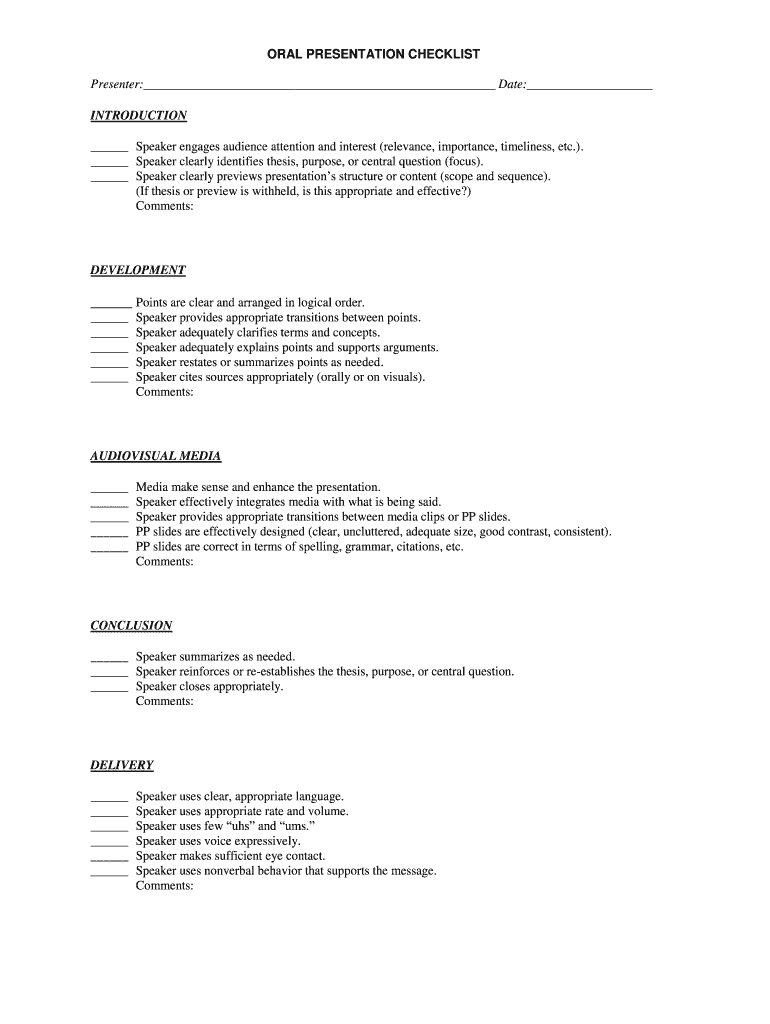
ORAL PRESENTATION CHECKLIST Presenter: Date: INTRODUCTION Speaker engages audience attention and interest (relevance, importance, timeliness, etc.). Speaker clearly identifies thesis, purpose, or.

Open form follow the instructions

Easily sign the form with your finger

Send filled & signed form or save
How to use or fill out the Hamilton College Oral Presentation Checklist online
The Hamilton College Oral Presentation Checklist is a valuable tool for presenters to evaluate and enhance their presentations. This guide provides a step-by-step approach to completing the checklist, ensuring users can effectively assess their speaking skills and presentation quality.
Follow the steps to complete the checklist online
- Click ‘Get Form’ button to access the checklist and open it in your preferred online editor.
- Begin filling in the presenter’s name and the date at the top of the checklist. Ensure accurate information to maintain proper record-keeping.
- In the introduction section, evaluate how well the speaker engages the audience. Mark off the relevant boxes regarding audience attention, thesis clarity, and presentation structure.
- Proceed to the development section. Here, review the clarity and order of the points made by the speaker. Mark the appropriate boxes that reflect the speaker's transitions, term clarifications, and supportive arguments.
- In the audiovisual media section, assess the effectiveness of any media used during the presentation. Check the boxes indicating whether the media enhances the presentation and is well integrated with the spoken content.
- Next, evaluate the conclusion. Ensure the speaker summarizes key points, reinforces the main thesis, and closes the presentation effectively. Check the boxes accordingly.
- Finally, review the delivery section. Analyze the speaker's language use, volume, pacing, and engagement with the audience through eye contact and nonverbal behavior. Mark the relevant boxes that demonstrate effective delivery.
- Once all sections are completed, be sure to save the changes made to the checklist. You may also choose to download, print, or share the completed document as needed.
Start filling out the Hamilton College Oral Presentation Checklist online today to enhance your presentation skills!
Experience a faster way to fill out and sign forms on the web. Access the most extensive library of templates available.
Related content
Aug 8, 2011 — An evaluation rubric has been developed to assess the content...
Speaker engages audience attention and interest (relevance, importance, timeliness, etc.)...
We are delighted to present the 2019 edition of the European Association of Urology (EAU)...
Get answers to your most pressing questions about US Legal Forms API.
What are the 3 types of presentation?
Types of Presentations Informative. Keep an informative presentation brief and to the point. ... Instructional. Your purpose in an instructional presentation is to give specific directions or orders. ... Arousing. ... Persuasive. ... Decision-making.
What is the three step oral presentation process?
Oral presentations typically involve three important steps: 1) planning, 2) practicing, and 3) presenting.
What should be included in an oral presentation?
This is where you 1) capture your audience's interest, 2) give them a context for your work, 3) pose your central question, problem, or issue, and 4) offer the most concise answer or argument you can give. Remember, this is an introduction, not a summary.
How do you structure an oral presentation?
Just like other forms of academic writing, a presentation can be divided into three parts: an introduction detailing the purpose and structure of the talk; a body covering the main points; and a conclusion summarising and highlighting the significance of your talk.
What are the 3 key aspects of presentation?
There are three key elements of good presentations: Content, Organization, Delivery. Your audience needs interesting and appropriate content in order to pay attention, especially at the start of a presentation.
What are the 4 major steps in oral presentation?
Steps for Planning Your Oral Presentation Determine your reasoning for this presentation. Is your purpose to inform, educate, entertain or convince? ... Keep only the most important information. Determine what your topic will be and the areas that you plan to touch upon. Know your Audience. ... Create an Outline. ... Practice.
What 3 main sections does an oral presentation consist of?
All types of presentations consist of three basic parts: the introduction, the body, and the conclusion. In general, the introduction should be about 10-15% of your speaking time, the body around 75%, and the conclusion only 10%.
Use professional pre-built templates to fill in and sign documents online faster. Get access to thousands of forms.
If you believe that this page should be taken down, please follow our DMCA take down process here.