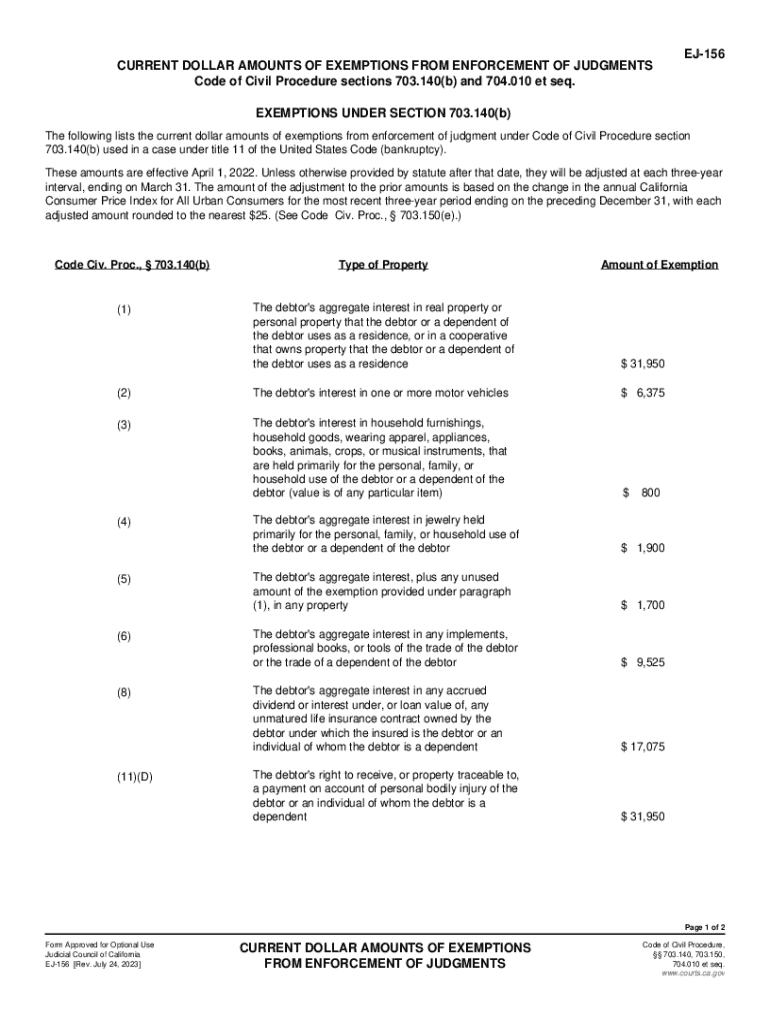
Rrent dollar amounts of exemptions from enforcement of judgment under Code of Civil Procedure section 703.140(b) used in a case under title 11 of the United States Code (bankruptcy). These amounts are effective April 1, 2022. Unless otherwise provided by statute after that date, they will be adjusted at each three-year interval, ending on March 31. The amount of the adjustment to the prior amounts is based on the change in the annual California Consumer Price Index for All Urban Consumers for th.
Loading

Open form follow the instructions

Easily sign the form with your finger

Send filled & signed form or save
How to fill out the CA EJ-156 online
The CA EJ-156 form provides essential information regarding current dollar amounts of exemptions from enforcement of judgments in California. This guide will help you understand how to fill out the form accurately and efficiently to meet your needs.
Follow the steps to complete the CA EJ-156 form online
- Click 'Get Form' button to access the CA EJ-156 and open it for completion.
- Review the title to ensure you are working with the correct form, CA EJ-156, which pertains to exemptions from enforcement of judgments.
- Locate the section that outlines the current dollar amounts of exemptions under Code of Civil Procedure sections 703.140(b) and 704.010 et seq. Ensure that you are aware of the specific amounts related to different types of property.
- Fill in your information where applicable. You may need to provide details concerning your personal situation and the type of exemptions you are claiming based on your assets.
- Review all filled fields for accuracy, ensuring that the amounts listed correspond with your property and compliance with the exemptions specified.
- Once you have completed all relevant sections, you can save your changes, download the form for your records, print it for submission, or share it as required.
Begin filling out your CA EJ-156 form online today to ensure you understand your exemptions.
Experience a faster way to fill out and sign forms on the web. Access the most extensive library of templates available.
Related content
List of the current dollar amount of exemptions listed in form EJ-155. Get form EJ-156...
CARB's mission is to promote and protect public health, welfare, and ecological resources...
Form Approved for Optional Use. Judicial Council of California. EJ-156 [Revised April 1...
Get answers to your most pressing questions about US Legal Forms API.
How long can a Judgement be enforced in California?
Money judgments automatically expire (run out) after 10 years. To prevent this from happening, you as the judgment creditor must file a request for renewal of the judgment with the court BEFORE the 10 years run out.
What personal property can be seized in a judgement in California?
Personal Property Levies as a Judgment Collection Tool A personal property levy allows a creditor to obtain possession of much of the debtor's property in California (e.g., equipment, inventory, vehicles, cash in cash registers), excluding real property and property held by third parties.
What is exempt from debt collection in California?
Exemption from the Enforcement of Judgments Type of PropertyCode Social Security Direct Deposit Accounts (the account itself) CCP § 704.080 Wages CCP § 704.070 Public Assistance (Welfare) CCP § 704.170 W&I § 17409 Charity; Fraternal Benefit Funds CCP § 704.17027 more rows
How long do you have to pay a judgment in California?
The Judgment Debtor has 30 days from the mailing of the entry of judgment to pay you the money, or do one of the following: File an SC-220 request for time payments and the EJ-165 Financial Statement. File an SC-140 Appeal. If they did not appear, file an SC-135 Motion to Vacate Judgment.
What property is exempt from judgement in California?
(a) Household furnishings, appliances, provisions, wearing apparel, and other personal effects are exempt in the following cases: (1) If ordinarily and reasonably necessary to, and personally used or procured for use by, the judgment debtor and members of the judgment debtor's family at the judgment debtor's principal ...
What happens if a defendant does not pay a judgment in California?
If you do not pay the judgment, the judgment creditor can sell your real property. The judgment creditor can get an order to sell your land, buildings, or home. Before your home can be sold, there must be a hearing to let you prove that you or your family live there.
Can you go to jail for not paying a judgement in California?
If you have been served with an Order to Appear and fail to go to the hearing and have not paid the judgment, including post-judgment costs and interest, a bench warrant may be issued for your arrest.
Use professional pre-built templates to fill in and sign documents online faster. Get access to thousands of forms.
If you believe that this page should be taken down, please follow our DMCA take down process here.