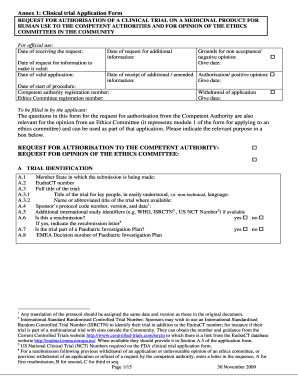
Annex 1 Clinical trial Application Form REQUEST FOR AUTHORISATION OF A CLINICAL TRIAL ON A MEDICINAL PRODUCT FOR HUMAN USE TO THE COMPETENT AUTHORITIES AND FOR OPINION OF THE ETHICS COMMITTEES IN THE COMMUNITY For official use Date of receiving the request Date of request for information to make it valid Date of valid application information Grounds for non acceptance/ negative opinion Give date Date of receipt of additional / amended Authorisati.
Open form follow the instructions
Easily sign the form with your finger
Send filled & signed form or save
How to fill out the Annex 1: Clinical Trial Application Form online
Filling out the Annex 1 Clinical Trial Application Form is crucial for obtaining approval for clinical trials involving medicinal products. This guide provides step-by-step instructions to help you complete the form with confidence, ensuring that all necessary information is accurately submitted.
Follow the steps to fill out the Clinical Trial Application Form online.
- Click 'Get Form' button to obtain the form and open it in the editor.
- Begin with Section A: Trial Identification. Enter the Member State for submission, EudraCT number, full title of the trial, and any additional study identifiers. Ensure that the trial title is clearly defined both technically and in layman's terms for easier understanding.
- Proceed to Section B: Identification of the Sponsor. Fill in the sponsor’s organizational name, contact person’s name, contact details, and whether a legal representative is involved. Provide all necessary contact information, including email and telephone.
- In Section C, indicate the applicant type and provide the required details for the applicant, including organizational names, addresses, and whether to receive a copy of the CTA data as XML.
- Continue to Section D, which focuses on Information on Each Investigational Medicinal Product (IMP). Complete each subsection regarding the IMP identification, status, description, and other relevant details as required for each product involved in the trial.
- Move on to Section E: General Information on the Trial. Outline the aims, objectives, inclusion and exclusion criteria, and the primary and secondary endpoints of the trial, ensuring clarity in all descriptions.
- Fill out Section F regarding Population of Trial Subjects, specifying age ranges, gender, and any vulnerable populations that will be included in the trial.
- Complete Section G with details related to clinical trial sites and investigators. You will need to provide comprehensive information about the coordinating and principal investigators, along with any central facilities involved.
- Finally, in Section H, provide the necessary details about the competent authority or ethics committee receiving the application and attach your signature in Section I, confirming the accuracy and completeness of the information provided.
- Once all sections are completed, save your changes, and ensure the form is thoroughly reviewed before downloading, printing, or sharing it as required.
Complete your Clinical Trial Application Form online today to ensure the success of your trial!
Experience a faster way to fill out and sign forms on the web. Access the most extensive library of templates available.
Related content
ANVISA is the regulatory authority responsible for clinical trial oversight, approval, and...
Prior to the beginning of the trial, the investigator should obtain the IEC's written...
Apr 3, 2020 — • Annex 1 – In Vivo Study Designs. • Annex 2 – Alternative Assays...
Get answers to your most pressing questions about US Legal Forms API.
How do you get enrolled in a clinical trial?
To get enrolled in a clinical trial, you typically need to find a trial that suits your health condition and meets eligibility criteria. This process may involve discussing your options with a healthcare provider, who can guide you to appropriate trials. Platforms like US Legal Forms can help you navigate the application forms and requirements necessary for enrollment.
What is the clinical trial application?
The clinical trial application refers to the comprehensive package of documents submitted to gain approval for initiating a trial. This application must follow the stipulations laid out in Annex 1: Clinical Trial Application Form. It is essential for ensuring that the trial is compliant with quality standards and regulations in place.
What is a clinical application?
A clinical application generally pertains to the use of research findings in practical health care settings. It involves applying evidence from clinical trials to improve treatment methodologies and outcomes. This concept bridges the gap between research and actual clinical practice, enhancing patient care.
What is a clinical trial application?
A clinical trial application is a complete submission that researchers provide to regulatory bodies for permission to conduct a trial. It typically includes details about the trial’s purpose, design, methodology, and participant safety. By submitting this application, researchers aim to demonstrate that they are ready to conduct their trial responsibly and ethically.
What is the main purpose of a clinical trial?
The primary purpose of a clinical trial is to evaluate new treatments, drugs, or interventions for safety and effectiveness. Trials gather essential data on how these treatments impact participants, helping researchers make informed decisions about their use. Ultimately, clinical trials aim to improve patient care and outcomes.
What is annex 1 in clinical trials?
Annex 1 refers specifically to the section of the regulatory guideline that outlines the requirements for a Clinical Trial Application Form. This annex provides essential information regarding the information that sponsors must submit to obtain approval for the trial. Understanding Annex 1: Clinical Trial Application Form is crucial for complying with regulations.
What is CTA application?
A Clinical Trial Application (CTA) is a formal request submitted to regulatory authorities to initiate a clinical trial. It includes detailed information about the study's design, objectives, and methodologies. The CTA ensures that the clinical trial meets all safety and regulatory standards to protect participants.
What is a CTA in clinical trials?
In clinical trials, a CTA refers to the Clinical Trial Application, which is essential for obtaining the necessary permissions to conduct research involving human subjects. This application includes comprehensive details about the study’s design, safety measures, and expected outcomes. The Annex 1: Clinical Trial Application Form is vital in consolidating this information to facilitate regulatory review.
What is the difference between a CTA and IND submission?
A CTA, or Clinical Trial Application, is the term used primarily in the EU, while an IND, or Investigational New Drug application, is common in the US. Both serve similar purposes in seeking permission to begin clinical trials, but they have different regulatory frameworks. Understanding these differences is crucial, and using the Annex 1: Clinical Trial Application Form can help align your submission with the appropriate standards.
What are the phases of clinical trials in the EU?
In the EU, clinical trials generally progress through four distinct phases: Phase 1 focuses on safety and dosage, Phase 2 emphasizes efficacy and side effects, Phase 3 compares the new treatment with standard treatments, and Phase 4 involves post-marketing surveillance. Each phase is designed to progressively gather more information about the treatment. Completing the Annex 1: Clinical Trial Application Form ensures that you address all regulatory requirements associated with these phases.
Use professional pre-built templates to fill in and sign documents online faster. Get access to thousands of forms.
If you believe that this page should be taken down, please follow our DMCA take down process here.