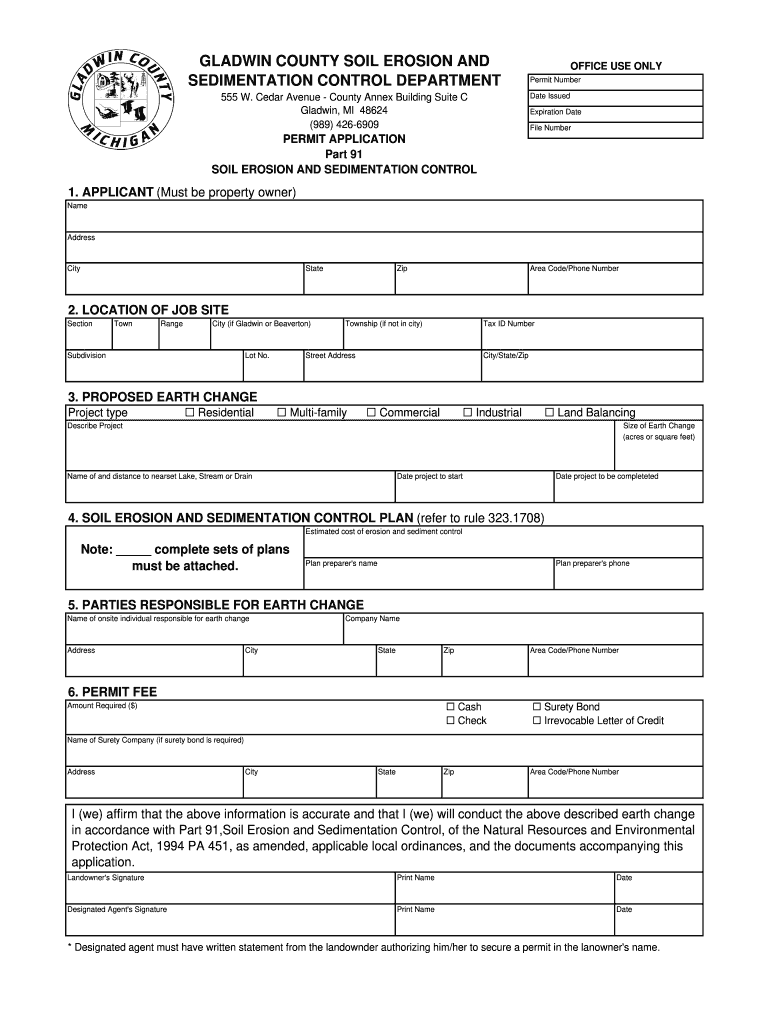
Ion Date File Number PERMIT APPLICATION Part 91 SOIL EROSION AND SEDIMENTATION CONTROL 1. APPLICANT (Must be property owner) Name Address State City Zip Area Code/Phone Number 2. LOCATION OF JOB SITE Section Town Range City (if Gladwin or Beaverton) Subdivision Lot No. Township (if not in city) Tax ID Number Street Address City/State/Zip 3. PROPOSED EARTH CHANGE Project type Residential Multi-family Commercial Industrial Land Balancing Describe Project Size of Earth Chan.
Loading

Open form follow the instructions

Easily sign the form with your finger

Send filled & signed form or save
How to fill out the MI Permit Application - Soil Erosion and Sedimentation Control online
Filling out the MI Permit Application for Soil Erosion and Sedimentation Control online can be straightforward with proper guidance. This guide outlines each section of the application, providing clear instructions to ensure a complete and accurate submission.
Follow the steps to successfully complete your application.
- Click ‘Get Form’ button to obtain the form and open it in the editor.
- Begin with the 'Applicant' section. Enter the name of the property owner, along with their address, including the state, city, zip code, and area code with phone number.
- Proceed to the 'Location of Job Site' section. Provide detailed information, including the section, town, range, city, subdivision, lot number, township (if applicable), tax ID number, and the street address along with the city, state, and zip code.
- In the 'Proposed Earth Change' section, indicate the type of project by choosing from residential, multi-family, commercial, industrial, or land balancing. Describe the project in detail, including the size of the earth change (in acres or square feet) and the name and proximity to the nearest lake, stream, or drain. Additionally, specify the expected start and completion dates of the project.
- Next, fill out the 'Soil Erosion and Sedimentation Control Plan' section. Provide the estimated cost for erosion and sediment control and attach complete sets of plans as required. Include the name and contact number of the plan preparer.
- In the 'Parties Responsible for Earth Change' section, enter the name and address of the on-site individual accountable for the earth change, along with their company name and contact details.
- Complete the 'Permit Fee' section by indicating the amount required. Specify the payment method: cash, check, surety bond, or irrevocable letter of credit. If a surety bond is required, provide the name, address, and contact number of the surety company.
- Finally, ensure the application is signed by the landowner and/or designated agent, following the requirements for authorization. Dates must also be included.
- After completing the form, save changes, then download or print the document for your records. Make sure to share it if necessary.
Complete your documents online for a streamlined filing experience.
Experience a faster way to fill out and sign forms on the web. Access the most extensive library of templates available.
Related content
A permit is generally required for any earth change activity which disturbs one or more...
The Grading, and Soil Erosion and Sedimentation Control Permit Application must be...
Feb 12, 2005 — EROSION CONTROL APPLICATION CRITERIA ... Temporary erosion control...
Get answers to your most pressing questions about US Legal Forms API.
What are the requirements for a soil erosion permit in Michigan?
In Michigan, obtaining a soil erosion permit involves submitting an erosion and sediment control plan and a completed application form. Applicants must also comply with local ordinances and guidelines specific to their project. For a smooth process with the MI Permit Application - Soil Erosion and Sedimentation Control, consider using uslegalforms to access the necessary forms and ensure your application meets all requirements.
What are erosion and sediment control techniques?
Erosion and sediment control techniques include practices such as grass seeding, mulching, and constructing retention ponds. Each technique serves to stabilize soil and reduce the movement of sediment during rainfall or construction activities. When completing the MI Permit Application - Soil Erosion and Sedimentation Control, make sure to identify the techniques you plan to implement for compliance.
What is an example of erosion and sediment control?
An example of erosion and sediment control is the installation of silt fences around a construction site. These barriers capture sediment from runoff, preventing it from entering nearby streams or ponds. When applying for your MI Permit Application - Soil Erosion and Sedimentation Control, you may include such examples in your plan to demonstrate effective strategies.
What are soil erosion and control measures?
Soil erosion control measures refer to various practices like silt fences, retention basins, and vegetation that help minimize soil erosion. These measures aim to keep soil in place and reduce the amount of sediment that enters waterways. To comply with regulations, consider the MI Permit Application - Soil Erosion and Sedimentation Control as a valuable resource in selecting appropriate measures for your project.
What are soil erosion and sediment controls?
Soil erosion and sediment controls are techniques and practices designed to prevent soil from being swept away by water or wind. These controls mitigate negative impacts on the environment and protect nearby water bodies from sedimentation. By understanding and implementing the MI Permit Application - Soil Erosion and Sedimentation Control, you can effectively safeguard your project from erosion-related issues.
What is the erosion and sediment control plan?
The erosion and sediment control plan outlines the strategies and practices to minimize soil erosion and manage sediment during construction or land development. It includes techniques such as vegetation, barriers, and proper drainage systems. When you complete the MI Permit Application - Soil Erosion and Sedimentation Control, ensure your plan meets local requirements for effective management.
Who prepares the erosion and sediment control plan?
Typically, a professional engineer or a qualified soil erosion control specialist prepares the erosion and sediment control plan. This expert assesses the site and identifies necessary strategies to mitigate soil erosion effectively. Utilize the MI Permit Application - Soil Erosion and Sedimentation Control for guidance and templates to develop your plan correctly.
What is an erosion control permit?
An erosion control permit is a legal authorization required for projects that may disturb soil and potentially lead to erosion. This permit ensures that proper measures are in place to prevent sediment runoff into surrounding areas. Engaging in the MI Permit Application - Soil Erosion and Sedimentation Control process helps you comply with local regulations and protect the environment.
How do you fill in soil erosion?
To effectively fill in soil erosion, start by excavating the eroded zone to create an even surface. Then, layer in high-quality topsoil to promote quick plant growth. It's crucial to incorporate erosion control measures like silt fences or erosion blankets to prevent future issues. For guidance and application support related to your MI Permit Application - Soil Erosion and Sedimentation Control, explore the tools offered by US Legal.
How to fill in soil erosion?
Filling in soil erosion involves assessing the affected area and determining the appropriate materials for restoration. Begin by removing any debris and adding suitable soil amendments to promote healthy growth. After filling, it's essential to apply hydroseeding or sod to establish vegetation that will stabilize the area. For help with licenses and forms for your MI Permit Application - Soil Erosion and Sedimentation Control, the US Legal platform can be a valuable resource.
Use professional pre-built templates to fill in and sign documents online faster. Get access to thousands of forms.
If you believe that this page should be taken down, please follow our DMCA take down process here.