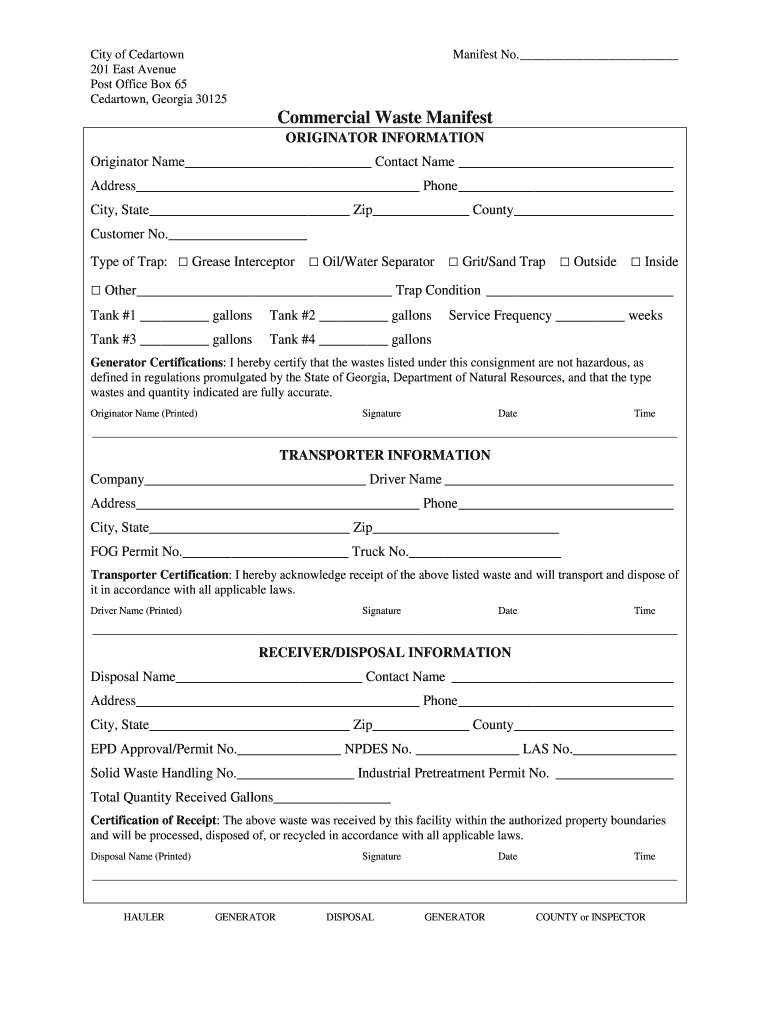
____________ Contact Name _______________________________ Address_________________________________________ Phone _______________________________ City, State_____________________________ Zip______________ County_______________________ Customer No.____________________ Type of Trap: □ Grease Interceptor □ Oil/Water Separator □ Grit/Sand Trap □ Outside □ Inside □ Other_____________________________________ Trap Condition ___________________________ Tank #1 __________ gallons Tank #2 __.
Loading

Open form follow the instructions

Easily sign the form with your finger

Send filled & signed form or save
How to fill out the GA Commercial Waste Manifest online
The GA Commercial Waste Manifest is an essential document for managing the disposal of commercial waste in Georgia. This guide provides clear, step-by-step instructions to help users complete the form accurately and efficiently online.
Follow the steps to complete the form correctly.
- Click ‘Get Form’ button to access the form and open it in the online editor.
- In the 'Originator Information' section, fill in your name and contact details. Ensure to provide an accurate address, contact number, city, state, zip code, and county.
- Select the type of trap by checking the appropriate box for Grease Interceptor, Oil/Water Separator, Grit/Sand Trap, Outside, Inside, or Other. You may also specify the type of trap in the 'Other' field if applicable.
- Indicate the condition of the trap in the designated field.
- Provide the capacity of each tank by entering the number of gallons for Tank #1 through Tank #4. Make sure to only input relevant data.
- Specify the service frequency in weeks to ensure proper scheduling for waste collection.
- In the 'Generator Certifications' section, read the statement regarding hazardous waste. Confirm that the waste is not hazardous by signing and dating the form where indicated.
- Next, move to the 'Transporter Information' section. Fill in the transport company name and driver details, including their contact number, address, city, state, and zip code.
- Enter the FOG Permit Number and Truck Number associated with the transport vehicle.
- Agree to the transporter certification by signing and dating the form.
- Then, proceed to the 'Receiver/Disposal Information' section. Provide the disposal facility's name and contact details.
- Fill in all applicable approval and permit numbers, including the EPD Approval/Permit No., NPDES No., and LAS No.
- Indicate the total quantity received in gallons to finalize the disposal details.
- Complete the certification of receipt by signing and dating the form in the disposal name section.
- Finally, review all entries for accuracy, and once satisfied, save the changes, download, print, or share the completed form as necessary.
Complete your forms online today to streamline your commercial waste management process.
Experience a faster way to fill out and sign forms on the web. Access the most extensive library of templates available.
Related content
US EPA revised the Hazardous Waste Manifest Forms used to track hazardous waste from a...
(10) Manifest Contents. A commercial waste transporter shall ensure that the manifest...
As part of the toxicity source evaluation, POTW staff can request industrial users to...
Get answers to your most pressing questions about US Legal Forms API.
How do I fill out a waste profile?
Filling out a waste profile involves providing detailed information about the specific type of waste generated, including its characteristics and potential hazards. This profile is vital for creating a GA Commercial Waste Manifest, ensuring proper handling and disposal of the waste. Accurate and thorough completion of the waste profile helps in complying with safety regulations and streamlining the disposal process. Consider using templates available on platforms like USLegalForms to guide you.
What information is included on a manifest?
A GA Commercial Waste Manifest includes essential details such as the generator's name and address, waste type, quantity, and the transporter’s details. It serves as a legal document that tracks the movement of waste, ensuring accountability and compliance with regulations. All parties should have access to this information to facilitate smooth transactions and safeguard against regulatory infractions. USLegalForms offers resources to help you correctly compile this information.
What three items need to be checked on the waste manifest?
When reviewing a GA Commercial Waste Manifest, it's crucial to check the waste's description, quantity, and the generator's contact information. These elements ensure that the waste is handled correctly and that all parties involved have the necessary details for compliance. Checking these items helps prevent issues and ensures a smoother waste disposal process. Make sure your documentation is complete to avoid legal complications.
How do you complete a manifestation?
Completing a manifestation involves documenting the transport of waste from its point of generation to its disposal site using a GA Commercial Waste Manifest. You need to accurately fill in specific details, including the generator's information, waste type, and the transport company's details. Each section must be clear and precise to ensure compliance with regulations. If you need assistance, consider using online tools that help streamline this process.
How to complete a manifest?
To complete a GA Commercial Waste Manifest, you must gather all pertinent information about the waste, including its type, quantity, and origin. Fill in the sections accurately, ensuring you follow the state's guidelines for hazardous materials. This process ensures that your waste is documented correctly, facilitating safe and compliant disposal. Utilizing platforms like USLegalForms can simplify this task by providing templates and guidance.
What does CF mean on a manifest?
In the context of a GA Commercial Waste Manifest, CF refers to 'Cubic Feet.' This measurement helps determine the volume of waste being transported. It's essential to accurately report this value to comply with regulations and ensure proper disposal. Understanding these abbreviations aids in the efficient processing of your waste documentation.
What is the difference between a bill of lading and a waste manifest?
The primary difference between a bill of lading and a waste manifest lies in their purposes. A bill of lading primarily serves to document the transportation of goods, while a waste manifest ensures proper handling and disposal of waste materials. By using the GA Commercial Waste Manifest, businesses can maintain a clear and compliant record of waste management practices.
What is the difference between a bill of lading and a clean bill of lading?
A Bill of Lading (BOL) is a document that outlines the shipping terms, while a clean bill of lading indicates that the goods were received in good condition. In contrast, a standard BOL might have discrepancies in the condition of the items. Understanding these differences helps businesses manage their shipping and waste handling more effectively, particularly when dealing with items documented in the GA Commercial Waste Manifest.
What does commercial waste include?
Commercial waste includes various types of waste generated by businesses, such as paper, plastics, and food waste. It can also encompass hazardous materials generated during operations. By utilizing the GA Commercial Waste Manifest, businesses can ensure that all types of commercial waste are documented and handled in a compliant manner.
Is a BOL the same as a manifest?
No, a Bill of Lading (BOL) and a waste manifest are not the same, even though they both serve transport purposes. A BOL focuses more on the shipping of goods, while a GA Commercial Waste Manifest specifically outlines hazardous waste handling. Understanding these distinctions is essential for compliance and efficient waste management.
Use professional pre-built templates to fill in and sign documents online faster. Get access to thousands of forms.
If you believe that this page should be taken down, please follow our DMCA take down process here.