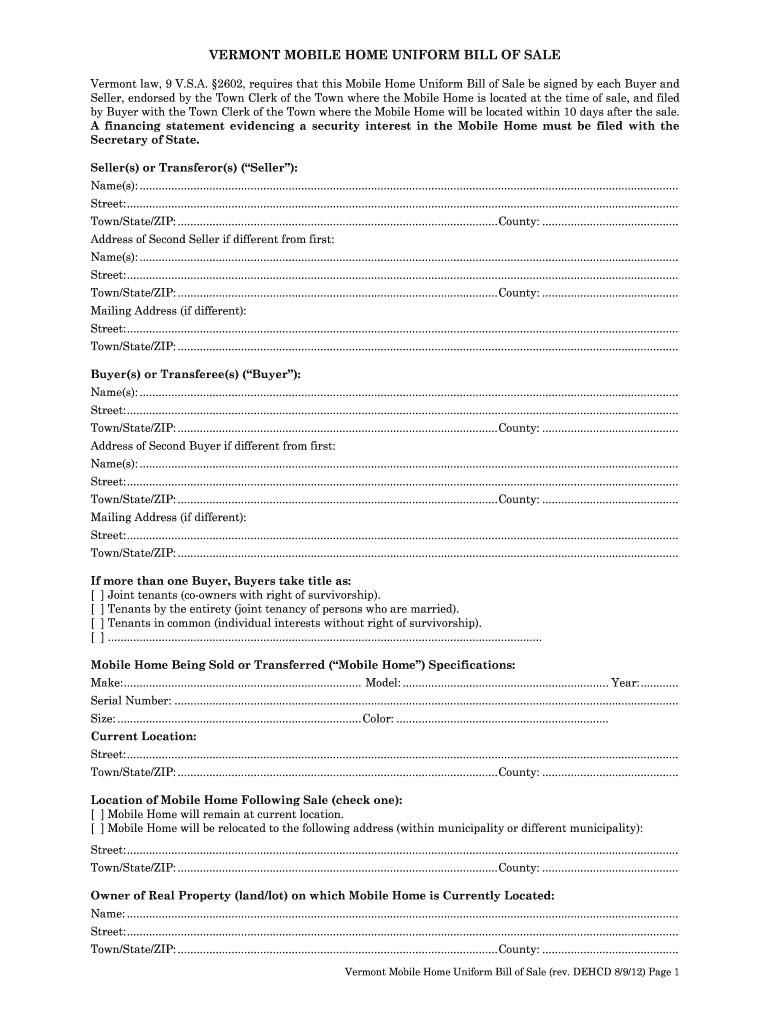
Iled with the Secretary of State. Seller(s) or Transferor(s) (“Seller”): Name(s): .......................................................................................................................................................................... Street: .............................................................................................................................................................................. Town/State/ZIP: .
Loading

Open form follow the instructions

Easily sign the form with your finger

Send filled & signed form or save
How to fill out the VT DEHCD online
The Vermont Mobile Home Uniform Bill of Sale is a critical document required for the sale of a mobile home in Vermont. This guide will provide you with detailed, step-by-step instructions on how to accurately complete this form online, ensuring compliance with state law.
Follow the steps to successfully complete the VT DEHCD online.
- Click ‘Get Form’ button to access the form and open it for editing.
- Begin by entering the Seller’s information. Fill in the names, street address, town, state, ZIP code, and county for each Seller or Transferor. If there is a second Seller, provide their details in the designated space.
- Next, input the Buyer’s information. Similar to the Seller section, record the names, street address, town, state, ZIP code, and county for each Buyer or Transferee. Ensure to list details for a second Buyer if applicable.
- Specify the ownership structure by selecting one option from the choices provided (joint tenants, tenants by the entirety, tenants in common). Ensure you check the appropriate box.
- Fill out the Mobile Home specifications, including make, model, year, serial number, size, and color. This information is crucial for accurately identifying the mobile home.
- Provide the current location of the Mobile Home, including street address, town, state, ZIP code, and county.
- Indicate the future location of the Mobile Home by checking one of the options: if it will remain at the current location or if it will be relocated. If relocating, provide the new address details.
- Document the owner of the real property where the Mobile Home is currently located, repeating the same fields as before. Also, include mailing information if different.
- Repeat the information for the owner of the real property where the Mobile Home will be located, again providing mailing information if applicable.
- If applicable, indicate if the sale is a retail installment transaction by checking the respective box.
- If the sale is an 'as is' sale, note any known deficiencies or defects in the Mobile Home.
- List any known liens on the Mobile Home.
- Complete the certification by checking the provided box to confirm the completed copy of the form was given to the real property owner 21 days prior to transfer.
- Finally, gather signatures from the Seller(s), Buyer(s), and witnesses, ensuring to date each signature.
- Once all fields are filled, save your changes. You can then download, print, or share the completed form as needed.
Complete your Vermont Mobile Home Uniform Bill of Sale online now to ensure a smooth sale process.
Experience a faster way to fill out and sign forms on the web. Access the most extensive library of templates available.
Related content
VT Department of Housing and Community Development. Community Investment Board Meeting...
Aug 24, 1994 — ... dehcd in the OPR Classification Guide (RcfLrb JCSG control number...
The iHP Handbook is a resource we wanted to develop to shed light onto the myriad of...
Get answers to your most pressing questions about US Legal Forms API.
How do I fill out an employment tax form?
Filling out an employment tax form requires accurate input of your earnings, tax obligations, and any withholdings. Ensure you have all necessary documents at hand for ease of completion. For personalized assistance, consider utilizing resources like the uslegalforms platform to guide you through the process.
What is the income limit for property tax credit in Vermont?
Property tax credit income limits in Vermont also vary yearly and are based on household size and income. For the latest information, please consult with the Vermont Department of Taxes. This is key to determining your eligibility for financial relief through the VT DEHCD.
What is the income limit for homestead declaration in Vermont?
The income limit for the homestead declaration in Vermont is updated periodically. You should check with the Vermont Department of Taxes for the most current figures. Understanding these limits helps guide your eligibility for benefits under the VT DEHCD.
How to fill out self-employment income?
Filling out self-employment income requires you to document all earnings accurately, along with necessary expenses. Use the IRS Schedule C form to report your income properly. This detail is important for setting up your qualifications under the VT DEHCD program.
How do I file my homestead declaration online in Vermont?
Filing your homestead declaration online in Vermont is straightforward. Visit the Vermont Department of Taxes website and follow their guided process for online submissions. Completing this step efficiently can simplify your application for VT DEHCD benefits.
How do I enter self-employed income?
To enter self-employed income, you must gather all earnings documentation, such as 1099 forms and client invoices. Use the applicable tax software or IRS forms to input your information accurately. Ensuring precise entries is essential for compliance with the VT DEHCD.
What is the property tax relief for seniors in Vermont?
Vermont offers property tax relief for seniors through various programs aimed at assisting older residents. These programs help reduce property tax obligations based on income levels and property value. By connecting with the VT DEHCD, seniors can explore available options to lessen their financial burden and enjoy their retirement years more comfortably.
What is the household income for Homestead Declaration in Vermont?
The household income for the Homestead Declaration in Vermont varies based on several factors, including family size. For accurate assessment, refer to the latest income guidelines from Vermont's tax department. This information is crucial for determining eligibility for benefits under the VT DEHCD.
Why don't I qualify for homestead credit?
You may not qualify for the homestead credit due to factors such as income limits or ownership conditions. It's vital to review the eligibility requirements set forth by the VT DEHCD. If you believe you should qualify, consider seeking assistance from a tax professional for further clarity.
Who qualifies for the homestead exemption in VT?
To qualify for the homestead exemption in Vermont, you must occupy your property as your primary residence and meet specific criteria regarding income and property type. The VT DEHCD outlines these guidelines to ensure that the exemption benefits those who truly reside in their homes. It's a beneficial program that helps reduce your overall property tax burden.
Use professional pre-built templates to fill in and sign documents online faster. Get access to thousands of forms.
If you believe that this page should be taken down, please follow our DMCA take down process here.