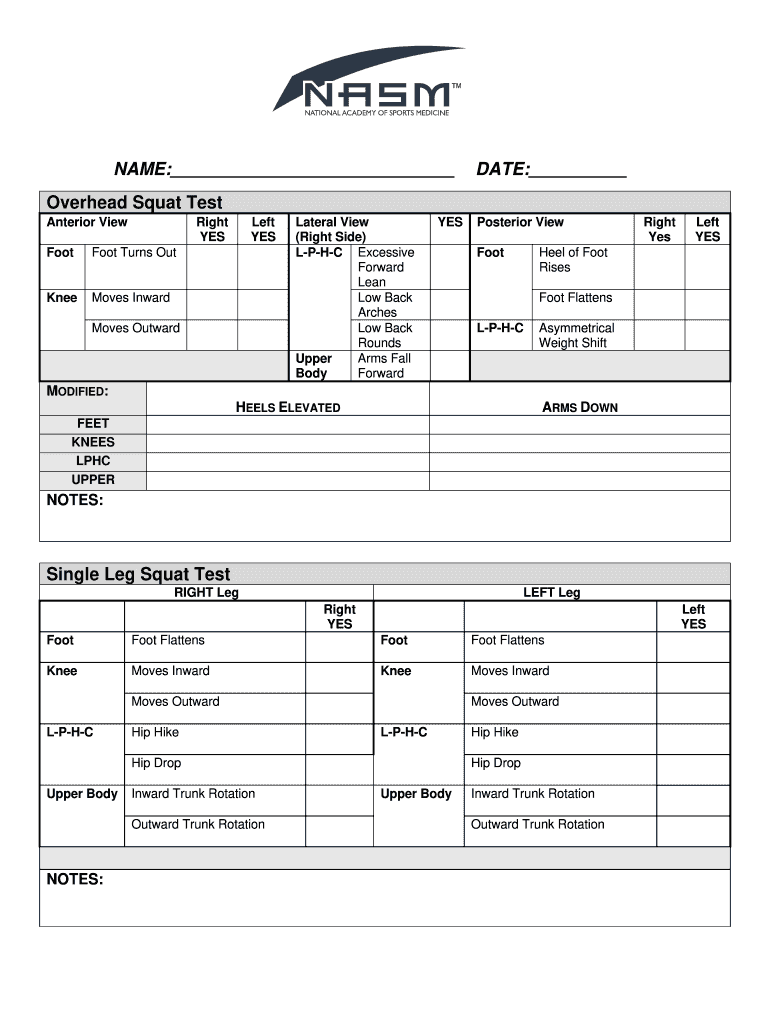
C Excessive Forward Lean Low Back Arches Low Back Rounds Arms Fall Upper Forward Body YES Posterior View Right Yes Left YES Heel of Foot Rises Foot Foot Flattens L-P-H-C Asymmetrical Weight Shift MODIFIED: HEELS ELEVATED ARMS DOWN FEET KNEES LPHC UPPER NOTES: Single Leg Squat Test RIGHT Leg LEFT Leg Right YES Left YES Foot Foot Flattens Foot Foot Flattens Knee Moves Inward Knee Moves Inward Moves Outward L-P-H-C Hip Hike Moves Outward L-P-H-C Hip Drop Upper Body Inwar.
Loading

Open form follow the instructions

Easily sign the form with your finger

Send filled & signed form or save
How to fill out the NASM CES Assessment Form online
The NASM CES Assessment Form is a crucial tool for assessing physical performance and identifying areas for improvement. This guide will provide clear, step-by-step instructions to help you complete the form online effectively.
Follow the steps to complete the NASM CES Assessment Form online.
- Press the ‘Get Form’ button to access the NASM CES Assessment Form and open it in the online editor.
- Begin by filling in your name and the date at the top of the form. Ensure that you enter this information accurately to maintain clear records.
- Proceed to the overhead squat test section. For the anterior view, indicate whether the foot turns out and if the knee moves inward for both the right and left foot. Answer 'yes' or provide notes as necessary.
- Next, in the lateral view section, review the conditions of the low back and arms. Document any excessive forward lean, arching, or rounding of the low back, and whether the arms fall forward.
- In the posterior view, assess whether the heel of the foot rises or flattens. Note any asymmetrical weight shifts present.
- Continue to the modified squat section. Indicate any observations for the feet, knees, and lower body posture regarding the elevated heels and level of upper arm placement.
- Move on to the single leg squat test section. Document the performance of both the right and left legs, noting if the foot flattens and any movements of the knee and hip during the squat.
- Complete any remaining notes as necessary throughout the form to provide context or additional observations pertinent to the assessment.
- Finally, review all entries to ensure the information is correct. Once verified, you can save your changes, download, print, or share the completed form as needed.
Complete the NASM CES Assessment Form online to streamline your assessment process.
Experience a faster way to fill out and sign forms on the web. Access the most extensive library of templates available.
Related content
Review the Stages of Readiness to Change questions on the Physical Activity Assessment...
Take your career to the next level with NASM Corrective Exercise Specialist (CES), an...
You must complete and submit the Job Guarantee Request form within 90 days of successfully...
Get answers to your most pressing questions about US Legal Forms API.
How do I add NASM to CEUs?
Log into your NASM account and click on the link to the NASM Recertification/Renewal Portal. Click on My CEUs under the Continuing Ed. section in the left menu column. Enter your CEUs by choosing Provider/Petition CEUs or Add Other CEUs.
What are the 5 kinetic checkpoints when observing a client during the static posture assessment?
The major joints and regions of the body that make up the five kinetic checkpoints are the foot and ankle, the knee, LPHC, shoulders and thoracic spine, and the head and cervical spine.
What are the 5 kinetic chain checkpoints for the overhead squat assessment OHSA )?
Feet and ankles. Knees. Lumbo-pelvic-hip (LPHC) complex. Shoulders. Head/cervical spine.
Which movement assessment is a good assessment of a client balance during movement?
The squat assessment is a dynamic movement assessment designed to measure the client's functional range of motion. It helps determine overall core strength, balance, kinesthetic awareness, and movement pattern discrepancies.
Which of the following is the first step within the systematic process of corrective exercise?
CEX PHASE 1: INHIBIT OVERACTIVE MUSCLES Inhibit is the first phase in the Corrective Exercise Continuum. The goal of the Inhibit phase is to reduce or modulate the activity of the nervous system that innervates the myofascial (Clark et al., 2014).
How hard is it to pass the NASM CPT exam?
NASM Test Difficulty – How Hard Is The NASM CPT Exam? The NASM CPT exam is all multiple choice questions, and you need to score at least 70% to pass. Some questions are easy, but others are hard and need more thinking. With diligent studying, many students have reported amazing exam results.
Is the NASM exam open book?
NASM'S CERTIFIED PERSONAL TRAINER EXAM OPTIONS This non-proctored and open-book exam has 100 questions and requires a passing grade of 70%. This exam is administered online only.
What is the correct order of the CES assessment flow when working with a new client?
The CES Assessment Flow The flow starts with the client intake screen. It then moves on to the static postural assessment. Next is the overhead squat assessment and modified overhead squat assessment. The next goes to the single leg squat and the split leg squat assessments.
Use professional pre-built templates to fill in and sign documents online faster. Get access to thousands of forms.
If you believe that this page should be taken down, please follow our DMCA take down process here.