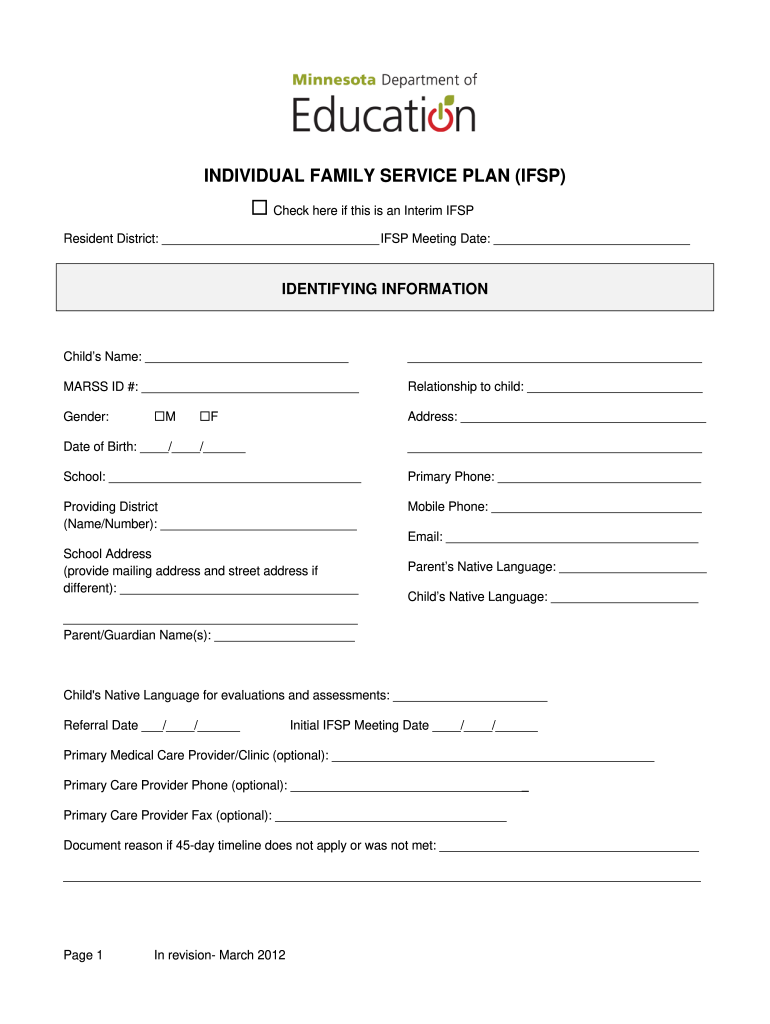
INDIVIDUAL FAMILY SERVICE PLAN (ISP) Check here if this is an Interim ISP Resident District: ISP Meeting Date: IDENTIFYING INFORMATION Child's Name: MASS ID #: Relationship to child: Gender: M F Address:.
Loading

Open form follow the instructions

Easily sign the form with your finger

Send filled & signed form or save
How to fill out the MN Individual Family Service Plan (IFSP) online
Filling out the Minnesota Individual Family Service Plan (IFSP) online can seem overwhelming, but it is an essential step in securing the necessary services for your child. This guide will provide you with clear, step-by-step instructions to help you complete the form effectively and confidently.
Follow the steps to complete your IFSP online.
- Press the ‘Get Form’ button to obtain the form and open it in your document editor.
- Begin with the identifying information section. Fill in your child's name, MARSS ID number, relationship to child, gender, address, date of birth, and school details. Ensure all fields are completed accurately to avoid any delays.
- Complete the contact information fields with your primary and mobile phone numbers, email address, and school address if different from the residence.
- Provide details on the child's and parent's native languages, along with the names of parents or guardians.
- Fill in the referral date and the initial IFSP meeting date. If applicable, include information about the primary medical care provider and phone numbers.
- In the IFSP team members section, list all individuals involved along with their roles and contact details. Indicate how they participated in the meeting.
- Proceed to the progress reporting section to indicate the projected periodic review and annual review dates.
- Complete the evaluation and assessment summary by selecting whether eligibility for Part C and Part B is being determined. Fill in details as required.
- Discuss the family-directed assessment, recording the family’s concerns, priorities, and resources related to the child’s development.
- Outline the measurable outcomes for the child and family, specifying the criteria for success and the timeline for monitoring progress. Be sure to detail any changes or modifications that may be needed.
- Specify the early intervention services required, including start date, length, frequency, intensity, method, and the anticipated duration of each service.
- Address the need for medical and other services not funded under IDEA Part C, including contacts and funding sources.
- If applicable, complete the transition planning section, identifying necessary steps and services to prepare for the transition from Part C services.
- Finally, finalize your document by obtaining the required signatures from the parent or guardian, district representative, and any representatives of other public agencies.
- Once completed, save your changes, and download or print the IFSP for your records or sharing as needed.
Start working on your MN Individual Family Service Plan (IFSP) online today to ensure your child's needs are met.
Experience a faster way to fill out and sign forms on the web. Access the most extensive library of templates available.
Related content
designed to meet the special developmental needs of a child eligible under Code of Federal...
The overall purpose of planning for evaluation and assessment is to gather and exchange...
Missouri Families for Effective Autism Treatment (MO-FEAT) ... Individualized Educational...
Get answers to your most pressing questions about US Legal Forms API.
What is equine liability insurance?
Equine Liability insurance helps protect you from third party bodily injury and property damage for which you are legally liable.
How do you write a simple release of liability?
How to Write (1) Calendar Date Of Document. Record the date when this release is filled out and completed. (2) Releasor Name. ... (3) Releasor Address. (4) Releasee Name. ... (5) Releasee Address. (6) Event Or Actions Being Indemnified. ... (7) No Payment By Releasee. ... (8) Required Payment For Release.
What is a liability release form?
A release of liability, also known as a liability waiver or a hold harmless agreement, is a contract in which one party agrees not to hold another party liable for damages or injury. These contracts are common in fields that involve some risk to property, finances, or health.
What should a waiver of liability include?
Generally, a liability waiver should include the following provisions: Risks. First and foremost, it should include a list of the representative inherent risks and any special risks of a trip and/or core activities in an itinerary. ... Liability Waiver Release. ... Assumption of Risk. ... Indemnification. ... Forum/Venue Selection.
How do you write a liability release form?
Here is all that pertains writing an effective liability waiver: Get help. Writing a waiver should not be complicated. ... Use the correct structure. ... Proper formatting. ... Include a subject line. ... Include a caution! ... Talk about the activity risks. ... Do not forget an assumption of risk. ... Hold harmless.
What is the purpose of a liability waiver?
A liability waiver form is a legal contract that educates one party about the risks associated with an activity. Once signed, it prevents the participant from opening a lawsuit against the company in the event of damage or loss, effectively shifting responsibility for injuries from the company to the customer.
What is the purpose of a release of liability?
A release of liability, also known as a liability waiver or a hold harmless agreement, is a contract in which one party agrees not to hold another party liable for damages or injury. These contracts are common in fields that involve some risk to property, finances, or health.
What are 3 types of insurance that equine businesses need?
The broad categories of equine insurance include: Mortality – essentially, life insurance on the horse. ... Loss of use – similarly to mortality insurance, designed to compensate for the loss of the horse's ability to compete or perform as anticipated. ... Medical – to cover expenses just as one might insure a family member.
What is an equine liability waiver?
Many equestrian facilities require their clients to sign liability release forms prior to engaging in any equine-related activities. Liability releases, also known as waivers and hold harmless agreements, are meant to protect the facility from liability in the event of an accident.
What should a liability form include?
Elements of a Liability waiver Formal structure. A waiver should follow a certain structure to be termed as valid: ... Risk involved section. ... Assumption of risk section. ... Choice of law provision section. ... Confirmation. ... Signature.
Use professional pre-built templates to fill in and sign documents online faster. Get access to thousands of forms.
If you believe that this page should be taken down, please follow our DMCA take down process here.