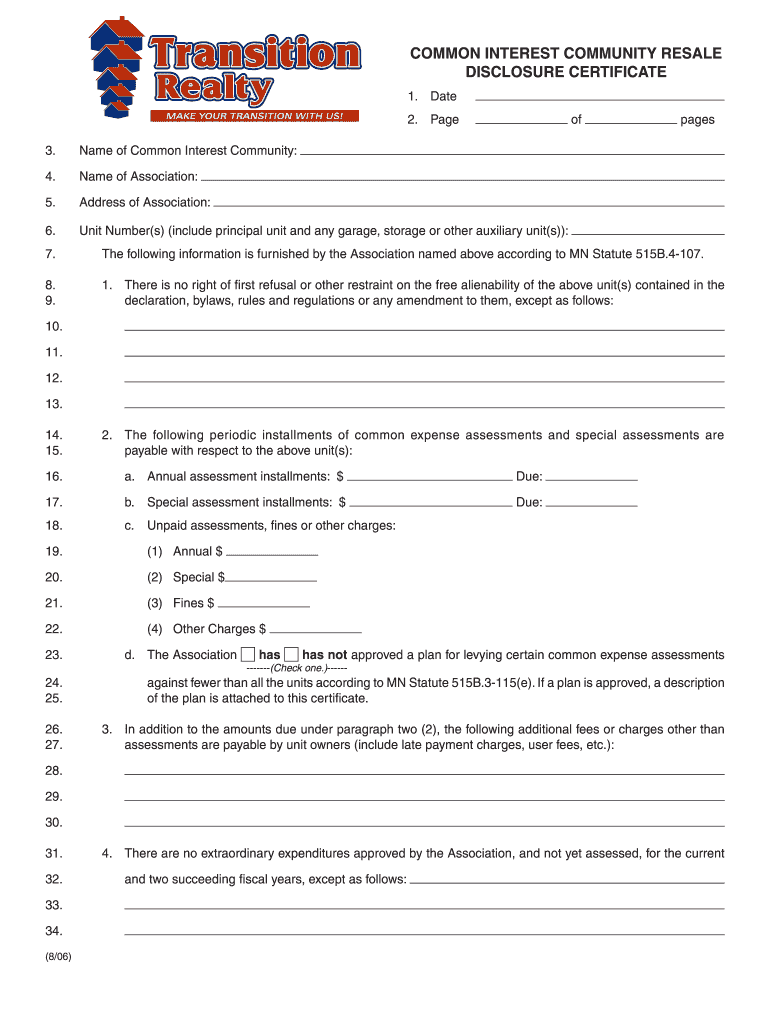
Principal unit and any garage, storage or other auxiliary unit(s)): pages 7. The following information is furnished by the Association named above according to MN Statute 515B.4-107. 8. 9. 1. There is no right of rst refusal or other restraint on the free alienability of the above unit(s) contained in the declaration, bylaws, rules and regulations or any amendment to them, except as follows: 10. 11. 12. 13. 14. 15. 2. The following periodic installments of common expense assessments an.
Loading

Open form follow the instructions

Easily sign the form with your finger

Send filled & signed form or save
How to fill out the Common Interest Community Resale Disclosure Certificate online
Filling out the Common Interest Community Resale Disclosure Certificate online is a crucial task for those involved in the resale of properties within a common interest community. This guide provides step-by-step instructions to help you complete the form accurately and efficiently.
Follow the steps to fill out the form correctly
- Click ‘Get Form’ button to access the Common Interest Community Resale Disclosure Certificate and open it in your preferred editing tool.
- Provide the date of filling out the form in the designated section. This ensures that the information is current and relevant.
- Indicate the page number and total pages of the document in the respective fields to maintain structure and clarity.
- Enter the name of the common interest community and the association handling the resale. Make sure to double-check the names for accuracy.
- Fill in the address of the association. This should include the street address, city, state, and zip code.
- List the unit numbers associated with the property, including any auxiliary units such as garages or storage areas.
- Fill out the section regarding the right of first refusal or any restraints on the free alienability of the unit. If applicable, describe any exceptions.
- Indicate the assessment details. Include annual assessment installments, special assessment installments, and any unpaid assessments or fines.
- If a plan for levying common expense assessments has been approved by the association, check the corresponding box and attach the description.
- Provide information about additional fees or charges other than assessments, such as late payment fees or user fees.
- Mention any extraordinary expenditures approved by the association that are not yet assessed for the current and following fiscal years.
- Specify the reserved amounts for maintenance, repair, or replacement, and detail any projects these reserves are designated for.
- Attach and reference required documents, including the most recent balance sheet and income and expense statement, along with the association's current budget.
- Identify any unsatisfied judgments against the association, providing creditor names and amounts as applicable.
- List any pending lawsuits involving the association, summarizing their current status.
- Detail the insurance coverages provided by the association for the benefit of unit owners, and mention any specific fixtures insured.
- Ensure to record whether the board of directors has notified the unit owner of any violations regarding alterations or improvements.
- Provide details of any leasehold estates affecting the common interest community, including terms for extensions or renewals.
- Include any additional matters impacting the unit or unit owner's obligations that are deemed material.
- At the end of the form, certify the information by signing your name, providing your title, address, and phone number.
- Finally, ensure to complete the receipt section, documenting the date of acknowledgment and obtaining signatures from the buyer(s).
- After completing the form, save your changes. You can also download, print, or share the completed document as needed.
Take the next step and complete your Common Interest Community Resale Disclosure Certificate online today.
Experience a faster way to fill out and sign forms on the web. Access the most extensive library of templates available.
Related content
515B.4-107 RESALE OF UNITS. ... (3) a resale disclosure certificate from the association...
All Common Interest Communities require delivery of a public offering statement to...
Dec 10, 2020 — The number of shares of HP Inc. common stock outstanding as of November...
Get answers to your most pressing questions about US Legal Forms API.
What do you have to disclose when selling a house Nevada?
The seller must complete the “Seller's Real Property Disclosure” form, detailing the condition of the property, known defects, and any other aspects of the property which may affect its use or value.
Which of these must be disclosed on the seller's real property disclosure in Nevada?
Nevada's Required Disclosures These disclosures cover electrical, heating, cooling, plumbing and sewer systems, and anything else on the property that affects use or value. See NRS § 113.120.
Is Nevada a non-disclosure state?
Commonly, there aren't definite disclosure laws and the sale prices will only reflect on public records if the seller submits one. These states are the following: Alabama, Arkansas, Louisiana, Nevada, North Carolina, Oklahoma, Rhode Island, and Tennessee.
What is an example of a common-interest community?
Common-interest communities, also known as common-interest developments or CIDs, include condominiums, coops, retirement communities, vacation timeshares, and other housing developments comprised of individually owned units, in addition to shared facilities and common areas.
Is Nevada a full disclosure state?
Disclosure Laws in Nevada for Home Sales The statute provides that, at least ten days before residential property is conveyed to the buyer, the seller must complete a disclosure form covering all known defects that materially affect the value or use of the property in an adverse manner.
What is a common-interest community in Nevada?
A common-interest community is one in which the people own a dwelling unit, and by virtue of that ownership, are responsible for paying a portion of the real estate taxes, insurance and other costs associated with the property.
Do you have to disclose if someone died in a house in Nevada?
In Nevada, ing to NRS 40.770, deaths (including homicide or suicide) do not need to be disclosed unless the death resulted from a condition of the property itself. Be sure to check out NRS 40.770 to see what other information does not need to be disclosed when purchasing a home.
Who is responsible for disclosing a Mello Roos tax to the buyer?
Realtors must inform potential buyers if a home is in a Mello-Roos Community Facilities District. The Mello-Roos tax is assessed against the land but is not based on the assessed value of the property. That is the way it gets around the cap imposed by Proposition 13.
Use professional pre-built templates to fill in and sign documents online faster. Get access to thousands of forms.
If you believe that this page should be taken down, please follow our DMCA take down process here.