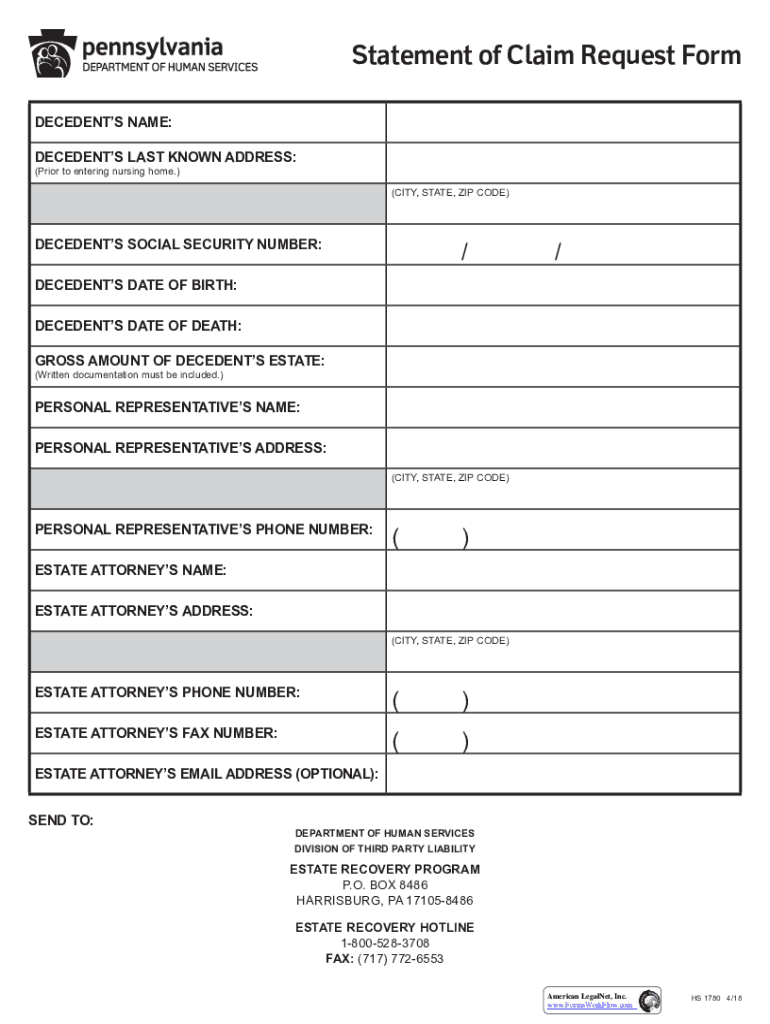
Statement of Claim Request FormDECEDENTS NAME: DECEDENTS LAST KNOWN ADDRESS: (Prior to entering nursing home.)(CITY, STATE, ZIP CODE)DECEDENTS SOCIAL SECURITY NUMBER://DECEDENTS DATE OF BIRTH: DECEDENTS.
Loading

Open form follow the instructions

Easily sign the form with your finger

Send filled & signed form or save
How to fill out the PA HS 1780 online
The PA HS 1780 is an essential document used for the statement of claim in estate recovery. This guide will provide you with detailed and user-friendly instructions on how to effectively fill out the form online.
Follow the steps to complete the PA HS 1780 form online.
- Click ‘Get Form’ button to access the form and open it for editing.
- Begin by entering the decedent’s name, ensuring to provide the full legal name as it appears on official records.
- Input the decedent’s last known address before entering the nursing home, including city, state, and zip code.
- Provide the decedent’s social security number, formatted correctly. Ensure all numbers are accurate to avoid processing delays.
- Fill in the decedent’s date of birth and date of death using the specified formats.
- Document the gross amount of the decedent’s estate, including any required written documentation to substantiate this amount.
- Enter the name and address of the personal representative, along with their phone number for contact purposes.
- Input the estate attorney’s name, address, phone number, fax number, and optional email address to ensure clear communication.
- Review all the entered information for accuracy. Ensure there are no typos or missing information.
- Once completed, save, download, or print the form as needed for your records. You can also share it with the necessary parties as required.
Complete your documents online today for a streamlined filing process.
Experience a faster way to fill out and sign forms on the web. Access the most extensive library of templates available.
Related content
Statement of Claim Request Form ... GROSS AMOUNT OF DECEDENT'S ESTATE: ... ESTATE RECOVERY...
Jan 2, 2020 — MEDICAL ASSISTANCE ESTATE RECOVERY ... Request for statement of claim....
Joe Schmider, EMS Director, State of Pennsylvania ... Incident Action Plan Safety and Risk...
Get answers to your most pressing questions about US Legal Forms API.
How do I avoid Medicaid estate recovery in PA?
One of the best ways to avoid estate recovery is where a caregiver resides in the Medicaid recipient's home and provides care or support either 1) for two years while the person received home- and community-based services, or 2) for the two years immediately prior to nursing home placement.
Does Medicaid have to be paid back in Pennsylvania?
The law requires every state to try to get back the money that the state pays for someone's Medicaid benefits. The state can then use this money to pay for long-term care for other people. For instance, suppose Pennsylvania pays $100,000 from Medicaid for a person's care.
Does Pennsylvania have Medicaid recovery?
The Estate Recovery Program allows the Commonwealth to recover Medical Assistance payments made on behalf of an individual who received long-term care Medical Assistance [including nursing facility, Home and Community Based Services (HCBS) and related services] from the time they turned 55 until their passing.
Is medical assistance the same as Medicaid in PA?
Medical Assistance (MA), also known as Medicaid, pays for health care services for eligible individuals.
Is there a statute of limitations on Medicaid recovery in Pennsylvania?
There is no limit on the number of years for which DHS can seek recovery, except that there can be no recovery for medical assistance provided prior to the effective date of the act, August 15, 1994.
What is the statute of limitations on estate recovery in PA?
Although there is no statute of limitations, Pennsylvania's estate recovery statute does set forth a time period in which the state must respond to a request for a statement of claim submitted by the duly appointed personal representative of an estate.
What assets are subject to estate recovery in Pennsylvania?
Pennsylvania's Estate Recovery Program can only reach probate assets; any non-probate assets—retirement accounts, jointly-owned property by the decedent and another, and life insurance policies paid directly to a beneficiary—will transfer outside of the estate recovery process.
How can I avoid estate recovery in PA?
One of the best ways to avoid estate recovery is where a caregiver resides in the Medicaid recipient's home and provides care or support either 1) for two years while the person received home- and community-based services, or 2) for the two years immediately prior to nursing home placement.
Use professional pre-built templates to fill in and sign documents online faster. Get access to thousands of forms.
If you believe that this page should be taken down, please follow our DMCA take down process here.
This form is available in several versions. Select the version you need from the drop-down list below.