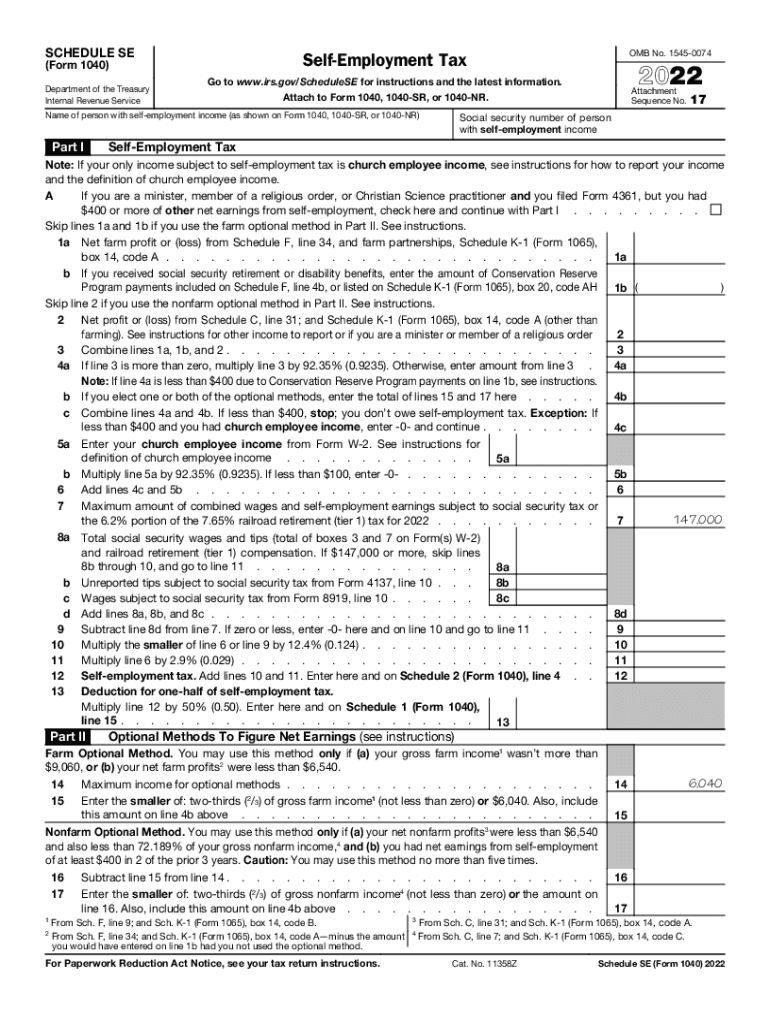
SCHEDULE SE Department of the Treasury Internal Revenue Service2022Go to www.irs.gov/ScheduleSE for instructions and the latest information. Attach to Form 1040, 1040SR, or 1040NR. Name of person.
Loading

Open form follow the instructions

Easily sign the form with your finger

Send filled & signed form or save
How to fill out the IRS 1040 - Schedule SE online
Filling out the IRS 1040 - Schedule SE form can be a straightforward process if approached correctly. This guide offers you clear and supportive instructions for completing the form online, specifically tailored to meet your needs as a user.
Follow the steps to accurately complete the IRS 1040 - Schedule SE online.
- Click ‘Get Form’ button to obtain the form and open it in the editor.
- Begin by entering the name of the person with self-employment income as shown on Form 1040, 1040-SR, or 1040-NR. Ensure that the correct name is reflected to avoid confusion later in the filing process.
- Input the Social Security number of the person with self-employment income. This is essential for accurate identification and processing of the form.
- In Part I, address the self-employment tax calculations. You may need to report your net farm profit or loss on line 1a and additional income from Schedule C if any (line 2). Follow the instructions carefully regarding optional methods.
- Combine the amounts from lines 1a, 1b, and 2 on line 3. This total represents your overall self-employment income before any adjustments are made.
- If line 3 indicates a profit, multiply that amount by 92.35% at line 4a. If your income is from church employee income, make sure to follow the specific guidelines provided in the form.
- Proceed to calculate any additional specifics such as social security wages and tips on line 8. If your income exceeds the maximum amount subject to tax, skip to line 11.
- Complete lines 9 through 12 to calculate your self-employment tax and any associated deductions. Be attentive to the instructions for proper calculations.
- If you wish to utilize optional methods in Part II, complete lines 14 through 17 according to the specific requirements. Ensure that you meet the criteria for using these methods.
- After reviewing all entries for accuracy, you can save changes, download the completed document, print it for your records, or share it as necessary.
Take control of your self-employment tax filings by completing your IRS 1040 - Schedule SE online today.
Experience a faster way to fill out and sign forms on the web. Access the most extensive library of templates available.
Related content
Oct 5, 2022 — Information about Schedule SE (Form 1040), Self-Employment Tax, including...
See Instructions for Schedule SE (Form 1040). Name of person with self-employment income...
23 Jul 2019 — Use Schedule SE (Form 1040 or 1040-SR) to figure the tax due on net...
Get answers to your most pressing questions about US Legal Forms API.
Is Schedule C and Schedule SE the same thing?
IRS Schedule C, Profit or Loss from Business, is a tax form you file with your Form 1040 to report income and expenses for your business. The resulting profit or loss is typically considered self-employment income. Usually, if you fill out Schedule C you'll also have to fill out Schedule SE, "Self-Employment Tax."
What is 1040 Schedule SE?
Use Schedule SE (Form 1040) to figure the tax due on net earnings from self-employment. The Social Security Administration uses the information from Schedule SE to figure your benefits under the social security program.
What is the difference between 1040 Schedule C and SE?
The net income information on Schedule C is used to determine the amount of self-employment tax you owe for Social Security and Medicare taxes. Schedule SE is used to calculate the self-employment tax amount.
What is Schedule SE tax deduction?
You also must file Schedule SE (Self-Employment Tax) with your 1040 if your net earnings from self-employment were $400 or more. The self-employment tax rate is 15.3%. The rate consists of two parts: 12.4% for social security (old-age, survivors, and disability insurance) and 2.9% for Medicare (hospital insurance).
Who should file Schedule SE?
Self-Employed Persons You must pay SE tax if you had net earnings of $400 or more as a self-employed person. If you are in business (farm or nonfarm) for yourself, you are self-employed. You must also pay SE tax on your share of certain partnership income and your guaranteed payments.
Is all Schedule C income subject to SE tax?
Generally, your net earnings from self-employment are subject to self-employment tax. If you are self-employed as a sole proprietor or independent contractor, you generally use Schedule C to figure net earnings from self-employment.
Who needs to file a 1040 SE?
You must pay SE tax if you had net earnings of $400 or more as a self-employed person. If you are in business (farm or nonfarm) for yourself, you are self-employed. You must also pay SE tax on your share of certain partnership income and your guaranteed payments.
What is the IRS form for self-employment deductions?
In order to report your Social Security and Medicare taxes, you must file Schedule SE (Form 1040 or 1040-SR ), Self-Employment TaxPDF. Use the income or loss calculated on Schedule C to calculate the amount of Social Security and Medicare taxes you should have paid during the year.
Use professional pre-built templates to fill in and sign documents online faster. Get access to thousands of forms.
If you believe that this page should be taken down, please follow our DMCA take down process here.