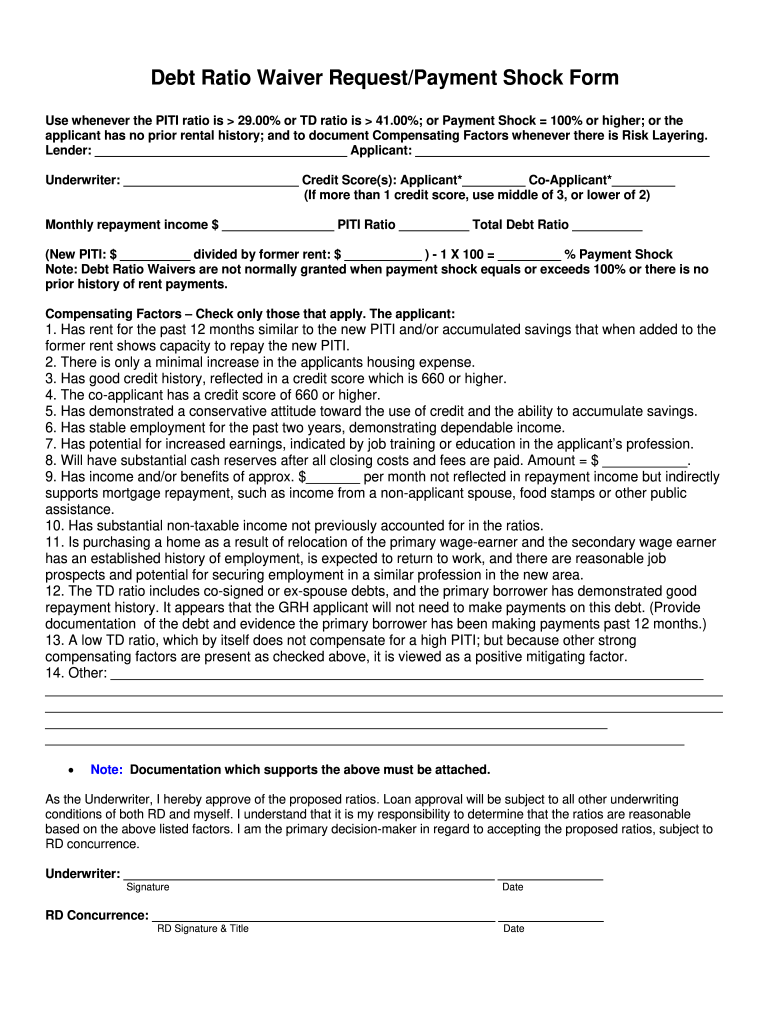
E applicant has no prior rental history; and to document Compensating Factors whenever there is Risk Layering. Lender: ____________________________________ Applicant: __________________________________________ Underwriter: _________________________ Credit Score(s): Applicant*_________ Co-Applicant*_________ (If more than 1 credit score, use middle of 3, or lower of 2) Monthly repayment income $ ________________ PITI Ratio __________ Total Debt Ratio __________ (New PITI: $ __________ divided by .
Loading

Open form follow the instructions

Easily sign the form with your finger

Send filled & signed form or save
How to fill out the USDA Debt Ratio Waiver Request/Payment Shock Form online
Completing the USDA Debt Ratio Waiver Request/Payment Shock Form online is an essential process for applicants facing challenges with debt ratios and payment shocks. This guide will help you understand each section of the form and provide you with step-by-step instructions to ensure a smooth submission.
Follow the steps to successfully complete the form.
- Press the ‘Get Form’ button to access the document and open it in the editor.
- Fill in the lender’s name in the appropriate field followed by the applicant's name. Ensure that the names are entered correctly as they appear on legal documents.
- In the monthly repayment income field, enter the applicant’s total monthly income. Calculate the PITI (Principal, Interest, Taxes, Insurance) Ratio and the Total Debt Ratio. Use the formulas provided in the form for accuracy.
- Check the compensating factors that apply to the applicant. Ensure to select only those that are relevant to the individual’s financial situation and document any necessary evidence to support these claims.
- The underwriter must sign and date the form, acknowledging the proposed ratios. Include all required signatures and dates for D&R concurrence.
- Once all fields are completed, review the form for accuracy. You can now save the changes, download a copy, print the document, or share it as needed.
Complete the USDA Debt Ratio Waiver Request/Payment Shock Form online today to ensure you meet your mortgage needs.
Experience a faster way to fill out and sign forms on the web. Access the most extensive library of templates available.
Related content
eligible for debt ratio waivers if: 1. There is not one applicant with a validated credit...
by MD Fielding — There needs to be a better, more effective approach for resolving...
Jun 3, 2002 — ... form. For example, gasoline placed in a sealed container will...
Get answers to your most pressing questions about US Legal Forms API.
What is the USDA debt ratio waiver?
The USDA debt ratio waiver allows borrowers to apply for exceptions to the standard debt-to-income ratio limits. This waiver is especially useful in cases where financial situations may suggest a higher ratio is manageable. By submitting the USDA Debt Ratio Waiver Request/Payment Shock Form, recipients can continue to pursue USDA loans even when they initially appear ineligible. This flexibility helps more families achieve homeownership despite their unique debts.
What is the 20% rule for USDA?
The 20% rule for USDA primarily refers to ensuring that a borrower’s monthly housing costs do not exceed 20% of their gross income. This rule helps maintain financial stability while servicing a mortgage. Additionally, if this ratio poses challenges, the USDA Debt Ratio Waiver Request/Payment Shock Form can help manage payment adjustment requests. It is a way to keep payments manageable while achieving the goal of homeownership.
What is the maximum debt-to-income ratio to buy a house?
When buying a house, the maximum debt-to-income ratio usually caps at 43%. However, many lenders, including those working with USDA loans, might allow higher ratios in certain circumstances. Utilizing the USDA Debt Ratio Waiver Request/Payment Shock Form can present an opportunity for approval beyond traditional limits. It assesses your unique situation to find potential pathways for homeownership.
What is the maximum debt to income ratio for USDA?
For the USDA, the typical maximum allowable debt-to-income ratio is 41%. Yet, this number is not set in stone. With the USDA Debt Ratio Waiver Request/Payment Shock Form, borrowers can apply for exceptions. This process evaluates your overall financial picture and may approve a higher ratio if justified.
What is the maximum debt-to-income ratio for USDA loans?
The maximum debt-to-income ratio for USDA loans generally stands at 41%. This ratio considers all your monthly debt payments against your gross monthly income. However, the USDA Debt Ratio Waiver Request/Payment Shock Form allows flexibility under certain conditions. Borrowers can seek waivers if they can demonstrate they can handle higher ratios based on other mitigating factors.
What is the 20 percent rule for USDA?
The 20 percent rule for USDA refers to a guideline that suggests borrowers should aim for a monthly housing payment that does not exceed 20% of their gross monthly income. This approach helps ensure that housing expenses remain manageable. If you're concerned about exceeding this guideline, you might consider using the USDA Debt Ratio Waiver Request/Payment Shock Form to provide your lender with additional context regarding your financial situation and needs.
What is the maximum debt-to-income ratio for USDA?
The maximum debt-to-income ratio for USDA loans is generally set at 41%. However, with the USDA Debt Ratio Waiver Request/Payment Shock Form, borrowers may apply for exceptions based on unique circumstances. This flexibility is designed to assist individuals in demonstrating their ability to manage financial commitments despite higher debt ratios.
What is the USDA email domain?
The USDA email domain typically ends with @usda. It is important to ensure you are using this domain when sending communications related to your USDA Debt Ratio Waiver Request/Payment Shock Form. Confirming the domain helps guarantee that your email reaches the correct department and receives prompt attention.
How do I request a payoff request?
To request a payoff, you should complete the USDA Debt Ratio Waiver Request/Payment Shock Form. This form allows you to clearly outline your request and provide necessary details. Once you have filled out the form, submit it according to the guidelines provided on the USDA website. Utilizing the proper format ensures a smoother processing of your request.
What disqualifies a home from the USDA financing quiz?
Several factors can disqualify a home from passing the USDA financing quiz. Primarily, if the home is located in an area not designated as eligible for USDA loans, it will not qualify. Additionally, homes that do not meet minimum property standards or have significant structural issues may also be disqualified. To find out more, you can utilize our USDA Debt Ratio Waiver Request/Payment Shock Form for specific criteria.
Use professional pre-built templates to fill in and sign documents online faster. Get access to thousands of forms.
If you believe that this page should be taken down, please follow our DMCA take down process here.