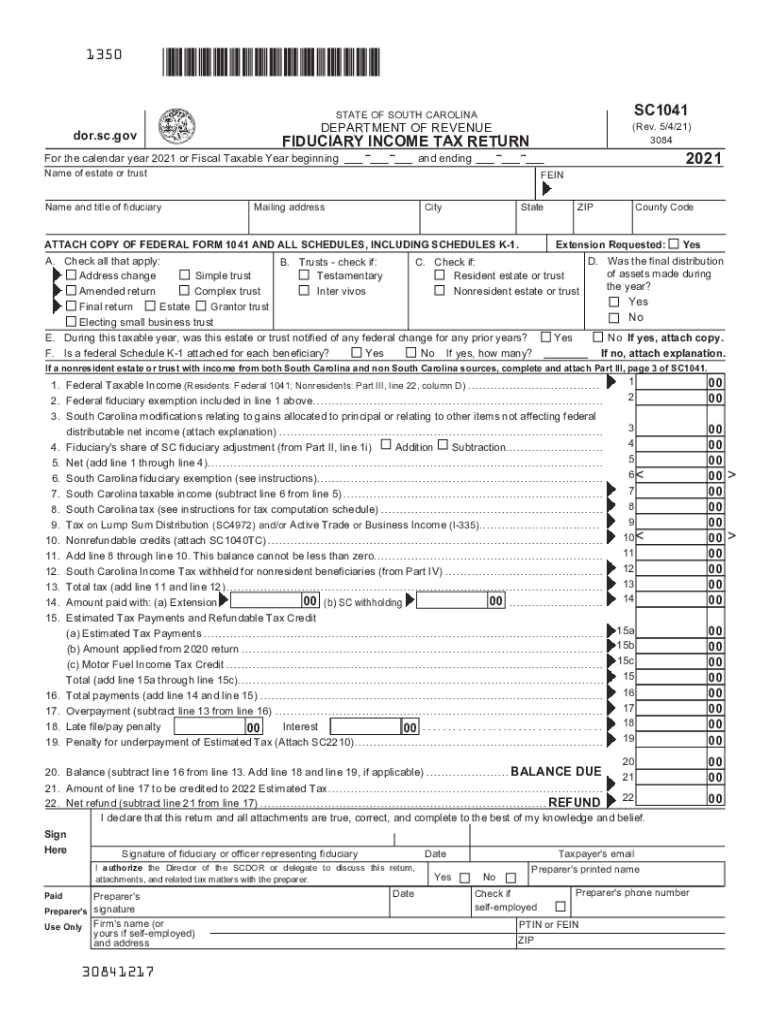
1350SC1041STATE OF SOUTH CAROLINAdor.sc.govDEPARTMENT OF REVENUE(Rev. 5/4/21) 3084FIDUCIARY INCOME TAX RETURNFor the calendar year 2021 or Fiscal Taxable Year beginningand ending2021Name of estate.
Loading

Open form follow the instructions

Easily sign the form with your finger

Send filled & signed form or save
How to fill out the SC DoR SC1041 online
Filling out the SC DoR SC1041 form online can seem daunting, but this guide will simplify the process for you. With clear instructions for each section, you will be able to complete the fiduciary income tax return efficiently and accurately.
Follow the steps to successfully fill out the SC1041 form.
- Click ‘Get Form’ button to obtain the form and open it in the editor.
- Enter the name of the estate or trust, along with the name and title of the fiduciary in the designated fields.
- Provide the Federal Employer Identification Number (FEIN) and the mailing address for the estate or trust.
- Check the appropriate boxes regarding the type of fiduciary return, which may indicate if the return is amended, final, or if an extension is requested.
- Complete the federal taxable income section by inputting the figures from the federal 1041 form (residents) or the specified line for nonresidents.
- Fill in the various modifications relating to gains allocated to principal or other items not affecting the federal distributable net income.
- If applicable, fill out Part II to allocate the South Carolina fiduciary adjustment among the beneficiaries.
- For nonresident estates or trusts, complete Part III to compute the federal taxable income from South Carolina sources.
- Utilize Part IV to indicate the nonresident beneficiaries' shares of income and ensure tax is withheld correctly.
- Review all entries for accuracy, and sign the form. Finally, you can save changes, download, print, or share the completed SC DoR SC1041 online.
Start filling out your SC DoR SC1041 online today to ensure timely and accurate submission.
Experience a faster way to fill out and sign forms on the web. Access the most extensive library of templates available.
Related content
File an amended SC1041 for the appropriate tax year to report the federal adjustment to...
Get answers to your most pressing questions about US Legal Forms API.
What is the difference between fiduciary and estate tax return?
While fiduciary income tax is the income taxation of a person's estate or trust assets, estate tax is a tax on the right to transfer property when a person passes away.
Where do I mail my sc1041?
If filing by paper, mail balance due returns to SCDOR, TAXABLE FIDUCIARY, PO BOX 125, COLUMBIA, SC 29214-0038. Mail refunds or zero tax returns to SCDOR, NONTAXABLE FIDUCIARY, PO BOX 125, COLUMBIA, SC 29214-0039.
Will my SC state refund be offset?
I filed a 2021 South Carolina Individual Income Tax return, but did not receive a refund. Maybe. If you have paid off your balance due, you will receive a rebate. If your balance due is greater than your tax liability – line 15 - (line 21 + line 22) – the rebate will be used to offset your balance.
Does SC require an estate tax return?
South Carolina also does not impose an Estate Tax, which is a tax taken from the deceased's estate soon after the loved one has passed.
What is a fiduciary tax filing?
Form 1041 (fiduciary tax return) is the income tax form used for estates and trusts. It is used to report INCOME in the estate or trust, including sales of property. The estate or trust exists until final distribution of its assets.
What is a 1041 fiduciary tax return?
The fiduciary of a domestic decedent's estate, trust, or bankruptcy estate files Form 1041 to report: The income, deductions, gains, losses, etc. of the estate or trust. The income that is either accumulated or held for future distribution or distributed currently to the beneficiaries.
Who must file form 1041?
If the estate generates more than $600 in annual gross income, you are required to file Form 1041, U.S. Income Tax Return for Estates and Trusts. An estate may also need to pay quarterly estimated taxes.
Who must file fiduciary income tax return?
The IRS requires the filing of an income tax return for trusts and estates on Form 1041—formerly known as the fiduciary income tax return. This is because trusts and estates must pay income tax on their income just like you report your own income on a personal tax return each year.
Use professional pre-built templates to fill in and sign documents online faster. Get access to thousands of forms.
If you believe that this page should be taken down, please follow our DMCA take down process here.