Loading
Form preview
  • US Legal Forms
  • Form Library
  • More Forms
  • More Multi-State Forms
  • Unit Chemical Bonding Covalent Bonding Wksh 3 Answer Key

Get Unit Chemical Bonding Covalent Bonding Wksh 3 Answer Key

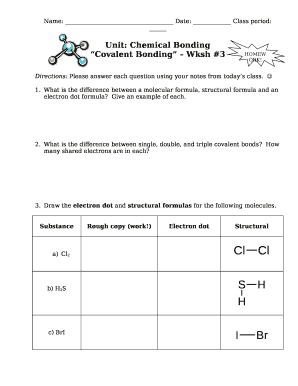
Name: Date: Class period: Unit: Chemical Bonding Covalent Bonding Wksh #3Directions:Please answer each question using your notes from todays class. 1. What is the difference between a molecular formula,.

How it works

  1. Open form

    Open form follow the instructions

  2. Easily sign form

    Easily sign the form with your finger

  3. Share form

    Send filled & signed form or save

How to fill out the Unit Chemical Bonding Covalent Bonding Wksh 3 Answer Key online

Filling out the Unit Chemical Bonding Covalent Bonding Wksh 3 Answer Key online provides an efficient way to complete homework assignments. This guide will walk you through each section and field of the form to ensure a smooth and accurate completion process.

Follow the steps to complete the form effectively.

  1. Click ‘Get Form’ button to obtain the form and open it in the editor.
  2. Begin by entering your name in the designated field at the top of the form. Make sure to accurately input your full name for identification.
  3. Next, fill in the date on which you are completing the assignment. Ensure that the date format adheres to the guidelines provided for clarity.
  4. Enter your class period in the appropriate section. This helps in categorizing your homework within your educational framework.
  5. Respond to the first question by clearly explaining the differences between a molecular formula, structural formula, and electron dot formula. Provide suitable examples for each to enhance your answer.
  6. For the second question, elaborate on the differences between single, double, and triple covalent bonds, indicating the number of shared electrons involved in each type.
  7. When addressing the drawing of electron dot and structural formulas for the specified substances, use the rough copy sections to sketch out your answers. Label each drawing clearly.
  8. Continue filling out the remainder of the questions, following the same structure as outlined in the previous steps.
  9. Once you have completed all sections of the form, review your answers for accuracy and completeness.
  10. Finally, save your changes, and choose if you would like to download, print, or share the completed answer key.

Start completing your documents online for a more streamlined homework experience.

Get form

Experience a faster way to fill out and sign forms on the web. Access the most extensive library of templates available.
Get form

Related content

CH105: Chapter 3 – Ionic and Covelent Bonding...
These shared electrons simultaneously occupy the outermost shell of both atoms. The bond...
Learn more

Related links form

Ally Used Vehicle Book-Out Sheet 2014 American Legion 30-001 2005 American Youth Football Mandatory Play Form Application for Permission to Date My Daughter

Questions & Answers

Get answers to your most pressing questions about US Legal Forms API.

Contact support

To identify covalent bonding: Covalent bonding takes place between two non-metals by the sharing of electrons. The identification of covalent bond can be done by electronegative difference. The electronegative the molecules will be in between. 0 - 0 . 3 , then the bonding will be non-polar covalent bonding.

Triple covalent bond is the bond that is formed by sharing of three electron pairs between two atoms in which each atom contributes three electrons.

Chemical bonding refers to the formation of a chemical bond between two or more atoms, molecules or ions to give rise to a chemical compound. These chemical bonds are what keep the atoms together in the resulting compound.

A covalent bond consists of the simultaneous attraction of two nuclei for one or more pairs of electrons. The electrons located between the two nuclei are bonding electrons.

Five examples of covalent bonds are hydrogen (H₂), oxygen (O₂), nitrogen (N₂), water (H₂O), and methane(CH₄). 2. What is a covalent bond? A chemical bond involving the sharing of electron pairs between atoms is known as a covalent bond.

Which statement best describes a covalent bond? A chemical bond that involves sharing a pair of electrons between atoms in a molecule.

Nitrogen atoms will form three covalent bonds (also called triple covalent) between two atoms of nitrogen because each nitrogen atom needs three electrons to fill its outermost shell.

Covalent bonding occurs when pairs of electrons are shared by atoms. Atoms will covalently bond with other atoms in order to gain more stability, which is gained by forming a full electron shell. By sharing their outer most (valence) electrons, atoms can fill up their outer electron shell and gain stability.

Get This Form Now!

Use professional pre-built templates to fill in and sign documents online faster. Get access to thousands of forms.
Get form
If you believe that this page should be taken down, please follow our DMCA take down processhere.
Get Unit Chemical Bonding Covalent Bonding Wksh 3 Answer Key
Get form
  • Adoption
  • Bankruptcy
  • Contractors
  • Divorce
  • Home Sales
  • Employment
  • Identity Theft
  • Incorporation
  • Landlord Tenant
  • Living Trust
  • Name Change
  • Personal Planning
  • Small Business
  • Wills & Estates
  • Packages A-Z
  • Affidavits
  • Bankruptcy
  • Bill of Sale
  • Corporate - LLC
  • Divorce
  • Employment
  • Identity Theft
  • Internet Technology
  • Landlord Tenant
  • Living Wills
  • Name Change
  • Power of Attorney
  • Real Estate
  • Small Estates
  • Wills
  • All Forms
  • Forms A-Z
  • Form Library
  • Legal Hub
  • About Us
  • Help Portal
  • Legal Resources
  • Blog
  • Affiliates
  • Contact Us
  • Delete My Account
  • Site Map
  • Industries
  • Forms in Spanish
  • Localized Forms
  • State-specific Forms
  • Forms Kit
  • Real Estate Handbook
  • All Guides
  • Notarize
  • Incorporation services
  • For Consumers
  • For Small Business
  • For Attorneys
  • USLegal
  • FormsPass
  • pdfFiller
  • signNow
  • altaFlow
  • DocHub
  • Instapage
Form Packages
  • Adoption
  • Bankruptcy
  • Contractors
  • Divorce
  • Home Sales
  • Employment
  • Identity Theft
  • Incorporation
  • Landlord Tenant
  • Living Trust
  • Name Change
  • Personal Planning
  • Small Business
  • Wills & Estates
  • Packages A-Z
Form Categories
  • Affidavits
  • Bankruptcy
  • Bill of Sale
  • Corporate - LLC
  • Divorce
  • Employment
  • Identity Theft
  • Internet Technology
  • Landlord Tenant
  • Living Wills
  • Name Change
  • Power of Attorney
  • Real Estate
  • Small Estates
  • Wills
  • All Forms
  • Forms A-Z
  • Form Library
Customer Service
  • Legal Hub
  • About Us
  • Help Portal
  • Legal Resources
  • Blog
  • Affiliates
  • Contact Us
  • Delete My Account
  • Site Map
  • Industries
  • Forms in Spanish
  • Localized Forms
  • State-specific Forms
  • Forms Kit
Legal Guides
  • Real Estate Handbook
  • All Guides
Prepared for you
  • Notarize
  • Incorporation services
Our Customers
  • For Consumers
  • For Small Business
  • For Attorneys
Our Sites
  • USLegal
  • FormsPass
  • pdfFiller
  • signNow
  • altaFlow
  • DocHub
  • Instapage
Social Media
Call us now toll free:
+1 833 426 79 33
As seen in:
© Copyright 1999-2026 airSlate Legal Forms, Inc. 17 Station Street, Suite 303, Brookline, MA 02445
  • Your Privacy Choices
  • Terms of Service
  • Privacy Notice
  • Content Takedown Policy
  • Bug Bounty Program