We use cookies to improve security, personalize the user experience, enhance our marketing activities (including cooperating with our marketing partners) and for other business use.
Click "here" to read our Cookie Policy. By clicking "Accept" you agree to the use of cookies. Read less
Read more
Accept
Loading
Form preview
  • US Legal Forms
  • Form Library
  • Miscellaneous Forms
  • Gehart Chapter 2 Case Conceptualization Form 2009

Get Gehart Chapter 2 Case Conceptualization Form 2009-2025

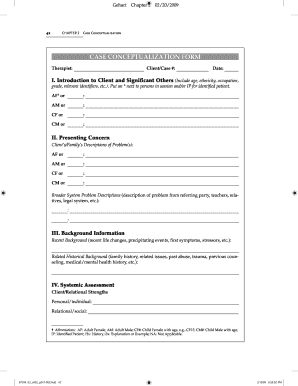
Hnicity, occupation, grade, relevant identifiers, etc.). Put an * next to persons in session and/or IP for identified patient. AF † or : AM or : CF or : CM or : II. Presenting Concern Client’s/Family’s Descriptions of Problem(s): AF or : AM or : CF or : CM or : Broader System Problem Descriptions (description of problem from referring party, teachers, relatives, legal system, etc.): : : III. Background Information Recent Background (recent life changes, precipitating event.

How it works

  1. Open form

    Open form follow the instructions

  2. Easily sign form

    Easily sign the form with your finger

  3. Share form

    Send filled & signed form or save

How to fill out the Gehart Chapter 2 Case Conceptualization Form online

This guide provides a comprehensive walkthrough for users to effectively complete the Gehart Chapter 2 Case Conceptualization Form online. By following these steps, you can ensure that all necessary information is accurately captured.

Follow the steps to successfully fill out the form.

  1. Click the ‘Get Form’ button to access the form and open it in your preferred editor.
  2. In the first section, enter the information about the therapist and the client. Make sure to include the client’s identification number and the date of the assessment.
  3. For the introduction to the client and significant others, provide details such as age, ethnicity, occupation, and any relevant identifiers. Mark those who are present in the session with an asterisk (*) or indicate the identified patient with 'IP'.
  4. In the presenting concern section, detail the client's or family's description of the problem, including broader system problems described by referring parties.
  5. Next, fill out the background information, detailing recent changes, precipitating events, and any historical background relevant to the client's issues.
  6. For the systemic assessment section, evaluate client and relational strengths, including personal, relational, and spiritual dimensions.
  7. Document the family structure and interaction patterns, including couple boundaries and communication stances as outlined in the form.
  8. Describe any intergenerational patterns that may relate to substance use, abuse histories, or mental health issues.
  9. Construct a genogram that maps out historical family relationships, including necessary details such as names, ages, and relational patterns.
  10. Finish the form by assessing client perspectives on areas of agreement and disagreement regarding the assessment, along with plans to respectfully address discrepancies.
  11. Once you have completed the form, ensure that all changes are saved. You may choose to download, print, or share the form as needed.

Take the next step in your case conceptualization by completing the Gehart Chapter 2 Case Conceptualization Form online today.

Get form

Experience a faster way to fill out and sign forms on the web. Access the most extensive library of templates available.
Get form

Related content

Mastering Competencies In Family Ther Pdf
Summary, case conceptualization, and discussion questions included in each chapter...
Learn more
(DOC) CaseConceptform-Satir1 (1).docx
This case conceptualization examines the dynamics within a family involving significant...
Learn more
MULTI-PHASE EXTRACTION - USACE Publications
Jun 1, 1999 — Following this introductory chapter, Chapter 2 provides a more detailed...
Learn more

Related links form

Assignment Of Agreement Addendum 2020 Sidings Possession Form 2020 Form Iv 2020 Danby Dpac7599 Pdf 2020

Questions & Answers

Get answers to your most pressing questions about US Legal Forms API.

Contact support

An example of a case formulation might involve a client presenting with anxiety and avoidance behavior. By using the Gehart Chapter 2 Case Conceptualization Form, a practitioner can identify the potential triggers of anxiety, explore the client’s thought patterns, and establish clear intervention strategies that address these issues. This structured approach not only clarifies the client's needs but also streamlines the treatment planning process.

Case conceptualization involves creating a comprehensive understanding of a client's problems by considering various factors, including personal history, environment, and psychological dynamics. This process helps in identifying goals and methods for treatment. The Gehart Chapter 2 Case Conceptualization Form provides a structured outline that makes this intricate task easier and more effective for professionals involved in mental health care.

While case formulation and case conceptualization are often used interchangeably, they can have slightly different focuses. Case formulation looks primarily at understanding a client's specific problems and establishing a treatment plan, whereas case conceptualization is broader and may encompass the client's history, strengths, and contextual factors. Utilizing the Gehart Chapter 2 Case Conceptualization Form can help clarify these distinctions and enhance your understanding.

Case formulation refers to the process of gathering and interpreting information about a client's issues to devise a clear understanding of their situation. It often includes identifying the problems, potential causes, and therapeutic approaches that may be helpful. The Gehart Chapter 2 Case Conceptualization Form provides a structured way to synthesize this information, enabling professionals to create effective treatment plans tailored to individual needs.

The 7 P's of case conceptualization include presenting problem, predisposing factors, precipitating factors, perpetuating factors, protective factors, process variables, and progress evaluations. This model is particularly effective for a comprehensive understanding of client issues. Leveraging the Gehart Chapter 2 Case Conceptualization Form helps structure these elements systematically. It ensures that you consider all aspects pertinent to developing a successful treatment plan.

To write a case formulation report, begin with a clear description of the client's presenting problem. Next, incorporate relevant background information and factor in the insights from the Gehart Chapter 2 Case Conceptualization Form. These elements need to be articulated succinctly, providing a coherent picture, followed by your proposed interventions. Ensure the report flows logically for easy comprehension.

Case conceptualization focuses on understanding a client’s challenges by integrating various factors surrounding their issue, while case formulation bridges this understanding with actionable steps for therapy. Essentially, the conceptualization is more about analysis, and formulation moves towards treatment planning. Utilizing the Gehart Chapter 2 Case Conceptualization Form can clarify these distinctions. With this structure, you can transition smoothly from understanding to action.

The 7 P's case formulation expands on traditional models and includes presenting problem, predisposing factors, precipitating factors, perpetuating factors, protective factors, process variables, and progress evaluations. This model provides a more detailed framework for professionals to understand client dynamics. The Gehart Chapter 2 Case Conceptualization Form is an excellent resource to implement these elements effectively. It allows for a thoughtful approach in developing suitable interventions.

In the 5 P assessment, the 5 P's are presenting problem, predisposing factors, perpetuating factors, protective factors, and plan. These components serve as a comprehensive framework for understanding the client's situation. The Gehart Chapter 2 Case Conceptualization Form can help you effectively document and analyze each area. By leveraging this form, you can enhance your assessment and treatment planning.

The 5 P's of case conceptualization are presenting problem, predisposing factors, perpetuating factors, protective factors, and plan. Each element provides distinct insights into the client’s issues, helping therapists formulate targeted interventions. The Gehart Chapter 2 Case Conceptualization Form simplifies this process, allowing clinicians to capture these important factors seamlessly. This ensures that every aspect of the client's experience is considered during treatment.

Get This Form Now!

Use professional pre-built templates to fill in and sign documents online faster. Get access to thousands of forms.
Get form
If you believe that this page should be taken down, please follow our DMCA take down processhere.

Industry-leading security and compliance

US Legal Forms protects your data by complying with industry-specific security standards.
  • In businnes since 1997
    25+ years providing professional legal documents.
  • Accredited business
    Guarantees that a business meets BBB accreditation standards in the US and Canada.
  • Secured by Braintree
    Validated Level 1 PCI DSS compliant payment gateway that accepts most major credit and debit card brands from across the globe.
Get Gehart Chapter 2 Case Conceptualization Form
Get form
Form Packages
Adoption
Bankruptcy
Contractors
Divorce
Home Sales
Employment
Identity Theft
Incorporation
Landlord Tenant
Living Trust
Name Change
Personal Planning
Small Business
Wills & Estates
Packages A-Z
Form Categories
Affidavits
Bankruptcy
Bill of Sale
Corporate - LLC
Divorce
Employment
Identity Theft
Internet Technology
Landlord Tenant
Living Wills
Name Change
Power of Attorney
Real Estate
Small Estates
Wills
All Forms
Forms A-Z
Form Library
Customer Service
Terms of Service
Privacy Notice
Legal Hub
Content Takedown Policy
Bug Bounty Program
About Us
Help Portal
Legal Resources
Blog
Affiliates
Contact Us
Delete My Account
Site Map
Industries
Forms in Spanish
Localized Forms
State-specific Forms
Forms Kit
Legal Guides
Real Estate Handbook
All Guides
Prepared for You
Notarize
Incorporation services
Our Customers
For Consumers
For Small Business
For Attorneys
Our Sites
US Legal Forms
USLegal
FormsPass
pdfFiller
signNow
airSlate WorkFlow
DocHub
Instapage
Social Media
Call us now toll free:
+1 833 426 79 33
As seen in:
  • USA Today logo picture
  • CBC News logo picture
  • LA Times logo picture
  • The Washington Post logo picture
  • AP logo picture
  • Forbes logo picture
© Copyright 1997-2025
airSlate Legal Forms, Inc.
3720 Flowood Dr, Flowood, Mississippi 39232
Form Packages
Adoption
Bankruptcy
Contractors
Divorce
Home Sales
Employment
Identity Theft
Incorporation
Landlord Tenant
Living Trust
Name Change
Personal Planning
Small Business
Wills & Estates
Packages A-Z
Form Categories
Affidavits
Bankruptcy
Bill of Sale
Corporate - LLC
Divorce
Employment
Identity Theft
Internet Technology
Landlord Tenant
Living Wills
Name Change
Power of Attorney
Real Estate
Small Estates
Wills
All Forms
Forms A-Z
Form Library
Customer Service
Terms of Service
Privacy Notice
Legal Hub
Content Takedown Policy
Bug Bounty Program
About Us
Help Portal
Legal Resources
Blog
Affiliates
Contact Us
Delete My Account
Site Map
Industries
Forms in Spanish
Localized Forms
State-specific Forms
Forms Kit
Legal Guides
Real Estate Handbook
All Guides
Prepared for You
Notarize
Incorporation services
Our Customers
For Consumers
For Small Business
For Attorneys
Our Sites
US Legal Forms
USLegal
FormsPass
pdfFiller
signNow
airSlate WorkFlow
DocHub
Instapage
Social Media
Call us now toll free:
+1 833 426 79 33
As seen in:
  • USA Today logo picture
  • CBC News logo picture
  • LA Times logo picture
  • The Washington Post logo picture
  • AP logo picture
  • Forbes logo picture
© Copyright 1997-2025
airSlate Legal Forms, Inc.
3720 Flowood Dr, Flowood, Mississippi 39232