We use cookies to improve security, personalize the user experience, enhance our marketing activities (including cooperating with our marketing partners) and for other business use.
Click "here" to read our Cookie Policy. By clicking "Accept" you agree to the use of cookies. Read less
Read more
Accept
Loading
Form preview
  • US Legal Forms
  • Form Library
  • More Forms
  • More Multi-State Forms
  • Cshcn Service Program Wheelchair Seating Evaluation Form Pdf

Get Cshcn Service Program Wheelchair Seating Evaluation Form Pdf

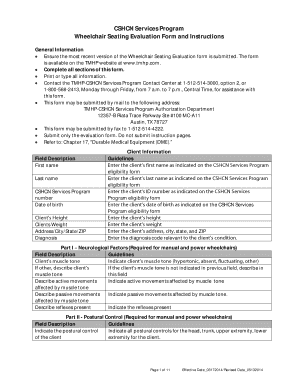
Is available on the TMHP website at www.tmhp.com. Complete all sections of this form. Print or type all information. Contact the TMHP-CSHCN Services Program Contact Center at 1-512-514-3000, option 2, or 1-800-568-2413, Monday through Friday, from 7 a.m. to 7 p.m., Central Time, for assistance with this form. This form may be submitted by mail to the following address: TMHP-CSHCN Services Program Authorization Department 12357-B Riata Trace Parkway Ste #100 MC-A11 Austin, TX 7872.

How it works

  1. Open form

    Open form follow the instructions

  2. Easily sign form

    Easily sign the form with your finger

  3. Share form

    Send filled & signed form or save

How to fill out the Cshcn Service Program Wheelchair Seating Evaluation Form Pdf online

Filling out the Cshcn Service Program Wheelchair Seating Evaluation Form Pdf online is an essential step for individuals seeking wheelchair seating evaluations. This guide provides a user-friendly overview of the form and detailed instructions to ensure a thorough completion.

Follow the steps to successfully complete the evaluation form online.

  1. Press the ‘Get Form’ button to obtain the Cshcn Service Program Wheelchair Seating Evaluation Form and open it in your preferred online editor.
  2. Begin by filling out the client information section. Provide the first name, last name, CSHCN Services Program number, date of birth, address, and relevant diagnosis. Ensure accuracy and completeness of all details.
  3. Proceed to Part I, Neurological Factors. Describe the active and passive movements affected by muscle tone and any reflexes present. This information is crucial for understanding the client’s needs.
  4. In Part II, Postural Control, indicate the level of head, trunk, upper extremity, and lower extremity control. Use the options given to provide a clear profile of the client’s postural capabilities.
  5. Move to Part III, Medical/Surgical History and Plans. Answer questions regarding skin integrity, orthopedic conditions, and any anticipated surgeries. Be detailed in your explanations to provide context for the evaluation.
  6. Complete Part IV, Functional Assessment, by indicating the client’s ambulatory status, dependency on a wheelchair, and feeding capabilities. This helps establish the functional needs of the client.
  7. In Part V, Environmental Assessment, describe the accessibility of the client’s home and school environment. This information will assist in determining the suitability of recommended equipment.
  8. Move to Part VI, Requested Equipment. Indicate the wheelchair type, serial number, purchase date, and medical necessity for the requested equipment. Provide a clear justification for any modifications needed.
  9. If applicable, complete Part VII for Power Wheelchairs. Describe the medical necessity for a power wheelchair and how it will be operated. Ensure that all questions are answered comprehensively.
  10. Lastly, ensure that the therapist signs the form, indicating their qualification to assess and recommend the equipment needed. Save your changes and download, print, or share the completed form as necessary.

Ready to complete your document? Fill out the Cshcn Service Program Wheelchair Seating Evaluation Form Pdf online now.

Get form

Experience a faster way to fill out and sign forms on the web. Access the most extensive library of templates available.
Get form

Related content

Commission for Children with Special Health Care...
retention schedule should cover all records for the Commission for Children with Special...
Learn more
27th International Seating Symposium • March...
219: PS 3.5: A Generic Backrest Shape Generated from 3D. Anatomical Scans ... CSHCN...
Learn more
Provider Manual - Molina Healthcare
accessible services in an efficient and caring manner. Core Values ... Enrollment...
Learn more

Related links form

UK EDF Energy VAT Certificate Of Declaration 2006 ID Termination Of Parental Rights 2022 Music Office Agreement For Sound Contracting 2008 IRS Publication 915 2023

Questions & Answers

Get answers to your most pressing questions about US Legal Forms API.

Contact support

Wheelchair Evaluation Seat width, depth, and height. Patient hip, trunk, and shoulder widths. Patient shoulder and axillae heights. WC Leg length, arm height, back height. WC width, height, and size. Knee-to-seat depth. Knee-to-heel length. Seat-to-back support angle.

What can I expect during the wheelchair evaluation? The evaluation will take approximately 2 hours. The physical or occupational therapist will be present at the time of the evaluation, along with a representative from a wheelchair company to assist in identifying the most appropriate equipment for you.

Typically the clinician is an Occupational Therapist (OT) or Physical Therapist (PT), so the prescription from your doctor will read, "OT or PT Wheelchair Evaluation." Getting a prescription from your doctor is essential, because it allows a therapist (OT or PT) to conduct an evaluation.

In most cases the physical assessment will also include a full musculoskeletal examination of the users range of motion, joint flexibility, muscle length, and skeletal alignment, with neurological issues such as tone and spasm pattern also noted as they affect posture and muscle length.

To assess the seated position effectively, you must: Ensure the seat depth matches the person's leg length correctly. Are the hips level? Ensure the seat or footplate height is set for correct loading of the legs and feet. Make sure the seat cushion is given maximum pressure management.

Here are the key components of a mat exam that we need to include. Muscle Tone. Muscle Strength. Range of Motion. Reflexes. Movement patterns. Postural Control.

The MAT assessment was designed to make sure that all child/family needs are assessed when a child/youth enters foster care. This assessment is meant to help a family meet some special needs a child or children may have that place this family in danger of a lengthy separation.

Here are the key components of a mat exam that we need to include. Muscle Tone. Muscle Strength. Range of Motion. Reflexes. Movement patterns. Postural Control.

Get This Form Now!

Use professional pre-built templates to fill in and sign documents online faster. Get access to thousands of forms.
Get form
If you believe that this page should be taken down, please follow our DMCA take down processhere.

Industry-leading security and compliance

US Legal Forms protects your data by complying with industry-specific security standards.
  • In businnes since 1997
    25+ years providing professional legal documents.
  • Accredited business
    Guarantees that a business meets BBB accreditation standards in the US and Canada.
  • Secured by Braintree
    Validated Level 1 PCI DSS compliant payment gateway that accepts most major credit and debit card brands from across the globe.
Get Cshcn Service Program Wheelchair Seating Evaluation Form Pdf
Get form
Form Packages
Adoption
Bankruptcy
Contractors
Divorce
Home Sales
Employment
Identity Theft
Incorporation
Landlord Tenant
Living Trust
Name Change
Personal Planning
Small Business
Wills & Estates
Packages A-Z
Form Categories
Affidavits
Bankruptcy
Bill of Sale
Corporate - LLC
Divorce
Employment
Identity Theft
Internet Technology
Landlord Tenant
Living Wills
Name Change
Power of Attorney
Real Estate
Small Estates
Wills
All Forms
Forms A-Z
Form Library
Customer Service
Terms of Service
Privacy Notice
Legal Hub
Content Takedown Policy
Bug Bounty Program
About Us
Help Portal
Legal Resources
Blog
Affiliates
Contact Us
Delete My Account
Site Map
Industries
Forms in Spanish
Localized Forms
State-specific Forms
Forms Kit
Legal Guides
Real Estate Handbook
All Guides
Prepared for You
Notarize
Incorporation services
Our Customers
For Consumers
For Small Business
For Attorneys
Our Sites
US Legal Forms
USLegal
FormsPass
pdfFiller
signNow
airSlate WorkFlow
DocHub
Instapage
Social Media
Call us now toll free:
+1 833 426 79 33
As seen in:
  • USA Today logo picture
  • CBC News logo picture
  • LA Times logo picture
  • The Washington Post logo picture
  • AP logo picture
  • Forbes logo picture
© Copyright 1997-2025
airSlate Legal Forms, Inc.
3720 Flowood Dr, Flowood, Mississippi 39232
Form Packages
Adoption
Bankruptcy
Contractors
Divorce
Home Sales
Employment
Identity Theft
Incorporation
Landlord Tenant
Living Trust
Name Change
Personal Planning
Small Business
Wills & Estates
Packages A-Z
Form Categories
Affidavits
Bankruptcy
Bill of Sale
Corporate - LLC
Divorce
Employment
Identity Theft
Internet Technology
Landlord Tenant
Living Wills
Name Change
Power of Attorney
Real Estate
Small Estates
Wills
All Forms
Forms A-Z
Form Library
Customer Service
Terms of Service
Privacy Notice
Legal Hub
Content Takedown Policy
Bug Bounty Program
About Us
Help Portal
Legal Resources
Blog
Affiliates
Contact Us
Delete My Account
Site Map
Industries
Forms in Spanish
Localized Forms
State-specific Forms
Forms Kit
Legal Guides
Real Estate Handbook
All Guides
Prepared for You
Notarize
Incorporation services
Our Customers
For Consumers
For Small Business
For Attorneys
Our Sites
US Legal Forms
USLegal
FormsPass
pdfFiller
signNow
airSlate WorkFlow
DocHub
Instapage
Social Media
Call us now toll free:
+1 833 426 79 33
As seen in:
  • USA Today logo picture
  • CBC News logo picture
  • LA Times logo picture
  • The Washington Post logo picture
  • AP logo picture
  • Forbes logo picture
© Copyright 1997-2025
airSlate Legal Forms, Inc.
3720 Flowood Dr, Flowood, Mississippi 39232