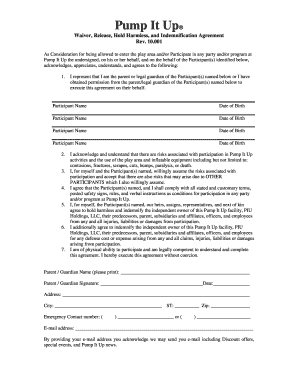
Mp It Up the undersigned, on his or her behalf, and on the behalf of the Participant(s) identified below, acknowledges, appreciates, understands, and agrees to the following: 1. I represent that I am the parent or legal guardian of the Participant(s) named below or I have obtained permission from the parent/legal guardian of the Participant(s) named below to execute this agreement on their behalf. Participant Name Date of Birth Participant Name Date of Birth Participant Name Date of Birth.
Loading
Open form follow the instructions
Easily sign the form with your finger
Send filled & signed form or save
How to fill out the Pump It Up Waiver Release Hold Harmless and Indemnification Agreement online
Filling out the Pump It Up Waiver Release Hold Harmless and Indemnification Agreement online is a crucial step for participants to ensure safety and compliance. This guide will provide clear and concise instructions to help users navigate the form easily.
Follow the steps to successfully complete your waiver online.
- Click ‘Get Form’ button to access the waiver and open it in your document editing interface.
- Indicate your relationship to the participant(s) by selecting the appropriate option, ensuring that you are the parent or legal guardian, or that you have permission from the legal guardian.
- Fill in the participant names along with their respective dates of birth in the fields provided. Ensure accuracy as this information is essential for processing the waiver.
- Read the section on risks associated with participation carefully. Acknowledge your understanding by confirming that you accept the risks outlined.
- Agree to comply with all posted safety regulations and verbal instructions by checking the corresponding box, indicating your commitment to safety policies.
- Complete the indemnification section by understanding that you agree to hold harmless and indemnify the mentioned entities in case of any injuries or damages that may occur.
- Provide your full name as the parent or guardian, sign the document, and include the date of signing in the designated fields.
- Enter your address, city, state, and zip code as required in the corresponding fields.
- Input an emergency contact number, ensuring you provide at least one complete format as required by the form.
- Finally, include your email address to receive important updates and offers. Review all entries for accuracy before final submission.
- Once all fields are filled out, save changes, then download, print, or share the form as needed.
Complete your document online today to ensure a safe and enjoyable experience at Pump It Up!
Experience a faster way to fill out and sign forms on the web. Access the most extensive library of templates available.
Related content
Pump It Up®. Waiver, Release, Hold Harmless, and Indemnification Agreement. Rev. 13.08...
by RB Malamud · 1992 · Cited by 12 — agree to indemnify, defend, and hold harmless...
Apr 24, 2013 — respect to the release or threatened release concerned. (e)(1) No...
Get answers to your most pressing questions about US Legal Forms API.
What are the three types of indemnification?
The three types of indemnification include contractual indemnification, implied indemnification, and statutory indemnification. Contractual indemnification arises from a specific agreement between parties, while implied indemnification occurs based on the relationship and circumstances, irrespective of a formal contract. Statutory indemnification is set by law, holding parties responsible according to legal standards. Understanding these categories is essential when evaluating the Pump It Up Waiver Release Hold Harmless and Indemnification Agreement to ensure comprehensive protection.
What is the difference between indemnification and hold harmless agreement?
Indemnification and hold harmless agreements serve different purposes in legal contexts. Indemnification involves compensating another party for losses or damages they may face, while a hold harmless agreement prevents one party from being held liable for those damages in the first place. When you look at the Pump It Up Waiver Release Hold Harmless and Indemnification Agreement, both terms ensure that participants acknowledge the risks involved and clearly define liability in a recreational or event setting.
What is a release indemnification and hold harmless agreement?
A release indemnification and hold harmless agreement is a legal document that protects one party from liability for injuries or damages incurred by another party. Essentially, it ensures that if one party is hurt or suffers a loss while participating in certain activities, the other party will not be held responsible. This agreement is commonly used in recreational settings and events, including those associated with the Pump It Up Waiver Release Hold Harmless and Indemnification Agreement. By signing, participants acknowledge the risks involved and agree to waive their right to seek compensation for injuries.
What is the difference between indemnification and waiver of liability?
Indemnification and waiver of liability serve different purposes in legal agreements. Indemnification involves one party agreeing to compensate the other for losses or damages, while a waiver of liability involves a party relinquishing their right to sue for damages. The Pump It Up Waiver Release Hold Harmless and Indemnification Agreement incorporates both elements, providing comprehensive protection for businesses and individuals alike.
What is the employee release liability waiver and indemnification agreement?
The employee release liability waiver and indemnification agreement informs employees about potential risks related to their job. This document requires employees to waive their rights to claim damages for certain incidents, thus protecting the employer. Utilizing the Pump It Up Waiver Release Hold Harmless and Indemnification Agreement can help streamline this process efficiently.
What is the employee liability waiver and indemnification agreement?
The employee liability waiver and indemnification agreement is a document that protects employers from claims made by employees. By signing this agreement, employees acknowledge the risks associated with their work and agree not to hold the employer responsible for certain types of incidents. The Pump It Up Waiver Release Hold Harmless and Indemnification Agreement is essential for organizations to safeguard against potential liabilities.
What is a release of liability and indemnification agreement?
A release of liability and indemnification agreement is a legal document designed to protect one party from legal claims resulting from the actions of another. This agreement typically states that the signer waives their right to sue and agrees to hold the other party harmless in case of any claims or damages. The Pump It Up Waiver Release Hold Harmless and Indemnification Agreement serves to minimize risk for businesses and participants.
What is another name for hold harmless agreement?
A hold harmless clause is also called a release of liability, a waiver of liability, a save harmless clause, or a hold harmless letter or release. These agreements are usually seen in leases, contracts, and easements, in an attempt to protect either one party or both.
What is the difference between hold harmless and waiver?
Hold Harmless Agreement vs. Essentially, one party is held free from liability in the case of an accident or damage. A waiver of subrogation obligates one party to give up the right for their insurer to subrogate or to step in on the insured's behalf to recover any losses by suing the party at fault.
What is the difference between hold harmless and release of liability?
A hold harmless agreement is also called a “release of liability” or a “waiver of liability.” It can be reciprocal or unilateral. A reciprocal hold harmless agreement says neither party will hold the other party responsible for losses. A unilateral hold harmless agreement protects only one party.
Use professional pre-built templates to fill in and sign documents online faster. Get access to thousands of forms.
If you believe that this page should be taken down, please follow our DMCA take down process here.