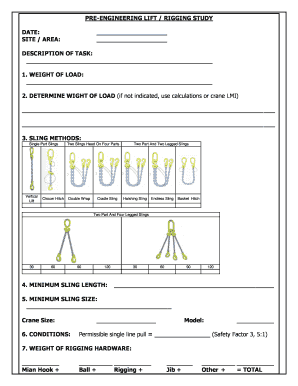
PREENGINEERING LIFT / RIGGING STUDY DATE: SITE / AREA: DESCRIPTION OF TASK: 1. WEIGHT OF LOAD: 2. DETERMINE WIGHT OF LOAD (if not indicated, use calculations or crane LMI) 3. SLING METHODS: Single.
Open form follow the instructions
Easily sign the form with your finger
Send filled & signed form or save
How to fill out the Rigging Study Template online
Filling out the Rigging Study Template is essential for ensuring safe and effective rigging operations. This guide provides comprehensive instructions on each section of the template to help users complete it accurately and efficiently.
Follow the steps to successfully fill out the Rigging Study Template online.
- Press the ‘Get Form’ button to obtain the Rigging Study Template and open it for editing.
- Insert the date and the specific site or area where the lift will occur in the designated fields.
- In the description of the task section, provide a detailed summary of the lifting operation intended.
- Enter the weight of the load in the given space. If the weight is not indicated, proceed to calculate it using appropriate methods or crane load moment indicator (LMI).
- Select the sling methods being implemented for the lift and document them under the appropriate sling methods section.
- Determine the minimum sling length required and input that information into the provided field.
- Specify the minimum sling size necessary for the operation and enter the crane size in the respective sections.
- List the conditions affecting the lift, including the size of the crane model and permissible pull limits considering safety factors.
- Calculate the total weight of the rigging hardware by summing the weights of all components, including hooks and balls.
- Document the actual load to be lifted by summing the calculated load weight and the weight of rigging hardware.
- Specify the reeving, including the parts of the line required for jib hooks and main blocks.
- Measure and determine the minimum load radius, boom length, boom angle, jib length, and jib angle, inputting the values accordingly.
- Choose options from the crane load chart based on the operational setup: on rubber or outriggers.
- Select the work area quadrants relevant to the lift, ensuring to address stability requirements.
- Enter the netto lifting capacity as specified on the load chart.
- Conduct a thorough risk analysis by checking ground conditions, wind speed, overhead power lines, and ensuring proper crane setup.
- Compare the netto lifting capacity to the actual load weight and state whether the lift is to be made or not based on the comparison.
- Complete the personal protective equipment section, listing the required safety gear.
- Have the rigger and crane driver sign the form, including their names and company numbers.
- Document any observations by a supervisor regarding compliance with the pre-engineering lift requirements and list any corrective measures if needed.
- Finally, save changes to the completed form, and utilize options to download, print, or share the template as necessary.
Complete your Rigging Study Template online today to ensure a safe lifting operation.
Experience a faster way to fill out and sign forms on the web. Access the most extensive library of templates available.
Related content
For additional lift plan examples, or to compare an ordinary lift planning to planning...
Apr 4, 2017 — But for the final, we can try to study in groups by doing practice...
A sail plan is a description of the specific ways that a sailing craft is rigged, as...
Get answers to your most pressing questions about US Legal Forms API.
How do you calculate load capacity?
Add together the wattage capacity of all general lighting branch circuits. Add in the wattage rating of all plug-in outlet circuits. Add in the wattage rating of all permanent appliances (ranges, dryers, water heaters, etc.) Subtract 10,000. Multiply this number by . ... Add 10,000.
What is rigging plan on ship?
Detailed written information regarding the load or loads must be obtained. Description of the load,type of equipment for example vessel,containor or motor. Weight: net gross weight including rigging and other accessories. ... Rigging safety is absorved and noted down for safety of rigging personel.
What is the purpose of rigging?
Rigging is the proper installation of airframe components (wings, ailerons and tail surfaces) designed to do a specific aerodynamic job and contribute to the aircraft's overall performance, stability and safety. Proper rigging insures that the designer's intent concerning performance, stability and safety are insured.
What is basic rigging?
Introduction: This training course was developed to provide maintenance employees (Artisans) with no formal Rigger qualification, with adequate knowledge and skills to execute the required Rigging Operations safely, according to pre-set standards, to lift loads to a maximum weight of 5 Ton.
What is difference between lifting and rigging?
Rigging refers to the maneuvering of heavy objects by way of pushing, pulling, lifting or hoisting. Lifting is a way to move heavy objects by moving the object up from below most commonly using a jack.
How do you do a critical lift plan?
Considering the Site. Take a look at the area where the critical lift will take place. ... Ensure Proper Equipment Is on Site. Let's assume it's the day of the lift. ... Proper Crane Setup. ... Ensure the Correct Personnel Are on Site.
How is rigging load calculated?
Introduction: This training course was developed to provide maintenance employees (Artisans) with no formal Rigger qualification, with adequate knowledge and skills to execute the required Rigging Operations safely, according to pre-set standards, to lift loads to a maximum weight of 5 Ton.
How do I make a rigging plan?
Verify all equipment, fixtures, and accessories before starting. Verify that all equipment has been properly inspected and that such inspections are valid. Identify a load manager or a rigging leader. ... Conduct a pre-use inspection and verify that all components are in good condition.
What is a rigging study?
The study consists of a detailed scale drawing showing the crane position in relation to the equipment being lifted. A complete analysis of the crane loads, rigging loads, ground conditions, wind effects and equipment weight are considered in the drawing. A detailed lift procedure is developed and shown on the drawing.
What is required in a lift plan?
The plan for any lifting operation must address the foreseeable risks involved in the work and identify the appropriate resources (including people) necessary for safe completion of the job. Factors to include may be any or all of the following: working under suspended loads. visibility.
Use professional pre-built templates to fill in and sign documents online faster. Get access to thousands of forms.
If you believe that this page should be taken down, please follow our DMCA take down process here.