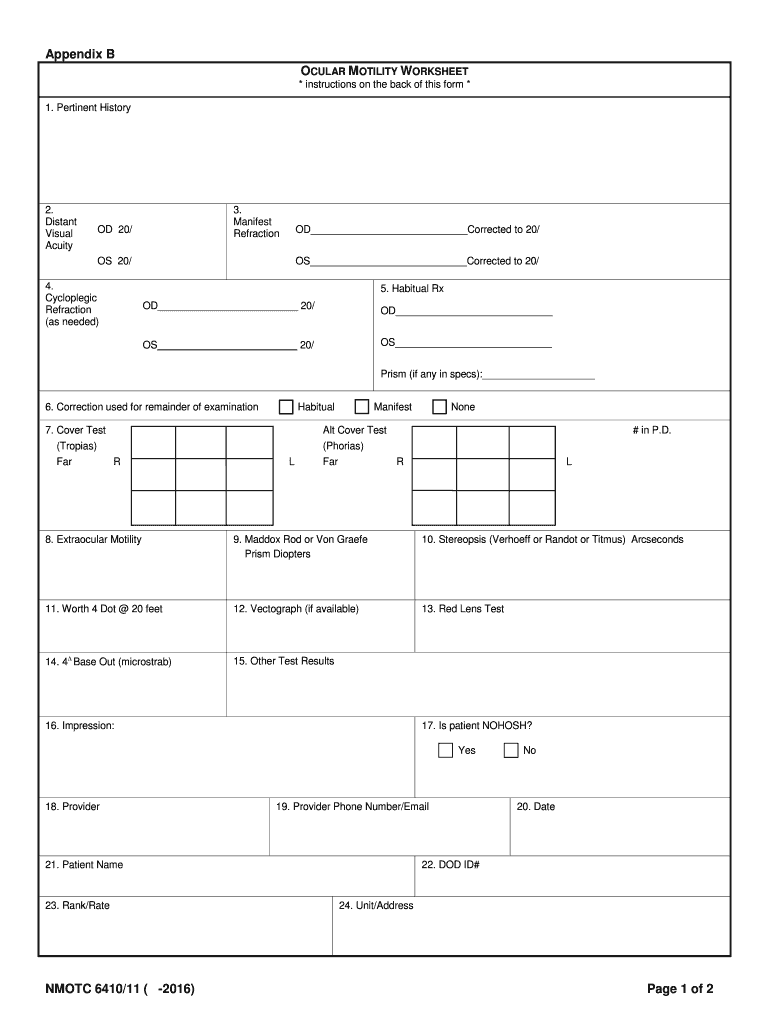
NMOTC 6410/11 ( -2016). Page 1 of 2. Appendix B. OCULAR MOTILITY WORKSHEET. * instructions on the back of this form *. 1. Pertinent ... 24. Unit/ Address .

Open form follow the instructions

Easily sign the form with your finger

Send filled & signed form or save
How to use or fill out the OCULAR MOTILITY WORKSHEET - Med Navy online
Filling out the ocular motility worksheet is an essential step for ensuring accurate assessment in ocular health. This guide provides clear, step-by-step instructions to assist users in completing the form correctly and efficiently.
Follow the steps to complete the ocular motility worksheet effectively.
- Press the ‘Get Form’ button to acquire the form and open it in a suitable editor.
- Begin with section 1: Pertinent history. Include relevant information such as past conditions or treatments, like 'scored 7 esophoria on AFVT' or 'strabismus surgery age 6 years.'
- For section 2, enter the distant visual acuity measurements for each eye as directed.
- In section 3, record the manifest refraction for the right eye (OD) followed by the left eye (OS). Ensure correctness as it will influence future treatment.
- Complete section 4 with the cycloplegic refraction if needed for specific candidates, following the same format as above.
- Section 5 pertains to habitual prescription. Document the habitual prescription for both eyes, noting any required prism adjustments.
- For section 6, indicate the correction used for the remainder of the examination, selecting either habitual or a specified alternative.
- In section 7, choose between 'None' or 'Alt Cover Test' for the cover test, reporting any observed issues.
- Document the findings for extraocular motility in section 8, providing a description such as 'Smooth and full.'
- In section 9, report prism diopter values using the Maddox rod or Von Graefe method, ensuring fixation at 20 feet.
- In section 10, measure stereopsis and record in arcseconds using appropriate testing methods.
- Complete section 11 with results from the Worth 4 Dot test at both distance and near measurements.
- For section 12, if available, document findings from the vectograph test, noting any suppression.
- Conduct the red lens test as noted in section 13, ensuring to test all required eye positions.
- Proceed with the 4Δ base out test in section 14 if applicable, documenting results as necessary.
- In section 15, summarize any additional test results that may be pertinent.
- Provide an impression in section 16 based on all accumulated data.
- Answer section 17 regarding the patient's NOHOSH status accurately.
- Document the provider's name in section 18, followed by their phone number and email address in section 19.
- Complete the remaining user information in sections 21 through 24 as required.
- Once finished, save changes, download, print, or share the completed form as needed.
Complete your ocular motility worksheet online today for a thorough assessment.
Experience a faster way to fill out and sign forms on the web. Access the most extensive library of templates available.
Related content
Aug 30, 2017 — Matters involving FAA medical certification of military personnel; or...
Dec 14, 2007 — U.S. Military Academy, Reserve Officers' Training Corps, and Officer...
Nov 20, 1995 — military are JP-4, JP-5, JP-6, JP-7, and JP-8. ... toxicity, motility in...
Get answers to your most pressing questions about US Legal Forms API.
Why do you do ocular motility?
Our ocular motility service treats people who have problems with their eye movements, eye alignment or double vision. Our ocular motility service treats people who have problems with their eye movements, eye alignment or double vision.
How to do ocular motility test?
Your provider will hold a pen or other object about 16 inches or 40 centimeters (cm) in front of your face. The provider will then move the object in several directions and ask you to follow it with your eyes, without moving your head. A test called a cover/uncover test may also be done.
What are the different types of ocular motility?
There are four basic types of eye movements: saccades, smooth pursuit movements, vergence movements, and vestibulo-ocular movements.
When should ocular motility be done?
The measurement of ocular motility is part of the routine evaluations of the ophthalmologist. However, this test should be done whenever the specialist receives a patient with double vision, Eye fatigue, alignment problems, strabismus or nystagmus.
What is the law of ocular motility?
A fundamental principle of ocular motility is the law of equal innervation of both eyes. It states that, in spite of mirror-symmetrical arrangement of the neural and muscular control for the right and left eyes, the two eyes routinely move in parallel.
Use professional pre-built templates to fill in and sign documents online faster. Get access to thousands of forms.
If you believe that this page should be taken down, please follow our DMCA take down process here.