Loading
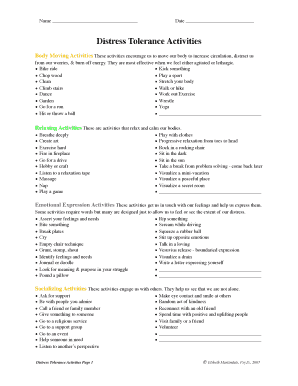
Get Distress Tolerance Activities
How it works
-

Open form follow the instructions
-

Easily sign the form with your finger
-

Send filled & signed form or save
How to fill out the Distress Tolerance Activities online
This guide provides a clear and supportive approach to completing the Distress Tolerance Activities form online. By following these steps, users will be able to effectively engage with activities designed to enhance emotional regulation and improve well-being.
Follow the steps to complete the form successfully.
- Click the ‘Get Form’ button to access the Distress Tolerance Activities form and open it in your preferred online editor.
- Begin by entering your name in the designated field at the top of the form. This personalizes your document and ensures it is tailored to your activities.
- Next, fill in the date in the corresponding section. This helps to track when the activities are being recorded.
- Review the sections labeled 'Body Moving Activities,' 'Relaxing Activities,' 'Emotional Expression Activities,' 'Socializing Activities,' 'In the Moment Activities,' 'Sensation Focused Activities,' and 'Thought Challenge Activities.' Each section contains a list of activities you can engage in. Carefully consider each activity and select those that resonate with you.
- For each section, you may check or mark the activities you wish to try or have completed. This helps to structure your approach to distress tolerance effectively.
- Once you have completed all sections, take a moment to review your selections to ensure they reflect your current needs and preferences.
- After reviewing, you can choose to save any changes made to the form, download a copy for your records, print it for physical reference, or share it with a trusted individual if desired.
Begin filling out your Distress Tolerance Activities form online today to take a proactive step towards managing your distress.
Distress tolerance skills refer to a type of intervention in Dialectical Behavioral Therapy (DBT) where clients learn to manage distress in a healthy way. These skills are helpful for situations where a client might not be able to control a situation, but they need to manage their own response.