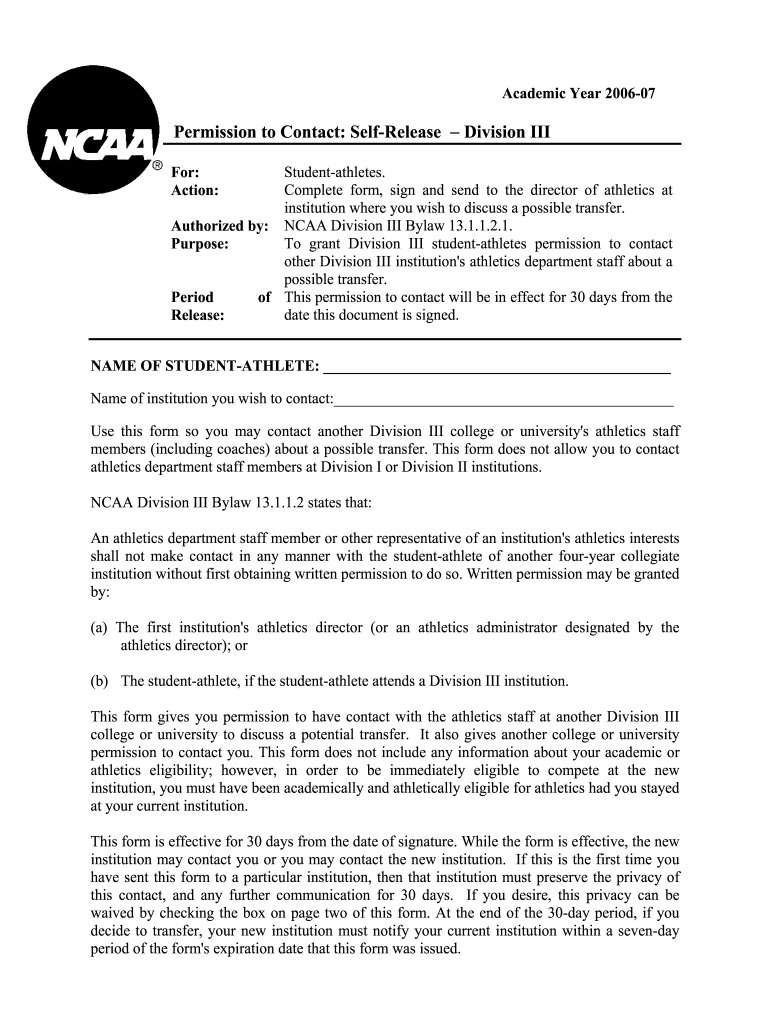
Is second release is beyond the first 30-day period, you are not guaranteed privacy for a second (or any other) self-release. Within seven days of receiving a second form from you, the college or university must notify your current institution that a second release was issued. By signing this form, you agree that you permit the named college or university to contact you for a 30-day period from the date this document is signed. You also agree that if you decide to transfer, or if you send a seco.
Loading

Open form follow the instructions

Easily sign the form with your finger

Send filled & signed form or save
How to fill out the NCAA D3 Self-Release Form online
Filling out the NCAA D3 Self-Release Form is an important step for student-athletes considering transferring to another Division III institution. This guide will walk you through the online process in a clear and supportive manner to ensure that you complete the form accurately.
Follow the steps to successfully complete the self-release form online.
- Press the ‘Get Form’ button to access the NCAA D3 Self-Release Form and open it in your preferred online editor.
- In the designated field, enter your full name as the student-athlete. Ensure that this matches the official records at your current institution.
- Specify the name of the institution you wish to contact regarding your potential transfer. This must be a Division III college or university.
- Indicate the sports you are interested in playing at the new institution by filling in the related field.
- Provide your current contact information, including a telephone number, email address, or physical address, to facilitate communication.
- Read the consent statements carefully. Check the appropriate boxes if this is the first release provided to the institution, or if you grant permission for them to notify your current institution.
- Sign the form in the designated area to authenticate your request. Remember to include the date of signing.
- Print the completed form to retain a copy for your records.
- Send the signed form to the director of athletics at the institution you wish to contact via email, fax, or standard mail. Ensure that your signature is included, even in digital formats.
- Once submitted, monitor any communications from the new institution within the 30-day active period of this release.
Take control of your future by filling out the NCAA D3 Self-Release Form online today.
Experience a faster way to fill out and sign forms on the web. Access the most extensive library of templates available.
Related content
Apr 30, 2015 — The self-release applies only to transfers from a Division III school to...
Completing this form gives you permission to have contact with the athletics staff at...
Jan 8, 2013 — Listing of All Files from GEnie Apple II Roundtable Bulletin Boards. File:...
Get answers to your most pressing questions about US Legal Forms API.
How to get NIL deals in D3?
To secure NIL deals as a Division III athlete, focus on building your personal brand and engaging with your community. Establishing a solid online presence can help attract potential sponsors. Additionally, understanding NCAA regulations and using the NCAA D3 Self-Release Form when necessary will support your eligibility and opportunities. This way, you can enjoy the benefits of NIL while navigating your collegiate athletics.
Do any D3 players have NIL deals?
Yes, some Division III athletes are starting to secure Name, Image, and Likeness (NIL) deals, even without the NLI structure. D3 athletes can take advantage of the NCAA's new guidelines on NIL opportunities. As an athlete, knowing how to navigate these deals may enhance your collegiate experience. For those considering transferring or managing your status, the NCAA D3 Self-Release Form is important in staying in compliance and clear about your intentions.
Do you commit to a D3 school?
Committing to a Division III school is typically less formal than committing to other divisions. You can express your interest and intent without the binding contract of an NLI. However, once you commit, it’s vital to maintain communication with the coaching staff. If circumstances change and you need to leave, using the NCAA D3 Self-Release Form will help make the transition more straightforward.
Does NLI apply to D3?
The National Letter of Intent (NLI) does not apply to NCAA Division III schools. D3 athletics prioritize the balance between academics and sports, allowing for a more personal decision-making process regarding school commitments. Therefore, if you are considering a transfer or want to leave your current team, completing the NCAA D3 Self-Release Form is essential. It supports your journey to find a better fit.
Do D3 athletes have to enter the Transfer Portal?
While entering the Transfer Portal is not a requirement for D3 athletes, it can be a helpful tool for those considering a transfer. It enables your current school to notify other institutions of your availability. However, you must still complete the NCAA D3 Self-Release Form to officially start your transfer process. That way, you are covered and have a strategy to move forward.
How do you transfer out of D3?
To transfer out of a Division III school, you typically need to submit a request through your athletic department. This is where the NCAA D3 Self-Release Form becomes crucial. It formally documents your intention to leave and allows you to explore opportunities at other institutions without jeopardizing your eligibility. Keep communication open with your current coaches while navigating this process.
Does D3 have NLI?
NCAA Division III does not have a National Letter of Intent (NLI) like other divisions. Instead, D3 schools offer a more flexible approach for student-athletes. This means you can commit to a school without being bound by an NLI, allowing you more freedom in your college choice. However, if you decide to leave and need to complete your NCAA D3 Self-Release Form, it’s important to follow the proper procedures.
Do D3 athletes have to enter Transfer Portal?
D3 athletes are not required to enter the Transfer Portal, but doing so can provide a structured method for exploring other options. If you intend to transfer, filling out the NCAA D3 Self-Release Form is essential, as it allows coaches from other schools to contact you legally. This can ultimately help you find a new environment that aligns with your aspirations.
Can you transfer out of D3?
Yes, you can transfer out of Division 3 schools. Many student-athletes make this choice for various reasons, including seeking new opportunities or challenges. Completing the NCAA D3 Self-Release Form is critical in this process, as it signifies your intent and helps maintain your eligibility during the transfer.
How can a D3 school become D1?
For a D3 school to transition to Division 1, the institution must first meet specific criteria set by the NCAA. This typically includes demonstrating financial stability, adequate facilities, and compliance with D1 standards. The process is extensive and requires strategic planning, but successfully navigating it can open new opportunities for athletic programs.
Use professional pre-built templates to fill in and sign documents online faster. Get access to thousands of forms.
If you believe that this page should be taken down, please follow our DMCA take down process here.
This form is available in several versions. Select the version you need from the drop-down list below.