7 Payments .....................................................................................................7 Owners Changes ................................................................................................7 Schedule of Work ...............................................................................................7 Dispute Resolution, Termination .
Open form follow the instructions
Easily sign the form with your finger
Send filled & signed form or save
How to fill out the NGWA Water Well Drilling Agreement online
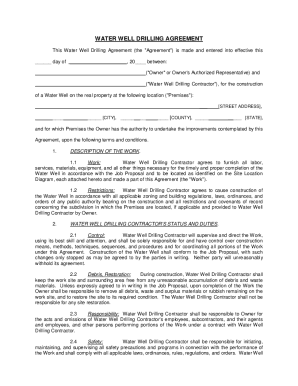
The NGWA Water Well Drilling Agreement is an essential document for establishing terms between property owners and water well drilling contractors. This guide provides a clear and structured approach to completing the agreement online, ensuring that all necessary details are accurately captured.
Follow the steps to effectively complete the NGWA Water Well Drilling Agreement.
- Click ‘Get Form’ button to access the NGWA Water Well Drilling Agreement and open it in your preferred online editor.
- Identify the parties involved. Enter the Property Owner's full legal name and the name of the Water Well Drilling Contractor accurately in the designated fields.
- Provide the property description. Enter an exact legal description of the property where the well will be located to ensure compliance with legal requirements.
- Describe the work to be performed. Include specific details about the well drilling, attaching any necessary Job Proposals and Site Location Diagrams to clarify the scope of work.
- Outline the contractor's status and duties. Ensure clarity regarding the responsibilities of the Water Well Drilling Contractor throughout the project.
- Set the contract price. Clearly state the drilling price, materials cost, total price, and any applicable discounts or initial payments, confirming that this aligns with the Job Proposal.
- Document any changes. Include a section for Owner's changes, ensuring that any modifications to the work are formally documented and agreed upon in writing.
- Schedule the work. Specify the start date and completion expectations to provide a clear timeline for both parties involved.
- Review the dispute resolution and termination clauses. Clarify how any disputes will be handled, emphasizing mediation and arbitration processes.
- Add warranties and acknowledgments. Ensure that all warranties for the workmanship, materials, and information regarding potential contaminants are clearly stated.
- Final step — signatures. Both the Owner and the Water Well Drilling Contractor must sign the agreement to formalize it. Ensure two copies are signed for both parties.
- Save the document, download it for your records, or print a copy as needed. You may also share the completed agreement with relevant parties.
Complete the NGWA Water Well Drilling Agreement online to ensure a smooth and well-defined collaboration for your water well project.
Experience a faster way to fill out and sign forms on the web. Access the most extensive library of templates available.
Related content
Can I drill my own well? A: New York State Building Code requires all wells to be drilled...
NGWA is a credible, valued resource on significant and timely issues that impact the...
This document is not an U.S. EPA policy, guidance or regulation. It does not create or...
Get answers to your most pressing questions about US Legal Forms API.
How hard is it to drill your own well?
Drilling your own well can be quite challenging, requiring physical stamina and technical knowledge. Factors such as soil type and depth play significant roles in the difficulty. To navigate these challenges successfully, consult resources from the NGWA Water Well Drilling Agreement for best practices and industry standards. Preparing yourself with the right information is key to making this endeavor easier.
Can you drill a water well yourself?
You can indeed drill a water well yourself, provided you possess the right tools and knowledge. Familiarizing yourself with local regulations is essential to ensure compliance. Use resources associated with the NGWA Water Well Drilling Agreement to guide you through the process. While DIY well drilling is feasible, professional expertise can yield more reliable results.
What is the cheapest way to drill a well?
The cheapest way to drill a well often involves DIY methods, but this requires a strong understanding of the process and equipment. Alternatively, using a manual well-drilling rig can reduce costs compared to hiring professionals. Always consider the long-term reliability of your water source, emphasizing the importance of following guidelines found in the NGWA Water Well Drilling Agreement to avoid costly mistakes.
Can you drill your own water well?
Yes, you can drill your own water well, but be aware of the local laws and regulations governing such actions. DIY drilling can be challenging, which is why many individuals seek professional help. Engaging with resources available through the NGWA Water Well Drilling Agreement can offer guidance. It’s essential to weigh the benefits and risks before deciding.
How to get into drilling water wells?
To start drilling water wells, begin by researching local regulations and obtaining necessary permits. You might consider pursuing training or certifications in well drilling. Joining professional organizations, such as those related to the NGWA Water Well Drilling Agreement, can provide vital resources and networking opportunities. This path enhances your skills and knowledge of best practices.
How deep must wells be drilled in order to collect water?
The depth to which wells must be drilled to collect water varies based on your location and geological conditions. Generally, residential wells in the US can range from 100 to 500 feet deep. Understanding local water tables is crucial, as they determine the depth needed. To ensure compliance and obtain the best outcome, refer to the NGWA Water Well Drilling Agreement.
How to finance a water well?
Financing a water well can involve several options, including personal savings, loans, or grants. One effective way to explore these options is to consult the NGWA Water Well Drilling Agreement guidelines, which may include information on funding sources. Additionally, some states offer financial assistance programs for well drilling. Investigating these resources can make your financing process smoother.
How long does it take to drill a 300 foot well?
Drilling a 300-foot well typically takes one to three days, depending on various factors like soil type and drilling conditions. The NGWA Water Well Drilling Agreement ensures the project is conducted professionally, which can help speed up the process. Additionally, experienced drillers can provide a more accurate estimate based on local conditions. You can rely on professional services to meet your well drilling needs effectively.
Can a neighbor drilling a new well affect my well?
Yes, a neighbor's well can impact your water supply and well performance. Changes in water flow, competition for resources, and shared aquifers may affect both wells. To protect your interests, familiarize yourself with the NGWA Water Well Drilling Agreement, which helps establish best practices for well monitoring and maintenance to safeguard your water supply.
Can you drill for a well anywhere?
Drilling for a well is subject to various regulations and requirements, which may limit where you can drill. Always assess your property according to local laws and environmental considerations. Utilizing resources like the NGWA Water Well Drilling Agreement can guide you in understanding the implications and responsibilities tied to your drilling efforts.
Use professional pre-built templates to fill in and sign documents online faster. Get access to thousands of forms.
If you believe that this page should be taken down, please follow our DMCA take down process here.