Loading
Form preview
  • US Legal Forms
  • Other Templates
  • Industry Forms
  • Industry Insurance & Medical Forms
  • Reinforcement Assessment For Individuals With Severe Disabilities (raisd)

Get Reinforcement Assessment For Individuals With Severe Disabilities (raisd)

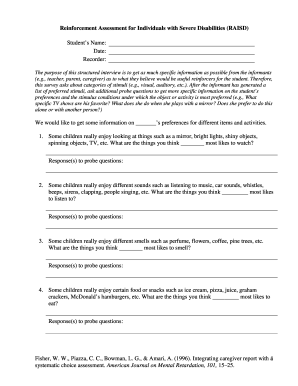
Which could be presented or withdrawn contingent on target behaviors during a session or classroom activity (e.g., a toy could be presented or withdrawn, a walk in the park could not). Write down all of the specific information about each selected stimulus on a 3” x 5” index card (e.g., likes a female adult to read him the ‘Three Little Pigs’ story.) Then have the informant(s) select the 16 stimuli and rank order them using the cards. Finally, list the ranked stimuli below. 1. 9. 2. 1.

How it works

  1. Open form

    Open form follow the instructions

  2. Easily sign form

    Easily sign the form with your finger

  3. Share form

    Send filled & signed form or save

How to fill out the Reinforcement Assessment for Individuals with Severe Disabilities (RAISD) online

Completing the Reinforcement Assessment for Individuals with Severe Disabilities (RAISD) online can help gather valuable insights into the preferences of individuals with severe disabilities. This guide provides clear, step-by-step instructions to ensure you have the necessary information to fill out the form accurately.

Follow the steps to successfully complete the RAISD online.

  1. Press the ‘Get Form’ button to obtain the form and open it in the editor.
  2. Begin by entering the student's name in the designated field to identify the individual for whom the assessment is being completed.
  3. Fill in the date to indicate when the assessment is being completed. This is important for tracking progress over time.
  4. Identify the recorder by entering the name of the person completing the form, such as a teacher, parent, or caregiver. This helps contextualize the responses.
  5. Respond to each probe question related to various stimuli preferences, such as visual, auditory, and tactile items. Provide detailed responses that reflect the student’s likes and dislikes for more accurate assessments.
  6. At the end of the assessment, compile and select stimuli that can be presented or withdrawn contingent on target behaviors. List these on an index card as specified, including details about the preferred activities or items.
  7. Rank order the selected 16 stimuli according to preference and document these rankings in the provided fields. This ranking helps prioritize the most effective reinforcers.
  8. Review all entries for accuracy and completeness. Once confirmed, you can save changes, download the document, print a copy, or share it as needed.

Start filling out the RAISD online today to better understand and support individuals with severe disabilities.

Get form

Experience a faster way to fill out and sign forms on the web. Access the most extensive library of templates available.
Get form

Related content

Reinforcement Assessment for Individuals with...
Individual's Name: Date: Recorder: The purpose of this structured interview is to get as...
Learn more
The Reinforcement Assessment for Individuals with...
The purpose of this structured interview is to get as much specific information as...
Learn more

Related links form

WA Home Improvement Contract WA Information Materials for a Variance Application - Chelan County 2001 WA Instructions for Electronic Forms 2009 WA Lighting Budget Calculation 2009

Questions & Answers

Get answers to your most pressing questions about US Legal Forms API.

Contact support

RAISD stands for Reinforcement Assessment for Individuals with Severe Disabilities, a structured approach to identifying effective reinforcers for those with significant support needs. This assessment aims to enhance engagement and learning by determining what motivates individuals most. By utilizing RAISD, caregivers can create targeted interventions that cater to the unique needs of each individual. Understanding RAISD allows you to optimize support and improve outcomes for individuals with severe disabilities.

Running a reinforcer assessment involves several steps, starting with determining the specific behaviors you wish to reinforce. Present various potential reinforcers in a controlled environment to see which ones evoke the desired responses. Collect data throughout the assessment to evaluate the effectiveness of each reinforcer. This process is essential for any effective Reinforcement Assessment for Individuals with Severe Disabilities (RAISD), laying the foundation for informed behavioral strategies.

To conduct a reinforcer assessment, begin by selecting a range of potential reinforcers based on the preferences of the individual. Next, systematically present these items or activities to observe their effects on behavior. It is important to record the data meticulously to analyze which reinforcers are most effective. By following these steps, you can ensure that your Reinforcement Assessment for Individuals with Severe Disabilities (RAISD) yields valuable insights that impact individual learning positively.

A reinforcement assessment is a systematic process used to identify the most effective reinforcers for individuals, particularly those with severe disabilities. This assessment evaluates various stimuli to determine what motivates and encourages positive behavior. Using reinforcement assessments allows caregivers to develop personalized strategies that support individual growth and learning. Thus, the Reinforcement Assessment for Individuals with Severe Disabilities (RAISD) plays a key role in enhancing the effectiveness of behavioral interventions.

To conduct a reinforcer assessment in ABA, start by selecting potential reinforcers based on the individual’s preferences. Following the framework of a Reinforcement Assessment for Individuals with Severe Disabilities (RAISD), observe the individual’s responses during the assessment, employing various strategies to determine which reinforcers yield the best outcomes. Regular documentation and analysis are key to refining the techniques and ensuring they remain effective over time.

An example of reinforcement can be providing a favorite toy to a child after they complete a task. This aligns with the principles of a Reinforcement Assessment for Individuals with Severe Disabilities (RAISD), where the desired behavior is reinforced with something the individual values. Effective reinforcers vary from person to person, emphasizing the need for personalized assessments.

Schedules of reinforcement assessment refer to the timing and frequency with which reinforcers are presented during an evaluation. In the context of a Reinforcement Assessment for Individuals with Severe Disabilities (RAISD), this could mean using continuous reinforcement or intermittent reinforcement to see how these patterns influence behavior. Understanding different schedules helps tailor strategies to maximize an individual's learning potential.

The three types of reinforcer assessments include single stimulus assessments, paired stimulus assessments, and multiple stimulus assessments. Single stimulus assessments present one item at a time to gauge the individual’s interest. Paired stimulus assessments compare items against each other, while multiple stimulus assessments present several items simultaneously. These methods enhance the effectiveness of the Reinforcement Assessment for Individuals with Severe Disabilities (RAISD).

The main difference lies in their focus; a preference assessment identifies what the individual likes, while a reinforcement assessment determines which of those preferences effectively increases desired behaviors. Preference assessments provide initial insights, but reinforcement assessments measure the impact of those preferences on behavior change. Both are essential in the process of the Reinforcement Assessment for Individuals with Severe Disabilities (RAISD).

To perform an ABA preference assessment, begin by selecting a variety of items or activities the individual may enjoy. Next, observe which items attract their attention and engagement. You can use direct observation, interviews, or structured assessments. This approach helps determine preferences that can inform the Reinforcement Assessment for Individuals with Severe Disabilities (RAISD).

Get This Form Now!

Use professional pre-built templates to fill in and sign documents online faster. Get access to thousands of forms.
Get form
If you believe that this page should be taken down, please follow our DMCA take down processhere.
Get Reinforcement Assessment for Individuals with Severe Disabilities (RAISD)
Get form
  • Adoption
  • Bankruptcy
  • Contractors
  • Divorce
  • Home Sales
  • Employment
  • Identity Theft
  • Incorporation
  • Landlord Tenant
  • Living Trust
  • Name Change
  • Personal Planning
  • Small Business
  • Wills & Estates
  • Packages A-Z
  • Affidavits
  • Bankruptcy
  • Bill of Sale
  • Corporate - LLC
  • Divorce
  • Employment
  • Identity Theft
  • Internet Technology
  • Landlord Tenant
  • Living Wills
  • Name Change
  • Power of Attorney
  • Real Estate
  • Small Estates
  • Wills
  • All Forms
  • Forms A-Z
  • Other Templates
  • Legal Hub
  • About Us
  • Help Portal
  • Legal Resources
  • Blog
  • Affiliates
  • Contact Us
  • Delete My Account
  • Site Map
  • Industries
  • Forms in Spanish
  • Localized Forms
  • State-specific Forms
  • Forms Kit
  • Real Estate Handbook
  • All Guides
  • Notarize
  • Incorporation services
  • For Consumers
  • For Small Business
  • For Attorneys
  • USLegal
  • FormsPass
  • pdfFiller
  • signNow
  • altaFlow
  • DocHub
  • Instapage
Form Packages
  • Adoption
  • Bankruptcy
  • Contractors
  • Divorce
  • Home Sales
  • Employment
  • Identity Theft
  • Incorporation
  • Landlord Tenant
  • Living Trust
  • Name Change
  • Personal Planning
  • Small Business
  • Wills & Estates
  • Packages A-Z
Form Categories
  • Affidavits
  • Bankruptcy
  • Bill of Sale
  • Corporate - LLC
  • Divorce
  • Employment
  • Identity Theft
  • Internet Technology
  • Landlord Tenant
  • Living Wills
  • Name Change
  • Power of Attorney
  • Real Estate
  • Small Estates
  • Wills
  • All Forms
  • Forms A-Z
  • Other Templates
Customer Service
  • Legal Hub
  • About Us
  • Help Portal
  • Legal Resources
  • Blog
  • Affiliates
  • Contact Us
  • Delete My Account
  • Site Map
  • Industries
  • Forms in Spanish
  • Localized Forms
  • State-specific Forms
  • Forms Kit
Legal Guides
  • Real Estate Handbook
  • All Guides
Prepared for you
  • Notarize
  • Incorporation services
Our Customers
  • For Consumers
  • For Small Business
  • For Attorneys
Our Sites
  • USLegal
  • FormsPass
  • pdfFiller
  • signNow
  • altaFlow
  • DocHub
  • Instapage
Social Media
Call us now toll free:
+1 833 426 79 33
As seen in:
© Copyright 1999-2026 airSlate Legal Forms, Inc. 17 Station Street, Ste. 203, Brookline, MA 02445
  • Your Privacy Choices
  • Terms of Service
  • Privacy Notice
  • Content Takedown Policy
  • Bug Bounty Program