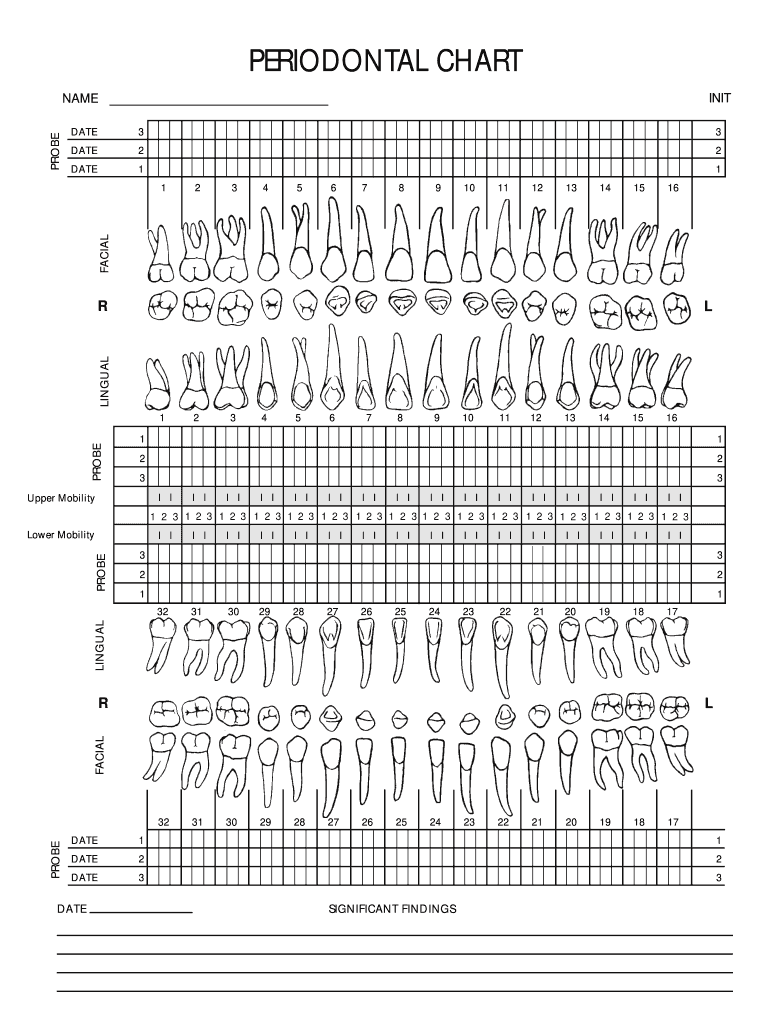
FACIAL 1 R LINGUAL L PROBE 1 2 3 4 5 6 7 8 9 10 11 12 13 14 15 16 1 1 2 2 3 3 I I Upper Mobility I I I I I I I I I I I I I I I I I I I I I I I I I I I I I I 1 2 3 1 2 3 1 2 3 1 2 3 1 2 3 1 2 3 1 2 3 1 2 3 1 2 3 1 2 3 1 2 3 1 2 3 1 2 3 1 2 3 1 2 3 1 2 3 Lower Mobility PROBE I I I I I I I I I I I I I I I I I I I I I I I I I I I I I I I I 3 3 2 2 1 1 31 30 29 28 27 26 25 24 23 22 21 20 19 18 17 LINGUAL 32 R FACIAL.
Loading

Open form follow the instructions

Easily sign the form with your finger

Send filled & signed form or save
How to fill out the DBIC Periodontal Chart online
The DBIC Periodontal Chart is an important tool for dental professionals to document periodontal assessment. This guide provides clear steps to assist users in accurately completing the form online, ensuring all necessary information is captured effectively.
Follow the steps to fill out the DBIC Periodontal Chart online:
- Press the ‘Get Form’ button to obtain the DBIC Periodontal Chart and open it in your preferred editor.
- Begin by filling in the 'Name' field at the top of the form with the individual's full name.
- Next, locate the 'Date' field next to 'INIT' and enter the date of the assessment.
- Proceed to the 'PROBE' sections, where you will record measurements for each tooth. Use the numbered fields corresponding to each probe number.
- In the 'Upper Mobility' and 'Lower Mobility' sections, indicate the mobility status of each tooth using the appropriate scales provided.
- Continue by entering any 'Significant Findings' noted during the assessment in the designated section at the bottom of the form.
- Review all entries for accuracy, ensuring each field has been completed appropriately.
- Once satisfied with the completed form, save your changes, and choose to download, print, or share the document as needed.
Complete your DBIC Periodontal Chart online today for efficient dental record management.
Experience a faster way to fill out and sign forms on the web. Access the most extensive library of templates available.
Related content
Dec 1, 2018 — The OBD coordi- nates with DBIC for Risk Management presentations as well...
Purpose of this study is to define and examine interactive metadiscourse markers that...
Get answers to your most pressing questions about US Legal Forms API.
What is the procedure for periodontal charting?
The procedure for periodontal charting typically begins with a dental professional using a probe to measure pocket depths around each tooth. Follow this with detailed documentation on the DBIC Periodontal Chart. This comprehensive approach captures essential data, including bleeding spots and tooth mobility. Regular charting plays a crucial role in monitoring and maintaining a patient’s periodontal health.
How to find perio chart in Dentrix?
To find the perio chart in Dentrix, navigate to the patient's chart and select the periodontal button. The DBIC Periodontal Chart integrates seamlessly with Dentrix, so it simplifies locating and reviewing periodontal data. This integration enhances your workflow, allowing you to provide more efficient patient care while maintaining detailed records of periodontal health.
Is there a dental code for perio charting?
Yes, there is a specific dental code for periodontal charting often referred to in coding systems like the Current Dental Terminology (CDT). This code enables dental professionals to accurately document the status of a patient's periodontal health, which is essential for treatment planning. By using the DBIC Periodontal Chart, you can streamline this process, ensuring you capture all necessary details in a user-friendly format.
How do you do periodontal charting?
To perform periodontal charting, a dental professional uses a probe to measure the depth of gum pockets around each tooth. They record these measurements on the DBIC Periodontal Chart, highlighting any areas of concern. This process not only identifies gum disease but also helps track improvements over time.
What is a 6 point periodontal charting?
A 6 point periodontal charting refers to the assessment of pocket depths around each tooth at six specific points. This thorough examination provides a comprehensive view of your gum health and helps identify areas needing intervention. Utilizing the DBIC Periodontal Chart can enhance accuracy in capturing these measurements.
What is the CDT code for perio charting?
The Current Dental Terminology (CDT) code for periodontal charting is D0180. This code is essential for billing purposes and ensures proper documentation of your periodontal health. Using the DBIC Periodontal Chart simplifies the process, making it easier for dental professionals to capture and report your data accurately.
What does periodontal charting look like?
Periodontal charting typically appears as a detailed visual representation of your mouth's current health status. The DBIC Periodontal Chart includes numeric data points, symbols, and color-coded zones indicating different areas of concern. This visual aid helps you and your dentist to easily understand your periodontal conditions.
What is recorded in a full periodontal charting?
A full periodontal charting records critical data about your gum health and tooth alignment. It includes measurements of pocket depths, gum recession, and bleeding points. The DBIC Periodontal Chart allows dentists to monitor your periodontal health effectively and make informed treatment decisions.
What do the numbers on a perio chart mean?
The numbers on a perio chart represent the depth of the spaces between your gums and teeth. In the DBIC Periodontal Chart, these readings help assess the condition of your gums. A lower number indicates healthy gums, while a higher number may point to potential periodontal issues. Understanding what these numbers imply allows for better management of your dental health.
What is Stage 4 Grade C periodontal disease?
Stage 4 Grade C periodontal disease is the most severe form of gum disease. It results in significant attachment loss and potential tooth loss, making early intervention critical. If you see these findings in your DBIC Periodontal Chart, it is essential to seek treatment promptly. Understanding your stage can help tailor an effective treatment plan.
Use professional pre-built templates to fill in and sign documents online faster. Get access to thousands of forms.
If you believe that this page should be taken down, please follow our DMCA take down process here.