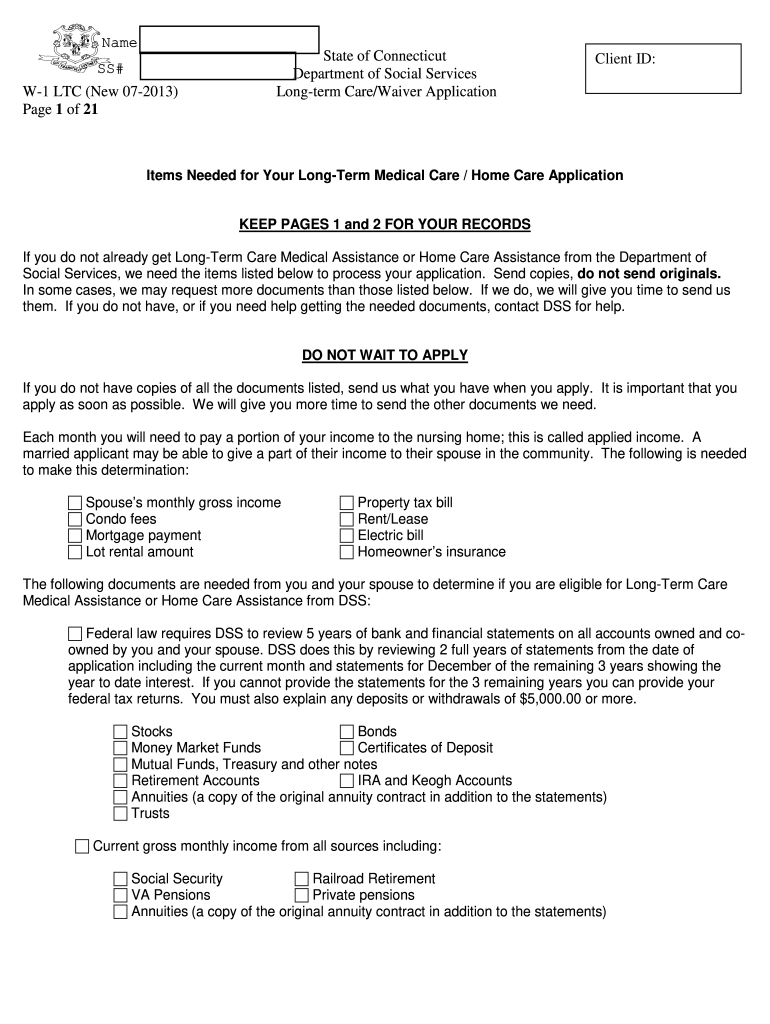
Quit Claim Documents Trusts and Annuities (including appendices, schedules, annual accountings, and amendments for the past 5 years) Private Health Insurance Cards including Medicare (copy of both sides) Health Insurance Premium Amounts A copy of your spouse’s death certificate, Will and Probate Inventory Document if your spouse died in the past 5 years. A copy of your divorce decree if you were divorced in the past 5 years. Power of Attorney or Conservator Document.
Loading

Open form follow the instructions

Easily sign the form with your finger

Send filled & signed form or save
How to fill out the CT W-1 LTC online
The CT W-1 LTC form is a crucial document for individuals applying for long-term care medical assistance in Connecticut. This guide provides step-by-step instructions on how to effectively complete the form online, ensuring that users, regardless of legal experience, can navigate the process with ease.
Follow the steps to fill out the CT W-1 LTC online.
- Click ‘Get Form’ button to obtain the form and open it in the editor.
- Begin by providing your personal information in Section A. This includes your last name, first name, middle initial, suffix, and Social Security Number along with your date and place of birth.
- Complete Section B by entering your current address, including the city, state, and zip code. If you live in a long-term care facility, provide the name and address of the facility.
- Fill out Section C if you have lived at your current address for less than five years, providing previous addresses and ownership status.
- In Section D, indicate if you have authorized someone to represent you in this application by providing their contact details.
- If you are a non-citizen, complete Section E by providing your immigration status, sponsor information, and other relevant details.
- Moving to Section G, provide information on any medical insurance you receive, including Medicare details, if applicable.
- In Section H, detail your income and benefits received from various sources, such as Social Security or pensions. Include proof of income.
- Complete Section I regarding your assets, checking each asset type and providing values for those owned individually or jointly.
- Once all the sections are filled out, review your responses for accuracy. You can attach additional sheets for any extensive details, making sure to include your name and client ID.
- Finally, save changes, download, print, or share your completed CT W-1 LTC form as needed.
Complete your CT W-1 LTC form online today to begin your application for long-term care assistance.
Experience a faster way to fill out and sign forms on the web. Access the most extensive library of templates available.
Related content
W-1 LTC (New 07-2013). Long-term Care/Waiver Application. Page 1 of 21 ... Street...
by Y Dikstein · 2020 · Cited by 25 — Abstract. Locally testable codes (LTC) are...
Run the above cables separately from such wiring and keep them a minimum of 100mm apart...
Get answers to your most pressing questions about US Legal Forms API.
How do I renew my DSS Medicaid in ct?
To renew your DSS Medicaid in Connecticut, you will need to fill out and submit a renewal form to DSS. Be sure to provide the necessary documentation that reflects your current financial situation and household details. Completing the renewal process on time is crucial to continue receiving benefits like CT W-1 LTC. If you have questions about the necessary documents, reach out to DSS or explore resources on uslegalforms for assistance.
How do I renew my DSS eligibility in ct?
Renewing your DSS eligibility in Connecticut requires you to submit a renewal application. You should include any changes to your circumstances, such as income or household composition. Check the DSS website for a list of required documents. If you are unsure about the process or need help, consider using uslegalforms to simplify your paperwork related to CT W-1 LTC.
How do I recertify for Medicaid in ct?
Recertifying for Medicaid in Connecticut involves submitting your updated information to DSS. You usually need to fill out a new application form, providing details about your household and income. Ensure that you do this before your current eligibility expires to maintain access to benefits like CT W-1 LTC. The application process can be completed online or by mailing in your forms.
How do I speak to someone at DSS ct?
To speak to someone at DSS in Connecticut, you can call their customer service line during business hours. Make sure you have your identification on hand for quicker assistance. It's also helpful to note down your inquiries ahead of time. If you need information regarding CT W-1 LTC, representatives can guide you through the process.
What is the income limit for Medicaid in CT?
Income limits for Medicaid in Connecticut can vary based on the specific Medicaid program. Generally, for programs like HUSKY A, the income limit is based on a percentage of the federal poverty level. Keeping track of these limits can help you qualify for benefits like CT W-1 LTC to support long-term care needs.
What are the four types of Medicaid?
The four main types of Medicaid include Medicaid for families, Medicaid for children, Medicaid for the elderly and disabled, and Medicaid for low-income adults. Each type addresses different healthcare needs and demographics. For individuals needing long-term care, CT W-1 LTC is particularly vital.
What are the different types of Medicaid in CT?
Connecticut has multiple types of Medicaid plans, including HUSKY A, HUSKY B, HUSKY C, and HUSKY D. Each plan serves specific populations, such as families, children, elderly individuals, and those with disabilities. For users seeking long-term care options, the CT W-1 LTC plan may provide substantial benefits.
What does CT Medicaid not cover?
While CT Medicaid provides extensive coverage, there are some limitations. It does not cover certain over-the-counter medications, experimental treatments, or private nursing care when you do not qualify for CT W-1 LTC. By knowing what is not covered, you can better plan for your healthcare needs.
What is the difference between HUSKY D and HUSKY C?
HUSKY C focuses on the elderly, disabled, and long-term care beneficiaries, while HUSKY D addresses the needs of lower-income adults without dependent children. Both plans help provide crucial support, but they cater to different populations. Understanding these differences can help you determine which plan, such as CT W-1 LTC, suits your needs.
What are the Medicaid plans in CT?
Connecticut offers several Medicaid plans, including HUSKY Health. HUSKY A provides coverage for low-income families and children. HUSKY B offers affordable health insurance for children. Additionally, for individuals with disabilities, HUSKY C and HUSKY D cover those who are elderly or need long-term care, such as CT W-1 LTC.
Use professional pre-built templates to fill in and sign documents online faster. Get access to thousands of forms.
If you believe that this page should be taken down, please follow our DMCA take down process here.