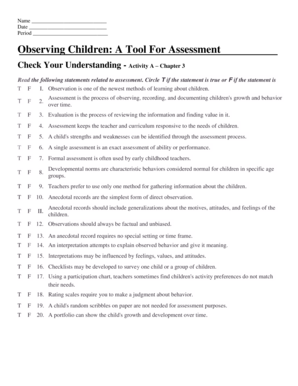
Name Date Period Observing Children: A Tool For Assessment Check Your Understanding Activity A Chapter 3 Read the following statements related to assessment. Circle T if the statement is true or F.

How it works
  • Open form

    Open form follow the instructions

  • Easily sign form

    Easily sign the form with your finger

  • Share form

    Send filled & signed form or save

How to fill out the Observing Children A Tool For Assessment online

This guide provides clear, step-by-step instructions for completing the Observing Children: A Tool For Assessment online. Whether you are new to assessment or looking to refine your skills, this resource will support you in accurately filling out the form.

Follow the steps to complete the assessment form effectively.

  1. Press the ‘Get Form’ button to access the form and open it in your editor.
  2. Begin by entering your name in the designated field at the top of the form.
  3. Next, fill in the date on which you are completing the assessment.
  4. Indicate the relevant period by specifying the timeframe related to the observations.
  5. Proceed to the section titled 'Check Your Understanding - Activity A – Chapter 3.' Read each statement carefully.
  6. For each statement, circle ‘T’ if you believe it to be true or ‘F’ if you believe it to be false. Ensure you consider your understanding of assessment concepts.
  7. Once you have completed all statements, review your answers for accuracy.
  8. Conclude by saving changes to your document, and if necessary, download, print, or share the completed form.

Complete your forms online today to enhance your assessment practices.

Get form

Experience a faster way to fill out and sign forms on the web. Access the most extensive library of templates available.

Related content

Anecdotal Records: Valuable Tools for Assessing...

Assessment involves observing and documenting children's development, their learning...

Learn more
(PDF) Observing Children: A Tool for Assessment |...

Chapter 3 Observing Children: A Tool for Assessment 53 Terms to Know 3-1 assessment...

Learn more
HIS Evaluation Checklist v14 - UNHCR

Health Information System (HIS) Evaluation Checklist p.1 of 39 ... This checklist is a...

Learn more
Questions & Answers

Get answers to your most pressing questions about US Legal Forms API.

Contact support

What is the value of observation for the child?

By observing children as they explore, play and learn, practitioners can ensure that a child's development is at the expected stage, whether the environment and resources (toys or equipment) are stimulating their development, and what future support the child will need in order to gain new interests, skills and ...

When you really see the child, you get to know her and see more of her abilities, interests, and personal characteristics. Knowing each child helps you to plan individualized and developmentally informed activities. Look at what the child does and says without evaluating or labeling.

Observation is an essential part of your practice that supports you to understand the individual needs of each child in your care. As you know every child is unique. Observing children enables you to learn about and enjoy the unique qualities of each individual child.

Observation can also be described as paying close attention to a child's behaviors, interactions, activities, and interests, and noticing all aspects of the child's development. 4. Both definitions stress the importance of observing with intention and observing to learn about a child.

Observation is often seen as one of the most simple, yet effective methods of assessing young children as they develop. For an early childhood educator, observing a child begins by noting how each child behaves, learns, reacts to new situations, and interacts with others.

Observation is a very important part of science. It lets us see the results of an experiment, even if they are not the results we expect. It lets us see unexpected things around us that might stimulate our curiosity, leading to new experiments. Even more important than observation is accurate observation.

Observation helps us assess children's progress; we can find out about the specific care and learning needs of each child. We can then plan next steps in children's development and learning. To find out about a child we need to observe them in a way that is valuable to the child and makes best use of our time.

On the opposite end of the spectrum, children can also acquire prosocial behaviors through observational learning. Watching someone cooperate, share, take turns and demonstrate altruistic acts can teach children to show those behaviors too.

Get This Form Now!

Use professional pre-built templates to fill in and sign documents online faster. Get access to thousands of forms.

If you believe that this page should be taken down, please follow our DMCA take down process here.

Get Observing Children A Tool For Assessment