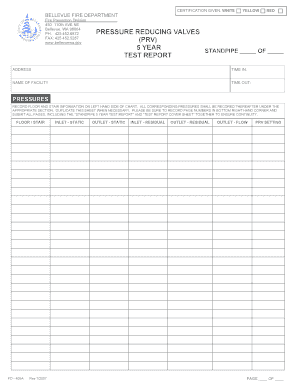
CING VALVES (PRV) 5 YEAR STANDPIPE OF TEST REPORT ADDRESS TIME IN: NAME OF FACILITY TIME OUT: PRESSURES RECORD FLOOR AND STAIR INFORMATION ON LEFT HAND SIDE OF CHART. ALL CORRESPONDING PRESSURES SHALL BE RECORED THEREAFTER UNDER THE APPROPRIATE SECTION. DUPLICATE THIS SHEET WHEN NECESSARY. PLEASE BE SURE TO RECORD PAGE NUMBERS IN BOTTOM RIGHT HAND CORNER AND SUBMIT ALL PAGES, INCLUDING THE STANDPIPE 5 YEAR TEST REPORT AND TEST REPORT COVER SHEET TOGETHER TO ENSURE CO.
Open form follow the instructions
Easily sign the form with your finger
Send filled & signed form or save
How to fill out the Bellevue Fire Department Prv Valve Testing Form online
Filling out the Bellevue Fire Department Prv Valve Testing Form is a crucial step for ensuring safety and compliance in fire prevention measures. This guide will provide you with comprehensive and user-friendly instructions on how to accurately complete the form online.
Follow the steps to complete the form successfully.
- Click ‘Get Form’ button to obtain the form and open it in the editor.
- Begin filling out the address section with the location relevant to the testing. This ensures that responders can accurately identify where the valve testing is to be conducted.
- Record the name of the facility where the testing is being performed. Clear identification of the facility is essential for record-keeping and compliance.
- Enter the time in and time out for the valve testing. Accurate timing will help in maintaining a detailed log of activities conducted during the testing process.
- Move to the pressures section on the left-hand side of the chart. Here, you will need to record the pressures for each corresponding floor and stair listed. Ensure precision while entering data.
- Document the inlet and outlet static pressure values, residual pressure values, and flow rate under the respective sections. Each field needs to be filled to comply with testing procedures.
- Detail the PRV setting. The correct setting is vital for operational accuracy and safety.
- If you need more space, duplicate the form sheet as necessary. Remember to record the page numbers in the bottom right-hand corner of each page.
- Review all data entered for accuracy. A comprehensive check ensures that all information is correctly recorded before final submission.
- Once all necessary fields are completed, save your changes, download, print, or share the form as needed to comply with submission guidelines.
Start completing your Bellevue Fire Department Prv Valve Testing Form online today to ensure compliance and safety!
Experience a faster way to fill out and sign forms on the web. Access the most extensive library of templates available.
Related content
BELLEVUE FIRE DEPARTMENT ... Bellevue, WA 98004 ... PIPING BETWEEN FDC AND CHECK VALVE...
W4-33 DOUBLE CHECK DETECTOR ASSEMBLY. ... Individual pressure reducing valves are required...
Jun 10, 2011 — 121 Type 2 - Appliance Control Valves Combined with Flame Safeguard ....
Get answers to your most pressing questions about US Legal Forms API.
How often should a PRV be tested?
It is recommended that you test pressure relief valves at least once every six months, especially to reduce leakage caused by the buildup of minerals and corrosion. Scheduling pressure relief valve testing every six months enables you to troubleshoot issues and fix them promptly.
How do you test a PRV valve?
The most commonly mandated form of pressure relief valve testing, bench testing is unique in that it requires you completely shut down your facility's system and remove all pressure relief valves. The valves are then transported to a lab where they are tested and repaired as necessary.
How do you pressure test a PRV valve?
It is actually relatively simple and can be broken down into three simple steps. Raise and lower the test lever – performing this several times will lift the brass stem it is fastened to. Look for water flowing through the pipe. If the water passes through as it should, then turn down the water pressure.
What is the standard pressure for PRV?
The PRV must be installed so that is easily accessible for maintenance. 7. The PRV must be set to a maximum of 65 psi and provide no pressures less than 35 psi.
What is a PRV number?
The PRV Taxonomy Codes segment is used to the provider type by a 10-digit identification number known as a Taxonomy-Specialty code. These codes are used by the health plan's claim adjudication logic.
How do you know if your PRV valve is bad?
How do I know if my pressure-reducing valve is bad? Diminishing or fluctuating water pressure… No water pressure. Thumping, banging, hammering, or vibrating noises in the walls… High water pressure, water leaking from faucet, toilet running constantly…
Use professional pre-built templates to fill in and sign documents online faster. Get access to thousands of forms.
If you believe that this page should be taken down, please follow our DMCA take down process here.