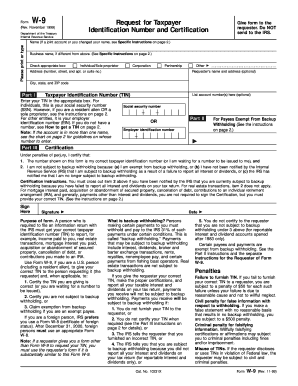
Backup Withholding on Missing and Incorrect Name/TINs Including Instructions for Reading Tape Cartridges IRS Department of the Treasury Internal Revenue Service Publication 1281 (Rev. 12-1999) Catalog.
Open form follow the instructions
Easily sign the form with your finger
Send filled & signed form or save
How to use or fill out the Publication 1281 (Rev. August 2005) online
This guide provides detailed instructions on how to effectively fill out the Publication 1281 form online, ensuring compliance with the IRS backup withholding regulations. Whether you are a new filer or have previous experience, this structured approach will help you navigate each section of the form with ease.
Follow the steps to successfully complete the Publication 1281 form online.
- Use the 'Get Form' button to access the Publication 1281 form and open it in your editor.
- Begin by reading the introduction section of the form, which outlines the purpose and importance of backup withholding.
- Fill in your information in the payer section, including your name, business name, and taxpayer identification number (TIN). Ensure that all details are accurate and match IRS records.
- Review the specific instructions provided for each part of the form, including parts that discuss missing TINs, incorrect name/TIN combinations, and backup withholding requirements.
- If you have received a CP2100 or CP2100A notice, follow the appropriate instructions related to the notice, ensuring to address any missing or incorrect TINs as outlined.
- Complete any additional required sections, such as documentation of backup withholding if applicable.
- Once all relevant sections are completed, carefully review your form for accuracy before submission.
- Save your changes and download the document. You can then print it for your records or submit it online as required.
Start filling out the Publication 1281 form online today to ensure compliance with IRS backup withholding requirements.
Experience a faster way to fill out and sign forms on the web. Access the most extensive library of templates available.
Related content
Publication Publication 3, Title Armed Forces' Tax Guide, Revision Date or Tax Year ... of...
Returns Electronically (see the forms section in the back of Publication 1220),...
In preparing this edition, we have carefully re-examined all of the content, clarified or...
Get answers to your most pressing questions about US Legal Forms API.
What actions should you take if the IRS informed you that you're subject to backup withholding?
If the IRS informs you that you're subject to backup withholding, first review the notice to understand the reasons. You may need to correct your TIN and provide the necessary documentation to the IRS and payers. To assist you in this process, resources such as Publication 1281 (Rev. August 2005) and services offered by US Legal Forms can prove invaluable.
What does subject to backup withholding mean in IRS?
Being subject to backup withholding means that the IRS mandates that a payer must withhold a certain percentage of your payments for tax purposes. This situation typically arises due to missing or incorrect TINs. For more in-depth information, you can reference Publication 1281 (Rev. August 2005), which covers this topic extensively.
Can I use my SSN instead of a TIN?
You can use your Social Security Number (SSN) as your TIN unless you specifically require an Employer Identification Number (EIN) for certain types of businesses. However, ensure you are aware of how this impacts your taxes and compliance. For further clarification, resources like Publication 1281 (Rev. August 2005) provide comprehensive guidance on using SSNs.
How to resolve an AB notice?
Resolving an AB notice involves understanding the reason behind it, often linked to issues with your TIN. You should verify your information and respond with any required documentation promptly. For assistance in navigating this process, resources such as Publication 1281 (Rev. August 2005) can be helpful, along with support from platforms like US Legal Forms.
What does it mean when the IRS inform you that you are subject to backup withholding?
When the IRS notifies you of your status as subject to backup withholding, it indicates that they require financial institutions to withhold a percentage of your payments. This action usually occurs if you fail to provide a correct TIN or have underreported interest or dividends in previous years. For detailed instructions, refer to Publication 1281 (Rev. August 2005).
How do I know if I am exempt from backup withholding?
You can determine your exemption from backup withholding by reviewing the criteria outlined in Publication 1281 (Rev. August 2005). Generally, if you provide your correct Taxpayer Identification Number (TIN) and meet other specific conditions, you may be exempt. If unsure, consulting a tax professional can further clarify your status.
Who is not subject to backup withholding by the IRS?
Various individuals and entities are not subject to backup withholding, primarily those who have provided their correct taxpayer information and whose earnings are not flagged by the IRS. This may include many regular taxpayers who file correctly. For specifics on who qualifies, consult Publication 1281 (Rev. August 2005) for detailed eligibility criteria.
Where do I find my backup withholding amount?
You can find your backup withholding amount on your tax documents, such as Form 1099, which summarizes your earnings and any taxes withheld. The indicated amounts will reflect any backup withholding taken out during the year. For guidance on how to interpret this information, refer to Publication 1281 (Rev. August 2005), where you'll find valuable insights.
Does everyone have backup withholding?
Not everyone is subject to backup withholding; it applies only in specific situations, such as when the IRS has not received your correct taxpayer information. If you are eligible for backup withholding, you will receive notifications from the IRS. To understand these criteria, check out Publication 1281 (Rev. August 2005) for a clearer understanding.
How does the IRS notify you of backup withholding?
The IRS notifies you of backup withholding through official correspondence, typically in the form of notices like the B notice. This communication will outline the reasons for backup withholding and any actions you need to take. For further information on these notifications, refer to Publication 1281 (Rev. August 2005), which provides essential clarifications.
Use professional pre-built templates to fill in and sign documents online faster. Get access to thousands of forms.
If you believe that this page should be taken down, please follow our DMCA take down process here.