How it works
  • Open form

    Open form follow the instructions

  • Easily sign form

    Easily sign the form with your finger

  • Share form

    Send filled & signed form or save

How to fill out the Pain: Activity Traffic Light - A Guide To Movement Safe online

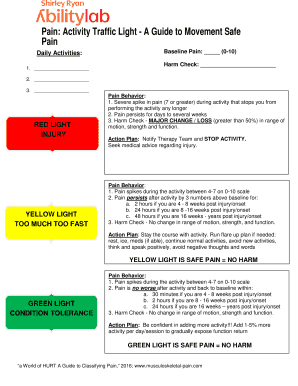
The Pain: Activity Traffic Light - A Guide To Movement Safe is a vital tool designed to help users understand and manage their pain during daily activities and exercises. This guide provides comprehensive instructions on how to fill out the form effectively to ensure accurate recording and assessment of pain levels.

Follow the steps to accurately complete the form online.

  1. Click ‘Get Form’ button to access the form and open it in the designated online editor.
  2. Begin by entering your average baseline pain level at the top of the activity handout, using a scale from 0 to 10.
  3. Next, identify and list 1-3 daily activities or therapy exercises you wish to focus on, such as standing, walking, or stretching.
  4. In the harm check section, record the movement or function that you can confidently perform to assess if you have done too much too quickly.
  5. For the yellow and green light sections, identify the appropriate time frame based on how long it has been since your injury or the onset of pain, circling the relevant option.
  6. As you engage in the identified activities, routinely refer to the specific pain behaviors outlined in the traffic light system and follow the corresponding action plan.
  7. If you experience a yellow light condition, implement the flare-up plan by taking prescribed actions such as rest, ice, and maintaining a positive mindset.
  8. Once you have completed the entries, review your responses, and proceed to save the changes. You can also download, print, or share the completed form as needed.

Take control of your pain management today by completing the Pain: Activity Traffic Light - A Guide To Movement Safe online!

Get form

Experience a faster way to fill out and sign forms on the web. Access the most extensive library of templates available.

Related content

State of the Evidence Traffic Lights 2019:...

by I Novak · 2020 · Cited by 1345 — Spasticity and dystonia cause involuntary...

Learn more
Your Guide to Physical Activity and Your Heart...

An example of a stretching move is sitting cross-legged on the floor and gently pushing...

Learn more
AMERICAN NATIONAL STANDARD - CrashStats - NHTSA

The Manual is designed to facilitate the development of data on accidents involving motor...

Learn more
Questions & Answers

Get answers to your most pressing questions about US Legal Forms API.

Contact support

What is the traffic light analogy for pain?

The traffic light analogy for pain uses a color-coded system to help individuals gauge their pain and activity levels. It explains how different colors represent varying degrees of safety in movement, making it easier to relate experiences with pain management. By visualizing their pain through this analogy, users can make informed decisions about when to engage in physical activity. Refer to the Pain: Activity Traffic Light - A Guide To Movement Safe for a comprehensive understanding of this analogy.

You can find the traffic light control game on various educational platforms or apps that focus on pain management and therapy. This game often mimics the traffic light system, providing an engaging way to practice recognizing pain levels and associated activities. Additionally, Uslegalforms offers valuable resources that might guide you in locating interactive tools related to the traffic light system and pain management.

An idiom related to traffic lights that conveys a sense of caution is 'proceed with caution.' This phrase serves as a reminder to assess situations before taking action, similar to how one would respond to a yellow traffic light. By relating this to pain management, individuals can remind themselves to be vigilant about their pain levels and adjust their activities accordingly. This reflects the core principles of the Pain: Activity Traffic Light - A Guide To Movement Safe.

The traffic light pain analogy simplifies the understanding of pain levels through a familiar concept. It relates one’s pain experience to a traffic light, where green indicates safety in movement, yellow suggests moderation, and red signifies 'stop.' This analogy provides clarity and reinforces the importance of monitoring pain while participating in activities. Embracing the Pain: Activity Traffic Light - A Guide To Movement Safe can further enhance your understanding.

To use the traffic light method, start by assessing your current pain level using the colors: green, yellow, and red. If your pain is in the green zone, engage in activities confidently; in the yellow zone, proceed with caution; and in the red zone, avoid certain movements. This method encourages individuals to listen to their bodies, facilitating safer activity while managing pain effectively. Remember, the Pain: Activity Traffic Light - A Guide To Movement Safe can be your helpful resource.

Creating a traffic light simulation can be a fun and interactive way to understand pain management. You can use resources like colored paper or craft materials to make a physical model, or create a digital simulation using applications. The goal is to mirror the traffic light system of pain, where users can simulate their activity levels based on pre-defined pain scenarios. This hands-on approach can enhance understanding of safe movement.

The traffic light system of pain categorizes pain levels using color codes, much like an actual traffic light. This system allows individuals to identify when they can safely engage in different activities based on their pain. Green means low pain and safe to move, yellow indicates moderate pain where caution is needed, and red represents high pain, suggesting movement should be avoided. Understanding this system helps individuals manage their pain effectively.

The traffic light system in therapy is a visual tool that helps individuals understand their ability to engage in activities based on their pain levels. It typically uses colors like red, yellow, and green to categorize activities. Green indicates safe activities, yellow suggests caution, and red warns against certain actions. This approach is beneficial for managing pain effectively while promoting safe movement.

The traffic light system in management offers a straightforward way to assess projects and activities based on risk and progress. Each color indicates a status: green for on track, yellow for caution, and red for issues. By applying this format in your activities, you can enhance communication and decision-making. This aligns with the principles of the Pain: Activity Traffic Light - A Guide To Movement Safe, as both systems promote clarity and awareness.

When engaging with the traffic light system, it’s vital to prioritize your safety based on the colors displayed. For instance, when you encounter a red light, it’s crucial to stop and reassess your activities. This Pain: Activity Traffic Light - A Guide To Movement Safe offers guidance on how to modify or halt movements that could lead to injury. Always listen to your body’s signals to ensure that you’re staying safe while being active.

Get This Form Now!

Use professional pre-built templates to fill in and sign documents online faster. Get access to thousands of forms.

If you believe that this page should be taken down, please follow our DMCA take down process here.

Get Pain: Activity Traffic Light - A Guide To Movement Safe