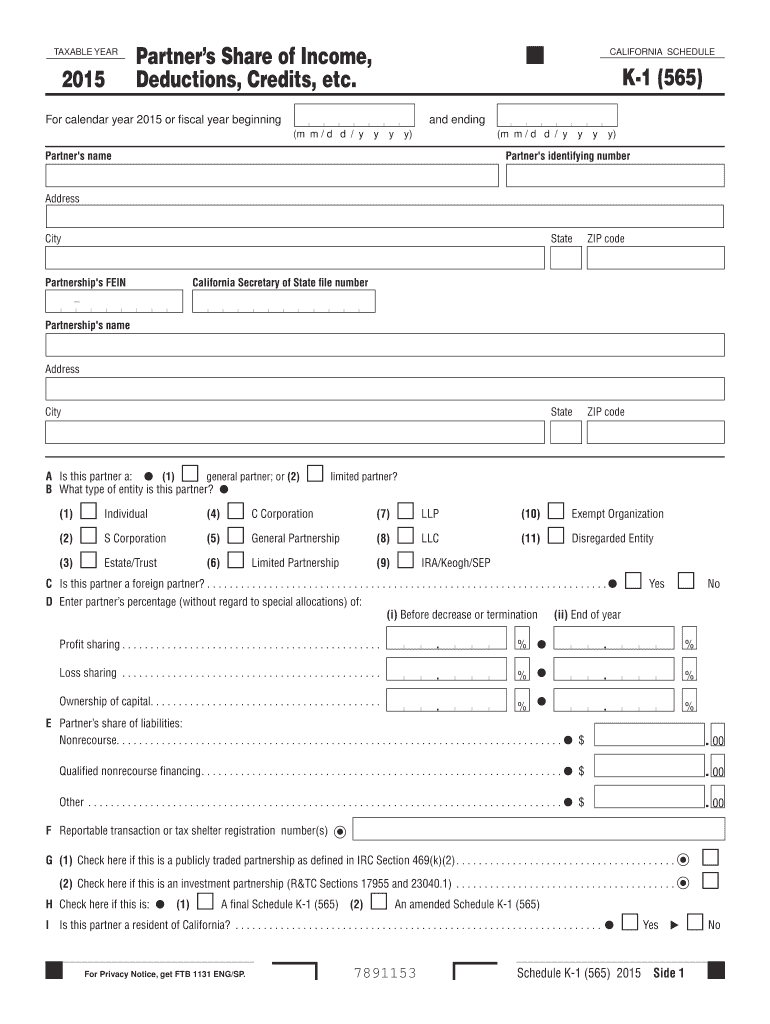
Y) and ending (m m / d d / y y y y) Partner's name Partner's identifying number Address City Partnership's FEIN State ZIP code State ZIP code California Secretary of State file number Partnership's name Address City A Is this partner a: (1) general partner; or (2) B What type of entity is this partner? Individual (2) S Corporation (3) Estate/Trust (1) limited partner?.
Loading

Open form follow the instructions

Easily sign the form with your finger

Send filled & signed form or save
How to fill out the CA Schedule K-1 (565) online
Filling out the California Schedule K-1 (565) is essential for reporting income, deductions, and credits from a partnership. This guide will help you navigate the form efficiently and accurately, ensuring your information is submitted correctly.
Follow the steps to effectively complete the CA Schedule K-1 (565) online.
- Press the ‘Get Form’ button to access the form and open it in your preferred editor.
- Provide the taxable year by filling in the start and end dates for the fiscal year if applicable.
- Enter the partner's name, identifying number, address, and other contact information accurately.
- Fill in the partnership's FEIN, state, ZIP code, and the Secretary of State file number.
- Indicate whether the partner is a general or limited partner.
- Specify the type of entity this partner represents by selecting from the available options, including S Corporation, C Corporation, LLC, etc.
- If applicable, denote if the partner is a foreign partner by checking 'Yes' or 'No.'
- Provide the partner's profit sharing, loss sharing, and ownership of capital percentages for both before decrease and end of year.
- Report the partnership's liabilities, including nonrecourse and qualified nonrecourse financing amounts.
- Indicate if this is a publicly traded payment or an investment partnership.
- Check the appropriate boxes if this is a final or amended Schedule K-1.
- Complete the analysis of the partner's capital account, summing contributions, withdrawals, and year-end capital account balance.
- Fill out the income and deduction details, including amounts for ordinary income, rental activities, and any applicable adjustments.
- Review and confirm all entries for accuracy.
- Once completed, save the changes, and proceed to download, print, or share the filled form as required.
Get started completing your documents online to ensure accurate submissions.
Experience a faster way to fill out and sign forms on the web. Access the most extensive library of templates available.
Related content
Caution: Refer to Partner's Instructions for Schedule K-1 (565) before entering...
by FT Board — Instructions for Schedule K (565) and Schedule K-1 (565), when completing...
Indicate by check mark if the registrant is a well-known seasoned issuer, as defined in...
Get answers to your most pressing questions about US Legal Forms API.
What is the minimum payment for CA 565?
The minimum payment for filing CA form 565 varies based on the income generated by the partnership or LLC. Generally, it is advisable to review the current California tax guidelines to determine any applicable minimum payments. If you are uncertain, consulting with tax professionals or using platforms like uslegalforms can help clarify any questions related to your CA Schedule K-1 (565) payments.
Where do I file form 565 in California?
You must file form 565 with the California Franchise Tax Board, either online or by mail. The process is straightforward, and you can find detailed instructions on the California tax website. If you have questions or need assistance, platforms like uslegalforms can provide valuable resources and guidance for completing your CA Schedule K-1 (565) filings.
Does California allow 2% portfolio deductions?
California does not permit a 2% portfolio deduction for individual taxpayers. Instead, the state requires taxpayers to include all income reported on forms such as the CA Schedule K-1 (565). Understanding these nuances can help you make informed decisions about your tax filings and ensure compliance with state tax laws.
Who must file form 565?
Form 565 must be filed by partnerships and limited liability companies (LLCs) operating in California. This filing is essential for reporting income, gains, losses, and contributions related to those entities. If you receive a CA Schedule K-1 (565), it is important to ensure your partnership or LLC files this form to avoid potential issues with the tax board.
What is a Schedule K-1 on your tax return?
A Schedule K-1 on your tax return details your share of earnings, deductions, and credits from partnerships or LLCs. This information flows into your personal tax return, impacting your overall tax liability. Properly reporting your CA Schedule K-1 (565) ensures compliance with state regulations, allowing you to accurately calculate your tax obligations.
What is the schedule k1 565?
The Schedule K-1 (565) is a tax form used to report income, deductions, and credits from partnerships and limited liability companies (LLCs) in California. This form provides detailed information on each partner or member's share of income, ensuring accurate reporting on individual tax returns. Understanding the Schedule K-1 (565) is crucial for reporting and tax compliance.
Why would I be getting a letter from the State of California franchise tax board?
Receiving a letter from the State of California Franchise Tax Board could indicate several situations, including a request for additional information or clarification regarding your CA Schedule K-1 (565). These letters often relate to discrepancies or questions about the income reported on your tax documents. It is essential to respond promptly to avoid potential penalties or additional tax liabilities.
What is the Schedule K-1 565?
The Schedule K-1 (565) specifically pertains to California LLCs and reports the income earned from the LLC to its members. This form provides vital information necessary for each member’s personal tax return, detailing their share of the profits or losses. Proper completion of your CA Schedule K-1 (565) ensures compliance with tax regulations and accurate reporting of your income.
What is the 2% rule for deductions?
The 2% rule for deductions indicates that certain expenses can only be deducted after they exceed 2% of your adjusted gross income. This rule primarily applies to miscellaneous deductions, including investment-related expenses. Utilizing the CA Schedule K-1 (565) helps you appropriately document these expenses and maximize your tax savings while adhering to California tax laws.
Can I deduct investment management fees in California?
You can deduct investment management fees in California, but they must be classified properly on your tax filings, particularly on your federal Schedule A. These fees are subject to the 2% floor deduction rule, which means only those exceeding 2% of your adjusted gross income can be deducted. Reviewing the implications with your CA Schedule K-1 (565) is essential to ensure you’re capturing all eligible deductions.
Use professional pre-built templates to fill in and sign documents online faster. Get access to thousands of forms.
If you believe that this page should be taken down, please follow our DMCA take down process here.
This form is available in several versions. Select the version you need from the drop-down list below.