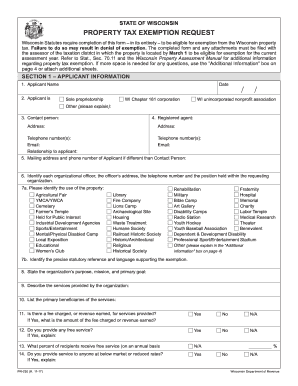
Do so may result in denial of exemption. The completed form and any attachments must be filed with the assessor of the taxation district in which the property is located by March 1 to be eligible for exemption for the current assessment year. Refer to Stat., Sec. 70.11 and the Wisconsin Property Assessment Manual for additional information regarding property tax exemption. If more space is needed for any questions, use the Additional Information box on page 4 or attach additional sheets.
Open form follow the instructions
Easily sign the form with your finger
Send filled & signed form or save
How to fill out the WI PR-230 online
The WI PR-230 form is essential for individuals seeking property tax exemption in Wisconsin. Completing this form accurately and thoroughly is crucial for a successful request. This guide will walk you through each section of the form, emphasizing clear and user-friendly instructions.
Follow the steps to complete the WI PR-230 form online.
- Click ‘Get Form’ button to access the form and open it for completion.
- Fill out Section 1 – Applicant Information. Provide the applicant's name, date, entity type (e.g., sole proprietorship, corporation), and contact person details. Ensure all available contact information is up-to-date.
- In Section 1, continue with identifying relevant officers and their roles within the organization. Clearly specify the purpose and nature of the property use in Section 1, question 7a.
- Detail the organization's purpose and describe the services provided in questions 8 and 9. Be specific about the primary beneficiaries of these services.
- Proceed to Section 2 – Subject Property Information. Enter the property address, tax parcel number, and any other relevant details regarding the subject property.
- Provide estimated market value in Section 2, along with any appraisal information if applicable. Clearly specify the owner of the subject property.
- In Section 3, complete the Tenant Information, identifying any individuals or entities that utilize the subject property besides the owner, and include detailed explanations of their usage.
- Attach necessary documents as outlined in Section 4. These may include proof of nonprofit status, leases, and any other pertinent documents that support your application.
- Complete Section 5 – Affidavit. Ensure that the authorized person signs and dates the form, confirming the accuracy of all provided information.
- After finishing the form, review all details for accuracy. Save your changes, and consider downloading, printing, or sharing the form as needed.
Complete your WI PR-230 form online today to ensure your property tax exemption request is submitted accurately.
Experience a faster way to fill out and sign forms on the web. Access the most extensive library of templates available.
Related content
This form is for property tax exemption requests. It must be filed with the assessor by...
A first course introducing students to the fundamentals of computational problem-solving...
O que este controle realmente faz depende da função que está sendo ajustada. Antes de...
Get answers to your most pressing questions about US Legal Forms API.
How do I apply for property tax exemption in Wisconsin?
To apply for property tax exemption in Wisconsin, fill out the official application form available from your local assessor's office or online. You will need to provide supporting documentation that verifies your eligibility based on income and other criteria. Be sure to check the application deadlines to ensure you don’t miss out on this opportunity. You can visit WI PR-230 for more details, and US Legal Forms can assist in accessing the right materials.
How to lower property taxes in Wisconsin?
Lowering property taxes in Wisconsin can be achieved through various means, including applying for exemptions or credits that you may qualify for. Another strategy could be to appeal your property assessment if you believe it is too high. Familiarizing yourself with the options available through WI PR-230 can empower you to make informed decisions. Additionally, US Legal Forms can offer resources and forms to facilitate this process.
How to apply for sales tax exemption in Wisconsin?
To apply for a sales tax exemption in Wisconsin, you must complete the relevant application and provide proof of your exempt status. Organizations such as nonprofits, educational institutions, and some governmental entities may qualify for this exemption. Ensure you carefully follow the application process as outlined in WI PR-230. For more support, US Legal Forms can provide access to the necessary forms and guidance.
What qualifies you for the homestead credit?
To qualify for the homestead credit in Wisconsin, you must be a homeowner, a renter, or a person who resides in the state. Your income must fall below a certain threshold, and you must occupy the property as your primary residence for at least part of the year. For detailed eligibility criteria, refer to the information found in WI PR-230. You might also find it helpful to utilize US Legal Forms for assistance with your application.
Who is eligible for Wisconsin property tax credit?
Eligibility for the Wisconsin property tax credit typically includes homeowners and renters who meet specific income and residency requirements. The program aims to assist those facing economic hardships, such as seniors and low-income families. To determine your eligibility and claim the credit, check the regulations outlined in WI PR-230. If you need help navigating the application, US Legal Forms can provide valuable resources.
At what point do seniors stop paying taxes?
Seniors do not stop paying taxes automatically, but they may be eligible for certain exemptions that can significantly reduce their tax obligations. In Wisconsin, programs like the homestead credit may help those aged 65 and older. If you are unsure of your status, the WI PR-230 form can assist in understanding your eligibility for tax relief. For comprehensive information and assistance, consider utilizing resources found on the US Legal Forms platform.
Why do I not qualify for homestead tax credit?
If you do not qualify for the homestead tax credit, it may be due to several factors, including income limits, property ownership status, or residence requirements. Additionally, you must file the necessary forms, such as the WI PR-230, on time to ensure proper evaluation. If you find the process confusing, you can seek support on the US Legal Forms platform, which simplifies understanding the eligibility criteria and filing requirements.
At what age in Wisconsin do you stop paying property taxes?
In Wisconsin, there isn't a specific age at which individuals stop paying property taxes entirely. However, some exemptions, such as the homestead credit, may become available to those 65 years and older, potentially reducing your tax burden. If you believe you qualify, consider using the WI PR-230 form to apply for these benefits. It’s a good idea to consult your local tax office for further details about possible exemptions.
How do I get property tax exemption in Wisconsin?
To get a property tax exemption in Wisconsin, you must meet specific eligibility criteria based on your property's use, such as for agricultural or charitable purposes. Begin by gathering required documentation and filling out the necessary forms, including the WI PR-230 application. Submitting your application on time is crucial, so ensure you check the deadlines. You can find assistance and resources on the US Legal Forms platform to help streamline your submission.
Why would a homestead application be denied?
A homestead application can be denied for several reasons, including failure to meet income limitations, incorrect or incomplete documentation, or not using the property as your main residence. Understanding the criteria under WI PR-230 can help you avoid these pitfalls when applying.
Use professional pre-built templates to fill in and sign documents online faster. Get access to thousands of forms.
If you believe that this page should be taken down, please follow our DMCA take down process here.
This form is available in several versions. Select the version you need from the drop-down list below.