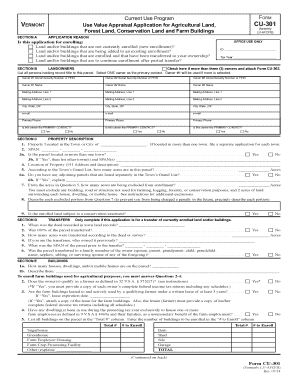
S for Select Questions All sections must be legible. Incomplete or illegible applications may be denied or experience processing delays. This application, other forms, and additional information are available online at www.tax.vermont.gov. Section A Application Reason Select one or more reasons for the purpose of the application. Deadlines and additional information about each reason are provided below. Land and/or buildings that are not currently enrolled (new enrollment) means the parce.
Open form follow the instructions
Easily sign the form with your finger
Send filled & signed form or save
How to fill out the VT DoT CU-301 online
Filling out the VT DoT CU-301 form online for the Current Use Program can be a straightforward process. This guide provides clear instructions on each section of the form to ensure your application is complete and accurate.
Follow the steps to successfully complete your application.
- Click the ‘Get Form’ button to obtain the form and open it in the editor.
- In Section A, select the reason for your application. Ensure that your choice is aligned with your intention to enroll land and/or buildings.
- In Section B, provide the information for all landowners involved. Designate one as the primary contact. This ensures clear communication regarding your application.
- Move to Section C to describe the property. Enter the town or city where the property is located, its SPAN, and provide a detailed description including acreage from the town's grand list.
- If applicable, complete Section D for Transfers. Indicate when the deed was recorded and whether the entire parcel was transferred.
- In Section E, list all buildings on the property. Specify which farm buildings are enrolled and ensure you meet the necessary qualifications to categorize as a farmer.
- Complete Section F for Agricultural Land. Enter the total acres in active agricultural use and provide any necessary documentation supporting your eligibility.
- Fill out Section G if you are enrolling forest land. Submit a forest management plan and follow the mapping standards for accurate enrollment.
- If applicable, address Section H for Conservation Land by confirming your organization's qualifications and the necessary approvals.
- In Section J, ensure all owners sign the application. Complete any additional paperwork required for power of attorney if applicable.
- Once all sections are completed, save changes, download, or share the form as necessary.
Complete your VT DoT CU-301 application online today to ensure timely processing and enrollment in the Current Use Program.
Experience a faster way to fill out and sign forms on the web. Access the most extensive library of templates available.
Related content
This part prescribes requirements pertaining to the maintenance, reconditioning, repair...
INFORMAZIONI GENERALI. Questa apparecchiatura è destinata ad uso professionale...
Jun 8, 2020 — Legal information. Warning notice system. This manual contains notices you...
Get answers to your most pressing questions about US Legal Forms API.
What is the non-resident tax form for Vermont?
The non-resident tax form for Vermont is the VT form 113, which allows non-residents to report income sourced from Vermont. Filing this form ensures compliance with Vermont tax regulations while potentially claiming tax credits. To assist you with this process, tools like VT DoT CU-301 are available on uslegalforms.
Does Vermont have a non-resident tax return?
Yes, Vermont has a specific non-resident tax return, which is the VT form 113. This form is designed for individuals who earn income in Vermont but reside elsewhere. By leveraging VT DoT CU-301, you can access valuable information on filing this form accurately.
What is the income tax form in-111 in Vermont?
The income tax form IN-111 serves as the primary individual income tax return for Vermont residents. It is essential for reporting your earnings and determining your tax due to the state. Don't forget, using tools like VT DoT CU-301 can help clarify the filing requirements for this important form.
What is the tax form for a non-resident?
Non-residents must use the Vermont Non-Resident Income Tax Return, which is the VT form 113. This form allows non-residents to report income derived from Vermont sources and calculate their tax obligations. You may find resources such as VT DoT CU-301 helpful in completing this form correctly.
What is the VT form 113?
The VT form 113 is known as the Vermont Non-Resident Income Tax Return. It is used by non-residents to report income earned in Vermont. Utilizing tools like VT DoT CU-301 can simplify the process of understanding this form and ensuring accurate filings.
What is the form in-111 in Vermont?
The form IN-111 is Vermont's Individual Income Tax Return form that residents must file each year. It helps residents report their income, calculate their Vermont tax liabilities, and claim any applicable credits. If you want to learn more about the filing process, consider using the VT DoT CU-301 resources available on uslegalforms.
What is 111 income tax?
The 111 income tax is a form of taxation that applies in Vermont for specific income brackets or types. Taxpayers should be aware of how this tax could potentially correlate with benefits from the VT DoT CU-301 program, especially for those who might qualify for exclusions or reductions. Making informed decisions on how to report this income can simplify your tax situation. Consulting with a tax expert ensures compliance and maximizes your financial benefits.
What is 111 tax?
The 111 tax refers to a specific category of tax assessed in Vermont, often related to property or income based on certain criteria. Understanding this tax can significantly impact individuals, particularly those involved in properties covered by the VT DoT CU-301 program. The applicable rate may vary based on a variety of factors, including assessments and local regulations. Refer to the Vermont Department of Taxes for the most current tax information.
What is a form 1041 tax return?
A Form 1041 tax return is utilized to report income, deductions, and taxes for estates and trusts. This form is crucial for fiduciaries managing these entities. If you are handling an estate or trust that generates income in Vermont, understanding how the VT DoT CU-301 may affect your situation can be beneficial. Always consider consulting a tax professional for advice on your specific circumstances.
Does Vermont have a property tax break for seniors?
Yes, Vermont offers property tax breaks for seniors under certain conditions. The VT DoT CU-301 program assists eligible senior residents in reducing their property tax burden. It is advisable to check the specific requirements and income thresholds to determine your eligibility. Engaging with local tax officials can provide personalized insights and guidance.
Use professional pre-built templates to fill in and sign documents online faster. Get access to thousands of forms.
If you believe that this page should be taken down, please follow our DMCA take down process here.
This form is available in several versions. Select the version you need from the drop-down list below.