). Calculate percentage to six places to the right of the decimal point.. . . . . . . . . . . . . . 6. . % 7. Apportionable Income (Form CO-411, Line 5). . . . . . . . . . . . . . . . . . . . . . . . 7. . 8. Income Apportioned to Vermont (Multiply Line 6 by Line 7). . . . . . . . . . . . . 8. . 9. Income Allocated to Vermont.
Open form follow the instructions
Easily sign the form with your finger
Send filled & signed form or save
How to fill out the VT DoT CO-411 online
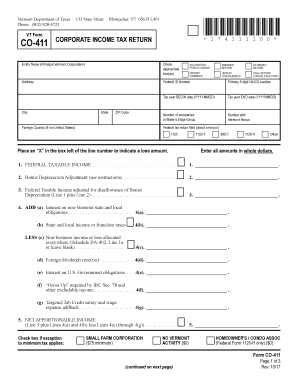
Filling out the VT DoT CO-411 form online can be a straightforward process if you follow the necessary steps. This guide aims to provide clear, step-by-step instructions to assist you in completing the Corporate Income Tax Return accurately.
Follow the steps to complete the VT DoT CO-411 form with ease.
- Press the ‘Get Form’ button to access the CO-411 form and open it in the online editor.
- Enter the entity name of your principal Vermont corporation in the designated field.
- Check the appropriate box(es) to specify the nature of the return (e.g., Accounting period change, Final return).
- Fill in the address fields, including city, state, and ZIP code.
- Provide the Federal ID number and the primary 6-digit NAICS number for your entity.
- Indicate the tax year BEGIN and END dates using the YYYYMMDD format.
- Number of companies in Water's Edge Group and those with Vermont Nexus should be entered.
- Select the federal tax return filed from the options provided (e.g., 1120, 990-T).
- For Line 1, enter the federal taxable income amount in whole dollars.
- Continue filling out the remaining lines with the required financial data such as bonus depreciation adjustment and apportionable income.
- Make sure to complete the tax computation schedule according to the instructions provided.
- After entering all relevant information, review your entries for accuracy.
- Save your changes and proceed to download or print the document for submission.
- You may also share the completed form if necessary.
Start completing your VT DoT CO-411 form online today!
Experience a faster way to fill out and sign forms on the web. Access the most extensive library of templates available.
Related content
Provides up to the minute traffic and transit information for New England. View the real...
Aug 15, 2024 — Fungal species in the Colletotrichum genus are the causal agents of...
May 4, 2020 — The table below shows format (411) Neutral sensor that indicates whether a...
Get answers to your most pressing questions about US Legal Forms API.
Does Vermont have a pass-through entity tax?
As mentioned earlier, Vermont does implement a pass-through entity tax. This tax structure supports business owners by avoiding double taxation. The VT DoT CO-411 contains critical information on how this tax is applied in Vermont, helping you comply with state regulations. Utilizing resources like UsLegalForms can assist you in understanding your responsibilities as a business owner.
What is the minimum corporate tax in Vermont?
Vermont's minimum corporate tax is also set at $250, which applies to corporations that have gross receipts of under $50,000. This tax ensures that even smaller businesses contribute to the state's revenue. The VT DoT CO-411 can provide more insights into how this tax works and how it affects your business. Planning ahead allows you to navigate your tax obligations smoothly.
Does Vermont have pass-through entity tax?
Yes, Vermont does have a pass-through entity tax, which was implemented to help business owners mitigate their tax burden. This tax applies to certain business entities and allows income to be reported directly on individual tax returns. The VT DoT CO-411 explains the criteria for eligibility. If you want to learn more about managing this tax, consider exploring resources available through UsLegalForms.
What states have pass-through entity tax?
Currently, several states, including New York, New Jersey, and California, have adopted a pass-through entity tax. This type of tax allows businesses to avoid double taxation, passing income directly to owners instead. The VT DoT CO-411 details how Vermont aligns with these states. This approach helps entrepreneurs manage their tax liabilities more effectively.
What is the minimum entity tax in Vermont?
The minimum entity tax in Vermont is $350. This applies to all corporate entities registered in the state. Understanding this tax is crucial for business owners, as the VT DoT CO-411 program simplifies the tax computation process. By staying informed about your tax obligations, you can ensure compliance and avoid potential penalties.
How are LLCs taxed in Vermont?
In Vermont, LLCs are generally taxed like pass-through entities, meaning profits are passed on to the members without being taxed at the business level. Each member then reports their share of LLC income on their personal tax returns. Keeping up with the changes in tax regulations, such as those outlined in the VT DoT CO-411, is essential for compliance. For comprehensive guidance, explore the tools available on the US Legal Forms website.
What is the business income tax in Vermont?
Vermont imposes a business income tax that varies based on your total income and the profitability of your business. Generally, corporate tax rates range from 6% to 8.5%, depending on your taxable income level. Consult the VT DoT CO-411 to get updated tax tables and rates that directly apply to your business. Using the resources on the US Legal Forms platform can help you navigate these complexities.
How is income from an LLC taxed?
Income from an LLC is typically taxed based on the structure of the business. If you're a single-member LLC, the IRS treats you as a sole proprietor, meaning profits are taxed on your personal tax return. For multi-member LLCs, the income is usually taxed as a partnership. Be mindful to review the VT DoT CO-411 to understand how Vermont handles LLC taxation specifically.
What is the self-employment tax rate in Vermont?
The self-employment tax rate in Vermont mirrors the federal rate, which is currently 15.3%. This rate applies to your net earnings from self-employment, so you should calculate your income carefully. Understanding the implications of the VT DoT CO-411 will help you comply with local tax laws. To ensure accuracy, consider consulting the US Legal Forms resources for help with self-employment taxes.
How to fill out EZ tax form?
To fill out the EZ tax form, start by gathering your income information, including wages, interest, and any other relevant earnings. Next, follow the form’s instructions closely, ensuring that you fill in your personal details accurately. Remember to reference the VT DoT CO-411 for specific guidance related to Vermont tax requirements. For additional support, consider using the US Legal Forms platform, which offers resources to assist you with your tax filing.
Use professional pre-built templates to fill in and sign documents online faster. Get access to thousands of forms.
If you believe that this page should be taken down, please follow our DMCA take down process here.
This form is available in several versions. Select the version you need from the drop-down list below.