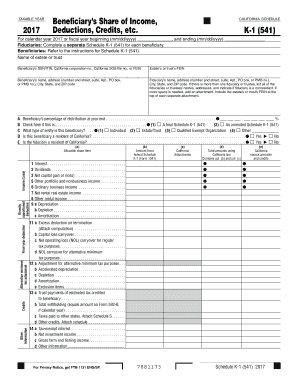
Beneficiaries: Refer to the instructions for Schedule K-1 (541). Name of estate or trust CALIFORNIA SCHEDULE K-1 (541) , and ending (mm/dd/yyyy) . Beneficiary s SSN/ITIN, California corporation no., California SOS file no., or FEIN Estate's or trust's FEIN Beneficiary s name, address (number and street, suite, Apt., PO box, or PMB no.), City, State, and ZIP code Fiduciary s name, address (number and street, suite, Apt., PO box, or PMB no.), City, State, and ZIP code. If ther.
Open form follow the instructions
Easily sign the form with your finger
Send filled & signed form or save
How to fill out the CA FTB 541 - Schedule K-1 online
Completing the CA FTB 541 - Schedule K-1 is an essential task for beneficiaries receiving income from trusts or estates. This guide provides a clear step-by-step process to help you fill out the form accurately and efficiently online.
Follow the steps to complete the CA FTB 541 - Schedule K-1 online.
- Press the ‘Get Form’ button to access the CA FTB 541 - Schedule K-1. This will allow you to open the document in your preferred online editor.
- Enter the taxable year at the top of the form. This should reflect the calendar year or fiscal year for which you are reporting, formatted as mm/dd/yyyy where appropriate.
- Provide the name of the estate or trust. Ensure that this is accurate as it identifies the source of the income or distributions being reported.
- Input the beneficiary's identification details, including their Social Security Number (SSN), Individual Taxpayer Identification Number (ITIN), California corporation number, or Federal Employer Identification Number (FEIN).
- Fill in the beneficiary's name and address. Ensure that the information is complete with a street address, city, state, and ZIP code.
- Enter the fiduciary’s details, including their name and complete address. If multiple fiduciaries are involved, list all their names and addresses.
- Indicate the beneficiary’s percentage of distribution at year-end. This percentage represents the beneficiary's share of the income from the estate or trust.
- Check the box as applicable if this is a final or amended Schedule K-1, ensuring the correct designation is selected.
- Determine the type of beneficiary by selecting from the options provided: Individual, Estate/Trust, Qualified Exempt Organization, or Other.
- Confirm whether the beneficiary is a resident of California by selecting 'Yes' or 'No'. Repeat this for the fiduciary's residency status.
- Complete the schedule of allocable share items. This includes entering amounts from federal Schedule K-1 and any California adjustments, as detailed in the form.
- Provide details for each income category such as interest, dividends, capital gains, and other relevant income sources, making sure to complete all applicable fields.
- Review all information for accuracy and completeness. When done, you can save changes, download, print, or share the completed form.
Take the next step and complete your CA FTB 541 - Schedule K-1 online today.
Experience a faster way to fill out and sign forms on the web. Access the most extensive library of templates available.
Related content
Purpose. The estate or trust uses Schedule K-1 (541) to report your share of the estate's...
by RS Kinyon · 2013 · Cited by 3 — ble for California, and identifies California...
Mar 16, 2020 — TOOLS AND RULES. ASSA ABLOY Door Security Solutions® Customer Service...
Get answers to your most pressing questions about US Legal Forms API.
Can tax amendments be filed electronically?
In certain situations, tax amendments can be filed electronically, particularly if they are within the scope of forms accepted by the IRS or California FTB. Make sure to verify the specific requirements for your amendment. Using user-friendly services like uslegalforms can simplify the amendment process for your CA FTB 541 - Schedule K-1 filing.
Can form 541 be filed electronically?
Yes, the CA FTB 541 Form can generally be filed electronically through approved e-filing services. E-filing offers a convenient and faster way to submit your forms, including the Schedule K-1. Utilizing platforms that support this functionality ensures a smoother filing process.
What forms cannot be electronically filed?
Some forms are not available for electronic filing, including those that require additional documentation or specific circumstances. Specifically, certain informational returns and amendments may need to be submitted on paper. It is advisable to refer to the IRS or California FTB guidelines for details regarding forms, including the CA FTB 541 - Schedule K-1.
What is a California schedule K-1?
A California Schedule K-1 is a form used to report income, deductions, and credits from partnerships, S corporations, or fiduciaries. Taxpayers receive this schedule to include relevant information on their personal income tax returns. Understanding the CA FTB 541 - Schedule K-1 is essential for accurate tax reporting.
Can you electronically file a California amended return?
Yes, you can electronically file a California amended return under specific conditions. Your amendment must involve forms that the California Franchise Tax Board accepts for electronic filing. If you have filed a CA FTB 541 - Schedule K-1, check your eligibility for e-filing your amendments.
How do I file a schedule K-1 on my taxes?
To file a CA FTB 541 - Schedule K-1, you will need to gather all necessary details from the entity that issued the K-1. Complete your tax return by including the information from the K-1 in the appropriate sections. If you use tax software or a tax professional, they can assist with properly integrating the K-1 into your overall tax filing.
What IRS forms can be filed electronically?
Various IRS forms can be filed electronically, including individual tax returns and certain related forms. However, not every form is eligible for e-filing. It's important to check the IRS website for the most current list of e-fileable forms, including the CA FTB 541 - Schedule K-1.
How do I report K1 income on a tax return?
To report K-1 income on your tax return, you will need to include the information from the CA FTB 541 - Schedule K-1 in the appropriate sections of your tax forms. Ensure you enter the amounts for the relevant categories such as ordinary income and capital gains. Using platforms like UsLegalForms can simplify this process by guiding you through the necessary steps.
What is the difference between a 1099 and a Schedule K-1?
The primary difference between a 1099 and a Schedule K-1 lies in their purpose and the entities involved. A 1099 form documents various types of income like freelance earnings, while a CA FTB 541 - Schedule K-1 specifically reports income from partnerships, S corporations, and trusts. Understanding these distinctions is vital for accurate tax reporting.
What is a Schedule K-1 for inheritance tax?
A Schedule K-1 for inheritance tax reports income received from an estate or trust. If you inherit assets that generate income, you may receive a CA FTB 541 - Schedule K-1 detailing your share of that income. It's crucial to understand how this income affects your tax obligations, and consulting resources like UsLegalForms can provide clarity.
Use professional pre-built templates to fill in and sign documents online faster. Get access to thousands of forms.
If you believe that this page should be taken down, please follow our DMCA take down process here.
This form is available in several versions. Select the version you need from the drop-down list below.