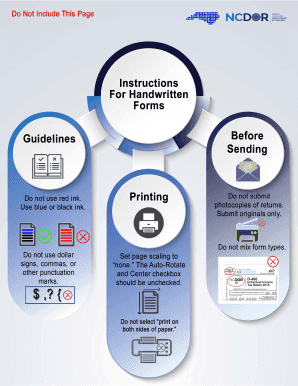
m!u: !!! .::::::: :Do Not Include This Page RI NC D(i)NORTH CAROLINA DEPARTMENT OF REVENUEInstructions For Handwritten Forms Before SendingGuidelinesDo not use red ink. Use blue or.
Open form follow the instructions
Easily sign the form with your finger
Send filled & signed form or save
How to fill out the NC D-407 NC K-1 online
Filling out the NC D-407 NC K-1 form online can streamline your process of reporting income, adjustments, and credits. This guide offers detailed, step-by-step instructions to help you accurately complete the form.
Follow the steps to successfully complete the NC D-407 NC K-1 form.
- Press the ‘Get Form’ button to access the form and open it in an editable format.
- For the fiscal year, indicate the beginning and ending dates in the specified format (MM-DD).
- Input the estate's or trust's federal employer identification number in the designated field.
- Provide the estate's or trust's name, address, and zip code accurately.
- Fill in the beneficiary's identifying number as required.
- Complete the beneficiary's name, address, and zip code in the respective fields.
- For the beneficiary's share of income, enter the appropriate amount from Federal Form 1041, Line 18 in the given field. Ensure this amount is included in the federal adjusted gross income.
- List any additions to income in the relevant sections as directed, including bonus depreciation and other additions from Form D-407, Schedule B.
- Document any deductions from income in the designated sections, including bonus depreciation and other deductions as necessary.
- If applicable, fill in the share of tax paid to another state or country and other tax credits per the instructions provided.
- If you are a nonresident, ensure to report the portions of income that are attributable to North Carolina sources as indicated in the respective fields.
- After completing all fields, review your entries for accuracy, then save your changes. You can choose to download, print, or share the completed form as needed.
Take action now and complete your NC D-407 NC K-1 form online with confidence.
Experience a faster way to fill out and sign forms on the web. Access the most extensive library of templates available.
Related content
Form D-407 NC K-1 reports each beneficiary's share of estate/trust income, NC adjustments...
by CS McCaffrey · 2024 — The 14th Amendment's Due Process Clause limits state power to...
Linear Scale is a registered trademark of Mitutoyo Corporation for its linear encoder...
Get answers to your most pressing questions about US Legal Forms API.
Who must file a NC trust return?
Any trust that has generated income and is subject to taxation in North Carolina must file a NC trust return. This applies to both resident and non-resident trusts. The filing includes the NC D-407 form along with supporting documents like the NC K-1. By filing correctly, you can ensure that all legal obligations are met while minimizing tax liabilities.
Who is responsible for filing a trust tax return?
The fiduciary of the trust is responsible for filing the trust tax return. This can be an individual, a bank, or a trust company managing the trust's assets. It’s vital to maintain accurate records and file in a timely manner to avoid penalties. Utilizing tools like the NC D-407 and understanding the NC K-1 can simplify this process.
What is a NC K 1 form?
The NC K-1 form is a tax document that reports the income, deductions, and credits passed through from a partnership or an S corporation to its owners. It is crucial for individuals who receive income from such entities to report their share on their personal tax returns. Understanding the NC K-1 form helps you accurately report your income and ensures compliance with state tax regulations.
How do I get a NC withholding number?
To obtain a NC withholding number, you need to apply through the North Carolina Department of Revenue. This number is necessary for businesses or individuals who are required to withhold income tax from payments made to employees or contractors. You can register online or submit a paper application. Ensure to use the NC K-1 form for accurate filings related to withholding.
Does North Carolina tax trust income?
Yes, North Carolina taxes trust income. When a trust earns income, it is generally subject to the state's tax laws. This means that fiduciaries should be aware of their responsibilities for reporting income on the NC D-407 and NC K-1. Proper tax compliance can protect the trust's assets and ensure smooth handling of distributions.
Who needs to file a 1041 tax return?
You must file a 1041 tax return if you are the fiduciary of a domestic estate or trust that has gross income exceeding a specific threshold. This form is used to report income, deductions, and tax liability of estates and trusts. Understanding the requirements for filing can help ensure you comply with federal tax laws. Moreover, the NC D-407 and NC K-1 forms may be necessary for state reporting.
Who needs to file a NC state tax return?
You need to file a NC state tax return if you are a resident of North Carolina and you earn income during the tax year. This includes wages, salaries, and other forms of compensation. Additionally, non-residents who have income sourced from North Carolina also must file. The forms NC D-407 and NC K-1 assist in accurately reporting this income.
How much can you inherit from your parents without paying taxes?
You can inherit any amount from your parents in North Carolina without facing an inheritance tax, as the state has eliminated such taxes. However, be mindful of the federal estate tax exemption limits, which may apply if your parents' estate is substantial. It is wise to discuss your situation with a tax expert who can navigate you through the necessary forms, including the NC D-407 NC K-1, to ensure compliance. Understanding these rules helps simplify the inheritance process.
How much can you inherit in NC without paying taxes?
In North Carolina, you can inherit any amount without incurring an inheritance tax, as the state does not impose such a tax. However, be cautious as the estate may be subject to federal estate tax if it exceeds certain limits. It is important to understand the implications of receiving a significant inheritance and consider seeking guidance on any potential estate taxes using tools like the NC D-407 NC K-1. Staying informed will help you manage your inheritance effectively.
Does trust income have to be reported on tax returns?
Yes, trust income must be reported on tax returns, regardless of whether the trust distributes its income or retains it. The trustee must file Form 1041 for the trust, and any distributions made to beneficiaries are reported on their individual tax returns, often via a K-1 form. Utilizing the NC D-407 NC K-1 can help ensure you correctly declare income received from the trust on your taxes. Consult with a tax professional for specific guidance related to your situation.
Use professional pre-built templates to fill in and sign documents online faster. Get access to thousands of forms.
If you believe that this page should be taken down, please follow our DMCA take down process here.
This form is available in several versions. Select the version you need from the drop-down list below.